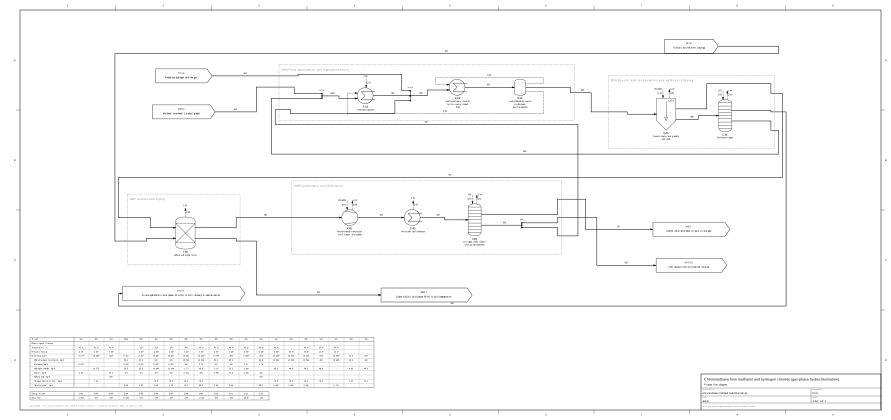
Fresh methanol and the methanol recovered from the quench acid are vaporised and mixed with anhydrous HCl (HCl/MeOH 1.10 at the inlet) and the recycle from the HCl column. The feed is superheated by the reactor coolant loop and reacts in a multitubular fixed bed of gamma-alumina (523 K in, 613 K out, about 300 kPa(a)); 97.6 % of the methanol is converted per pass, 98.8 % of it to methyl chloride and the rest to dimethyl ether (DME). A hydrochloric acid quench and a graphite cooler condense the water of reaction with the excess HCl as about 21 wt% acid; a stripper returns the dissolved methanol, and the dilute acid leaves the plant. Sulfuric acid (96 wt%) dries the crude gas and absorbs the DME, since DME and methyl chloride boil only 1 K apart. A two-stage compressor and a water-cooled condenser liquefy the methyl chloride at about 1 MPa, and an HCl column strips the dissolved HCl and inerts overhead; the overhead returns to the reactor with a 10 % purge.
All values are concept estimates: the conversion and selectivity are one open literature data point (near equilibrium, checked with cheme process reactors), the separator splits are ASSUMED and checked against the crude-gas, quench-acid and spent-acid ranges of US 4,794,204; the utilities are hand estimates. See DESIGN.md for every assumption and gated step.