
Chloromethane from methanol and hydrogen chloride (gas-phase hydrochlorination, 100 kt/a)

Methanol and anhydrous hydrogen chloride react over alumina to methyl chloride and water; the gas is quenched, dried with sulfuric acid (which also takes up the dimethyl ether by-product), compressed, condensed and freed of HCl in a light-ends column. Concept stage, assumed basis, preliminary gate-to-gate LCI per kg methyl chloride (foreground only).

Calculation maturity: not assessedDesign maturity: Concept (research)Not independently reviewedChlorinated organicsReport a problem with this process
Research outputNot engineering advice and not an approved design: do not use it for construction, operation or safety decisions. What this means

Overview

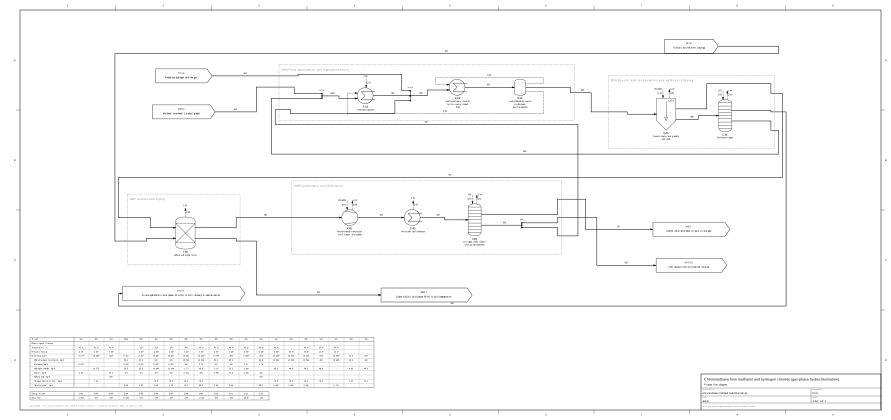
Fresh methanol and the methanol recovered from the quench acid are vaporised and mixed with anhydrous HCl (HCl/MeOH 1.10 at the inlet) and the recycle from the HCl column. The feed is superheated by the reactor coolant loop and reacts in a multitubular fixed bed of gamma-alumina (523 K in, 613 K out, about 300 kPa(a)); 97.6 % of the methanol is converted per pass, 98.8 % of it to methyl chloride and the rest to dimethyl ether (DME). A hydrochloric acid quench and a graphite cooler condense the water of reaction with the excess HCl as about 21 wt% acid; a stripper returns the dissolved methanol, and the dilute acid leaves the plant. Sulfuric acid (96 wt%) dries the crude gas and absorbs the DME, since DME and methyl chloride boil only 1 K apart. A two-stage compressor and a water-cooled condenser liquefy the methyl chloride at about 1 MPa, and an HCl column strips the dissolved HCl and inerts overhead; the overhead returns to the reactor with a 10 % purge.

All values are concept estimates: the conversion and selectivity are one open literature data point (near equilibrium, checked with cheme process reactors), the separator splits are ASSUMED and checked against the crude-gas, quench-acid and spent-acid ranges of US 4,794,204; the utilities are hand estimates. See DESIGN.md for every assumption and gated step.
Capacity
100 kt/a methyl chloride (ASSUMED)
Operation
8,000 h/a
Location
generic (not chosen)
Engineering gates
Concept and feasibility (no results yet)
Design basis and assumptions (8)
  • Route: gas-phase hydrochlorination of methanol over gamma-alumina, water quench, sulfuric acid drying, compression and distillation (D-001).
  • ASSUMED reactor: HCl/MeOH 1.10 mol/mol at the inlet, 523 K in, 613 K out, 350/300 kPa(a) (WO 2000/076658: about equimolar, 250-300 C, 1-10 bar) (D-004, D-005).
  • Reactor model: methanol conversion 0.976 and CH3Cl selectivity 0.988 per pass (Schmidt et al. 2014, best result at 340 C, near equilibrium); rest to DME. A sourced conversion model, not kinetics (D-004).
  • ASSUMED quench/condensation to 313 K, 200 kPa(a); crude gas 0.5 mol% HCl and water from a water activity of 0.7 over the acid (D-006).
  • ASSUMED methanol stripper: 99 % methanol recovery, returned to the vaporiser (D-007).
  • ASSUMED drying: 96 wt% acid at a rate giving 8 wt% DME in the spent acid (limit 5-10 %, US 4,794,204) (D-008).
  • ASSUMED HCl column: overhead 70 mol% CH3Cl, recycled to the reactor with a 10 % purge for the inerts (D-009).
  • Utilities are hand estimates (scripts/balance.py), not a rigorous energy balance: no property package qualified for HCl-water-methanol (D-010, D-011).

From process/design-basis.yaml.

Engineering model

Loading the drawing…
Drawing of the process (preview)Open the engineering model

The interactive model (drawings, streams, 3D) is made for larger screens.

Snapshot of c3ab348, cheme-as-code 1.6.0.

What goes in and out

In

  • MethanolFeedstockfeed:MEOH: methanol (e.g. methanol-1 product grade), 0.646 kg/kg
  • Hydrogen chlorideFeedstockfeed:HCLG: anhydrous hydrogen chloride gas, 0.823 kg/kg
  • Sulfuric acidFeedstockfeed:ACID: sulfuric acid 96 wt% for drying
  • NitrogenFeedstockInerts of the anhydrous HCl feed (0.1 mol%, ASSUMED)

Out

  • Chloromethane (methyl chloride)Main productMethyl chloride, liquid, to storage
  • NitrogenEmissionInerts in the purge (product:PURGE, 5.0 g/kg, to the site thermal oxidiser, a waste exchange). The dilute hydrochloric acid (product:DHCL, 0.447 kg/kg) and the spent sulfuric acid (product:SPENT, 69 g/kg) are not listed under chemistry yet

Utilities: Electricity (0.044 kWh/kg: methyl chloride compressor and pumps (hand estimate)), Steam (LP steam 500 kPa(a), 0.263 kWh/kg: methanol vaporiser (net of reactor heat), stripper and HCl column reboilers), Cooling water (0.649 kWh/kg, 25/35 C (ASSUMED); the quench is 69 % of it)

Show in the process graph

Reactions

IdAs writtenReactionOther processes
DME_FORMATION2 CH3OH → CH3OCH3 + H2O (dimethyl ether, the main by-product)2CH4OgivesC2H6O+H2O2 other processes
HYDROCHLORINATIONCH3OH + HCl → CH3Cl + H2O (gas phase, over alumina)CH4O+HClgivesCH3Cl+H2O

Each reaction's page has the conversion, heat of reaction, catalyst and sources this process states, next to those of other processes with the same reaction. All reactions

Life cycle assessment

No footprint assessed yet; the process is part of the life-cycle inventory below.

In the open LCI database (cheme-as-code-atlas-preview-c3ab348) as Chloromethane (methyl chloride), Methyl chloride product (liquid, to storage) Preliminary.

Download it for Brightway, openLCA and other tools.

In the LCI database: system model, datasets and KPIs against the benchmarks

In the LCI database

Status
Preliminary 5 unmapped exchanges. Some exchanges have no background mapping yet: they are exported unlinked and count no burden, so the inventory is incomplete.
System model
attributional, cut-off (methodology 1.1.0)
Allocation
mass (single-output, from default) · product:MECL 100 %
Allocation findings
none
Change report
Not available: this build has no change report against an earlier release.
Dataset pages
Chloromethane (methyl chloride), Methyl chloride product (liquid, to storage) Preliminary

KPI benchmark positions: not available (no benchmarked KPI for this process's datasets).

Maturity and review

Design maturity Concept (claimed): An idea or first flowsheet; numbers are rough. Concept PFD (4 blocks, 12 steps, 19 material and 13 energy streams, two recycles and an inert purge) with closed mass, component and element balances (cheme validate, cheme process streams: every block and step within tolerance). The reactor outlet is calculated by cheme from a sourced conversion and selectivity (Schmidt et al. 2014); its hydrochlorination quotient is 0.91 of the equilibrium constant (cheme process reactors), consistent with the source's near-equilibrium statement. Crude gas DME 0.56 mol%, quench acid 20.5 wt% HCl and spent acid 80.5 % fall inside the ranges of US 4,794,204. Fresh methanol 0.646 kg and HCl 0.823 kg per kg methyl chloride (stoichiometric 0.635 and 0.722). No rigorous energy balance: no property package covers HCl-water-methanol (electrolyte); duties are hand estimates; the reactor duty agrees with cheme's ideal-gas duty within 1.5 %. cheme maturity reaches no level. The LCI is foreground only, every background a gap (9 gaps): no impact result (lca.source none). Not reviewed. Main products and feeds are listed under chemistry with their chemicals registry entries (issue #251).

Calculation maturity, from the checked evidenceNot assessed

The process has no maturity report (cheme maturity, checks/maturity.json), so no calculation maturity is established.

No level shownThe design maturity (Concept) is the manifest's claim, not evidence. A level appears here once the process's repository holds a current report from cheme maturity --write.

Artifact completeness

Which deliverables exist. They never raise a calculation maturity level: a drawing from unchecked numbers is still unchecked.

Not reported without a maturity report.

Independent review

Not independently reviewed

No independent engineering review yet. Automated checks passing is not a review.

Set by people only. Reaching a calculation maturity level or passing automated checks is not an independent review or an approval.

Where the evidence comes from
Report
processes/chloromethane-1/checks/maturity.json (not in the library)
Design basis
process/design-basis.yaml
Method
How ChemE-as-Code checks the levels (requirement by requirement)

Open items

Sources

Engineering project
Chloromethane (methanol hydrochlorination) · cheme-as-code>=0.8
Library version
c3ab348 (process last changed in c3ab348)
Drawings rendered by
cheme 1.6.0 (pyDEXPI 2.1.0)
Data
Catalog record (JSON) · CC-BY-4.0
Files
View the files on GitHub · change history and authors

References

How to cite

For the data, cite the Process Atlas paper; for the platform that builds and checks it, the ChemE-as-Code paper.

Schweidtmann, A. M. & Weber, J. M. (2026, in preparation). Process Atlas: an open, git-native, reproducible library and life cycle inventory of chemical processes (working title).

For this process: "Chloromethane from methanol and hydrogen chloride (gas-phase hydrochlorination, 100 kt/a)", ChemE-as-Code process library, version c3ab348.

BibTeX
@unpublished{schweidtmann_process_atlas,
  author = {Schweidtmann, Artur M. and Weber, Jana M.},
  title = {{Process Atlas: an open, git-native, reproducible library and life cycle inventory of chemical processes (working title)}},
  year = {2026},
  url = {https://atlas.cheme-as-code.org},
  note = {in preparation}
}

Schweidtmann, A. M. (2026, in preparation). ChemE-as-Code: An Open-Source Platform for AI-Accelerated Chemical Process Engineering (working title).

BibTeX
@unpublished{schweidtmann_cheme_as_code,
  author = {Schweidtmann, Artur M.},
  title = {{ChemE-as-Code: An Open-Source Platform for AI-Accelerated Chemical Process Engineering (working title)}},
  year = {2026},
  url = {https://cheme-as-code.org},
  note = {in preparation}
}