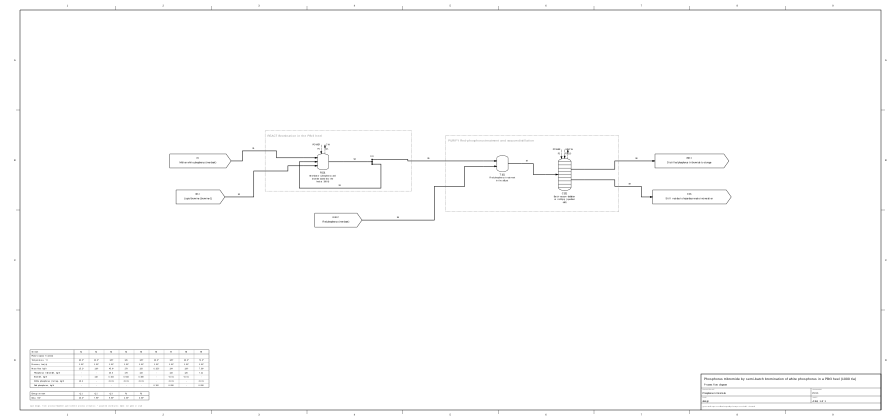
White phosphorus, held molten at 333 K, and dry liquid bromine are dosed together into a heel of crude PBr3 (3 kg per kg of phosphorus) at 398 K under nitrogen, with 0.4 % more bromine than P4 + 6 Br2 -> 4 PBr3 needs: the route of DE 1 281 414 / US 3 409 401, whose small bromine excess keeps free phosphorus out of the product, while the reaction temperature above 100 C avoids the solid PBr5 that the older low-temperature practice suppressed with excess phosphorus. The heel is kept in the brominator for the next batch; the rest of the crude goes to a batch still, where red phosphorus (1 kg per 100 kg of white phosphorus) takes up the free bromine, and PBr3 is distilled at 4 kPa(a). The overall yield is the patent example's 95.0 % on phosphorus; the residue (PBr3, red and white phosphorus, 58 g/kg) goes to hazardous-waste incineration. Per kg of PBr3: bromine 0.936 kg, white phosphorus 0.120 kg.
The batch is modelled with cheme-as-code's semi-batch reactor (reactor: semibatch, core ADR 0050) and batch recipe (process/recipe.yaml, core ADRs 0051 and 0052): the reaction releases 185 kJ per mol of PBr3, so the dosing time is set by the brominator's jacket at the small heel (10 h for a 1 m3 enamelled vessel), the brominator is the bottleneck (cycle 11.3 h, 704 batches a year), and the flowsheet's flows are the recipe's year averages. The kinetics are ASSUMED (no open data): a fast reaction keeps the accumulated bromine at 0.6 % and the cooling-failure temperature within 2 K of the process temperature, against an adiabatic rise of the whole batch of about 1000 K and the boiling point of PBr3, 446 K; a 1000 times slower reaction would exceed it. The vacuum distillation is a specified split until core has a batch distillation (core#165). See DESIGN.md for every assumption.