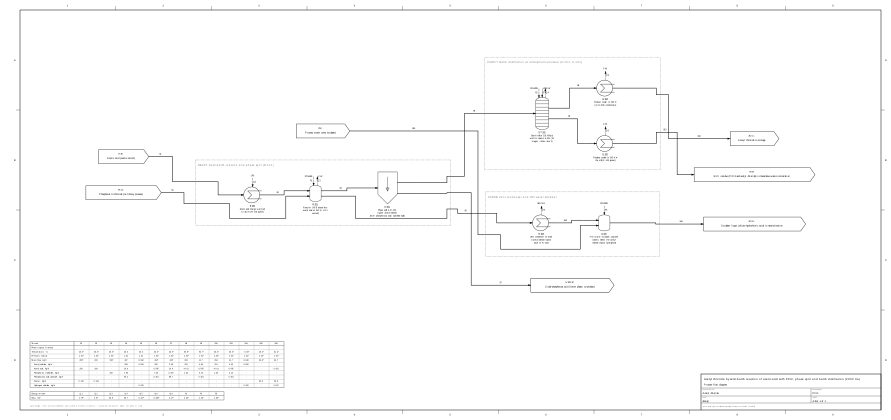
Glacial acetic acid (acetic-acid-1, 691 ppm water) is charged to an enamelled reactor and warmed to 313 K; phosphorus trichloride (1 mol per 3 mol of acid) is dosed into it over 2 h and held 0.5 h, 3 CH3COOH + PCl3 -> 3 CH3COCl + H3PO3, the batch route of CS 272 248 B2 (Nitrokemia, Example 1: below 40 C, then 30 min at 40-50 C). The water of the acid hydrolyses some PCl3; its HCl leaves by the vent through a brine condenser, which returns the acetyl chloride vapour, to a water scrubber. The mixture settles: the lower phase, 87.5 wt% phosphorous acid with acetic acid and acetyl chloride, leaves as a crude phosphorous acid co-product (0.41 kg per kg); the upper phase is distilled in a batch still with a column of about 10 stages at reflux 1. Product 99.43 wt% acetyl chloride with 0.57 wt% PCl3 (specification at least 99.0 wt%), which a column hardly separates (US 4 209 460 A); the PCl3-rich still residue (46 g per kg) goes to incineration. Yield 92.1 % of theory on the acetic acid and the PCl3: a model result, not a sourced one (no open source states a yield for this route).
The batch is modelled with cheme-as-code's semi-batch reactor with a gas vent (reactor: semibatch, batch.vent, core ADRs 0050 and 0054), its batch still with a rectifying column (still: with column, ADRs 0055 and 0061) and the batch recipe (process/recipe.yaml with units over several steps, ADRs 0051, 0052, 0057): the dosing, post-reaction, warming and distillation times come from the models, the reactor is the bottleneck (cycle 5.78 h, 1370 batches a year), the recipe sizes the reactor (2.5 m3) and checks its jacket, and the flowsheet's flows are the recipe's year averages. The semi-batch and the still write their own duties (ADR 0059), the still's reboiler with its reflux and charge's heat-up and its column's condenser (ADRs 0061, 0063), and the screening compares the gas a cooling failure releases with R-101's vent (ADR 0058). The phase split is a specified split until core has a liquid-liquid model for these liquids. The conversion and the phase split are calibrated to the source's lower phase; the kinetics are ASSUMED: the PCl3 accumulates to 11.7 % at the end of the dosing and the cooling-failure temperature stays 8.4 K below the boiling point of acetyl chloride; a 100 times slower reaction would exceed it. The vent, sized for 50 m3/h, passes every cooling failure the screening covers, but not the boiling and water-ingress cases, which need a relief study. See DESIGN.md for every assumption.