
Benzoyl chloride by semi-batch reaction of benzotrichloride with benzoic acid and batch vacuum distillation (2000 t/a)

A batch plant: benzotrichloride is dosed over 2 h into molten benzoic acid with zinc chloride at 140 C; the HCl it forms leaves as gas and is absorbed to 30 wt% hydrochloric acid, and the crude is distilled at 50 mbar through a packed column. Concept stage, 1229 kg per batch every 4.9 h on a dedicated train, thermal screening with a rate-constant sensitivity, preliminary gate-to-gate LCI.

Calculation maturity: not assessedDesign maturity: Concept (research)Not independently reviewedChlorinated organicsReport a problem with this process
Research outputNot engineering advice and not an approved design: do not use it for construction, operation or safety decisions. What this means

Overview

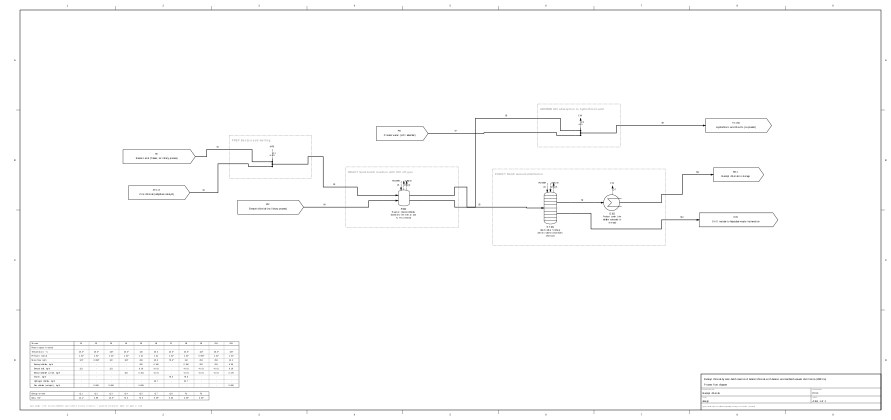
Benzoic acid flakes are melted with 0.74 wt% of anhydrous zinc chloride and heated to 413 K; benzotrichloride (14 mol per 15 mol of acid) is dosed into the melt over 2 h and held until 0.999 of it has reacted, C7H5Cl3 + C7H6O2 -> 2 C7H5ClO + HCl, the batch route of US 4 276 231 A (Bayer, Example 1). The HCl leaves the liquid as it forms, through a reflux condenser that returns the benzoyl chloride vapour it carries, and is absorbed in water to 30 wt% hydrochloric acid, 0.445 kg per kg of product. The crude is distilled at 5 kPa(a) in a batch still with a packed column (15 theoretical stages, reflux ratio 2): benzoyl chloride (99.999 wt%, 11 ppm benzotrichloride) goes to storage, the residue (benzoic acid, benzoyl chloride, zinc chloride, 64 g per kg) to hazardous-waste incineration. Yield 97.1 % of theory on the benzotrichloride (the patent's example: 96.7 %).

The batch is modelled with cheme-as-code's semi-batch reactor with a gas vent that carries the liquid's vapour through a partial vent condenser (reactor: semibatch, batch.vent with vapour and condenser, core ADRs 0050, 0054 and 0062), its batch still with a column on Diwekar's shortcut (still: with column, ADRs 0055 and 0061) and the batch recipe (process/recipe.yaml, ADRs 0051 and 0052): the dosing, post-reaction and distillation times come from the models, the reactor is the bottleneck (cycle 4.87 h, 1627 batches a year), the recipe sizes the reactor (1.6 m3) and checks its jacket, and the flowsheet's flows are the recipe's year averages. The kinetics and the heat of reaction are ASSUMED (no open data): the benzotrichloride accumulates to 7.0 % at the end of the dosing and the cooling-failure temperature stays 49 K below the boiling point of benzoyl chloride; a 100 times slower reaction would exceed it. See DESIGN.md for every assumption.
Capacity
2000 t/a distilled benzoyl chloride: 1627.1 batches/a of 1229.18 kg in 7920 h on a dedicated train (252.53 kg/h year average), ASSUMED (DESIGN.md D-002, D-003, D-013)
Operation
7,920 h/a
Location
generic fine-chemicals site with chlorine and toluene chemistry (not chosen)
Engineering gates
Concept and feasibility (no results yet)
Maintainers
Artur Schweidtmann
Design basis and assumptions (5)
  • Route of US 4 276 231 A (Bayer, 1981), Example 1: benzotrichloride dosed over 2 h into molten benzoic acid with zinc chloride at 140 C, about 7 % acid excess, the HCl off-gas absorbed, the crude distilled at 50 mbar (D-001, D-004).
  • ASSUMED second-order rate law (first in benzotrichloride and in benzoic acid), k 2.7e-3 m3/(kmol s) at 413 K, Ea 60 kJ/mol, and a heat of reaction of -50 kJ/mol with HCl as gas: no open kinetics or calorimetry (D-005); the 7 % accumulation follows from them.
  • ASSUMED all HCl leaves the liquid as it forms (batch.vent fraction 1): none stays dissolved in the crude (D-005); it leaves saturated with the liquid's vapour (an ideal liquid, ASSUMED) through a reflux condenser at 308 K whose condensate returns to R-101 (D-010).
  • Still: a batch still at 5 kPa(a) with a packed column of 15 theoretical stages (the still included) at a constant reflux ratio of 2, ASSUMED, on core's batch shortcut and Raoult's law with NIST Antoine constants (an ideal liquid, ASSUMED), to 40 mol% benzoyl chloride in the residue (D-007, D-008).
  • All flows are year averages of the recipe (D-003); the duties and power concept estimates (scripts/balance.py, D-006, D-009); accuracy +/-30 % not demonstrated.

From process/design-basis.yaml.

Engineering model

Loading the drawing…
Drawing of the process (preview)Open the engineering model

The interactive model (drawings, streams, 3D) is made for larger screens.

Snapshot of a3c52e4, cheme-as-code 1.6.0.

What goes in and out

In

  • BenzotrichlorideFeedstockBenzotrichloride (no library process; proxy: toluene side-chain photochlorination), 0.716 kg/kg benzoyl chloride
  • Benzoic acidFeedstockBenzoic acid flakes (no library process; proxy: toluene air oxidation), 0.479 kg/kg, 7 % above the stoichiometric need
  • Zinc chlorideFeedstockAnhydrous zinc chloride catalyst, 3.6 g/kg, leaves with the still residue
  • WaterFeedstockProcess water to the HCl absorber, 0.311 kg/kg
  • NitrogenFeedstockNitrogen (asu-1) for inerting and breaking the still's vacuum, 10 kg per batch, 8.1 g/kg (ASSUMED)

Out

  • Benzoyl chlorideMain productDistilled benzoyl chloride, 99.999 wt%, to storage under nitrogen
  • Hydrogen chlorideCo-productHydrochloric acid 30 wt%, 0.445 kg/kg (0.133 kg HCl), allocated no burden (shares 1/0, DESIGN.md D-012)

Utilities: Electricity (0.028 kWh/kg: agitators of M-101, R-101 and the still, vacuum pump (ASSUMED)), Steam (0.048 kWh/kg of MP steam 1100 kPa(a) to the benzoic acid melter), Steam (0.294 kWh/kg of LP steam 450 kPa(a) to the still's reboiler at the column's reflux ratio of 2), Cooling water (0.403 kWh/kg: R-101's tempered-water loop and its reflux condenser, the HCl absorber, the column's condenser and the product cooler)

Show in the process graph

Reactions

IdAs writtenReactionOther processes
BZCLC7H5Cl3 + C7H6O2 → 2 C7H5ClO + HCl · Benzotrichloride and benzoic acid to benzoyl chloride (ZnCl2)C7H5Cl3+C7H6O2gives2C7H5ClO+HCl

Each reaction's page has the conversion, heat of reaction, catalyst and sources this process states, next to those of other processes with the same reaction. All reactions

Life cycle assessment

–kg CO2-eqPreliminarypartial, 10 data gaps

Climate change per 1 kg Benzoyl chloride, cradle-to-gate

No factors. No contribution is characterised, so no factor stands behind any number.

Main contributors
    Method and data
    Goal
    Preliminary gate-to-gate life cycle inventory of benzoyl chloride made by the semi-batch reaction of benzotrichloride with molten benzoic acid over zinc chloride, the HCl off-gas absorbed to 30 wt% hydrochloric acid and the crude distilled under vacuum, at the concept stage: which raw materials, utilities and wastes the batch plant exchanges per kg of distilled benzoyl chloride, as the foreground for a later cradle-to-gate study. No impact results: most backgrounds are not mapped yet (D-012).
    Functional unit
    1 kg Benzoyl chloride (1 kg benzoyl chloride)
    Boundary
    cradle-to-gate
    Allocation
    shares
    Characterisation
    Factors kept with the process · GWP100
    Data quality
    No factors
    Result
    partial screening carbon footprint · 10 data gaps
    ScenarioClimate change (kg CO2-eq)
    baselineno total (data gaps)

    Inventory per 1 kg Benzoyl chloride (12 flows)

    FlowPhaseDirectionQuantityUnitProvenance
    Benzoic acid (flakes; no library process)operationinput0.4791kgassumed
    Zinc chloride (anhydrous catalyst)operationinput0.003557kgassumed
    Benzotrichloride (no library process)operationinput0.7157kgassumed
    Process water (HCl absorber)operationinput0.3112kgassumed
    Electric poweroperationinput0.02772kWhassumed
    MP steam 1100 kPa(a) (melter)operationinput0.04805kWhassumed
    LP steam 450 kPa(a) (still reboiler)operationinput0.294kWhcalculated
    Benzoyl chloride to storageoperationoutput1kgcalculated
    Hydrochloric acid 30 wt% (co-product)operationoutput0.4452kgcalculated
    Still residue to hazardous-waste incinerationoperationoutput0.06429kgcalculated
    Cooling water returnoperationoutput0.403kWhassumed
    Nitrogen for inerting R-101 and the still and breaking the still's vacuumoperationinput0.008135kgassumed

    Computed by ChemE-as-Code from lca/README.md, lca/dataset.yaml, lca/factors.yaml, lca/gaps.csv, lca/inventory.csv, lca/lca.yaml, lca/mappings.yaml, lca/results.csv, lca/results.md.

    In the open LCI database (cheme-as-code-atlas-preview-a3c52e4) as Benzoyl chloride to storage Preliminary.

    Download it for Brightway, openLCA and other tools.

    In the LCI database: system model, datasets and KPIs against the benchmarks

    In the LCI database

    Status
    Preliminary 4 unmapped exchanges. Some exchanges have no background mapping yet: they are exported unlinked and count no burden, so the inventory is incomplete.
    System model
    attributional, cut-off (methodology 1.1.0)
    Allocation
    shares (deviation, from study) · product:BZCL 100 %, product:HCLAQ 0 %
    Allocation findings
    none
    Change report
    Not available: this build has no change report against an earlier release.
    Dataset pages
    Benzoyl chloride to storage Preliminary

    KPI benchmark positions

    KPIValueReference rangePosition
    Benzotrichloride consumption per kg of benzoyl chloride (benzoic acid variant)– kg/kg0.7095 to 0.7243 kg/kgnot evaluated
    Distillation residue per kg of benzoyl chloride
    No open source with the residue of a benzoyl chloride distillation on the benzoic acid route without recycle found (searched 2026-11-05: Google Patents US 4 276 231 A read; its Example 1 gives no bottoms mass, its Example 2, the water variant, 210 g of bottoms on 3255 g of product before they are re-reacted, one value on other conditions; NIST WebBook and PubChem have no plant data).
    – kg/kgnot availablenot evaluated

    Maturity and review

    Design maturity Concept (claimed): An idea or first flowsheet; numbers are rough. Concept batch PFD with closed mass, component and element balances (cheme validate, cheme process streams: 4 blocks and 5 steps within tolerance). The semi-batch R101 with its HCl vent (from its ASSUMED rate law), the liquid's vapour the HCl carries and the reflux condenser E-102 that returns it (Raoult, an ideal liquid ASSUMED), the batch still ST101 with its column (15 theoretical stages at reflux ratio 2, ASSUMED, on Diwekar's shortcut and Raoult's law with NIST Antoine constants, the ideal liquid ASSUMED: 99.9989 wt% product at 97.31 % recovery of the crude's benzoyl chloride), the mixers and the product cooler are calculated by cheme process propagate, which also writes the duties of R101, E-102 and the still's reboiler and condenser (core ADRs 0059, 0061, 0062); scripts/balance.py gives the feeds for 2000 t/a, the absorber water and the melter's, absorber's and product cooler's duties (no property package of core covers these liquids). The recipe's year-average rate of the product agrees with the flowsheet (no cheme.recipe-basis finding); the recipe sizes R-101 (1.6 m3), its jacket check passes, and the still's distillation time comes from its boil-up. Thermal screening (cheme process reactor-hazards): dT_ad 94.7 K, accumulation 7.04 %, MTSR 421.9 K against an MTT of 471.0 K (hazard.mtt: the boiling point of benzoyl chloride); no criticality class without a TD24 (1 or 2 if the TD24 lies above the MTSR, 5 if below). At the MTSR the gas leaves at 107.2 m3/h with the liquid's vapour (0.239 of it), within R-101's off-gas capacity of 130 m3/h (ASSUMED, 1.2 times it, no condenser credited); the blocked-vent case needs a relief device (DESIGN.md D-014). With k/10 the MTSR is 443.3 K, with k/100 484.8 K, above the MTT (DESIGN.md D-011). The vent capacity holds for the assumed kinetics only: at k/10 the release at the MTSR is 273.2 m3/h (2.10 times it), at k/100 2951 m3/h (22.7 times), so the off-gas system is to be sized for the k/10 case (about 330 m3/h) or the dosing rate set from calorimetry (open, D-014); 164.3 m3/h and 200 m3/h were those figures for the HCl alone, before core 1.10.0 carried the vapour. Preliminary gate-to-gate LCI with the per-batch nitrogen; the nitrogen linked to asu-1, the other backgrounds gaps; the hydrochloric acid a by-product with shares 1/0. cheme maturity reaches no level (assumed feeds, kinetics and separations); the claim `maturity: concept` is the lowest value of the schema, not an evidenced level. Not reviewed. Needs cheme-as-code 1.10.0.

    Calculation maturity, from the checked evidenceNot assessed

    The process has no maturity report (cheme maturity, checks/maturity.json), so no calculation maturity is established.

    No level shownThe design maturity (Concept) is the manifest's claim, not evidence. A level appears here once the process's repository holds a current report from cheme maturity --write.

    Artifact completeness

    Which deliverables exist. They never raise a calculation maturity level: a drawing from unchecked numbers is still unchecked.

    Not reported without a maturity report.

    Independent review

    Not independently reviewed

    No independent engineering review yet. Automated checks passing is not a review.

    Set by people only. Reaching a calculation maturity level or passing automated checks is not an independent review or an approval.

    Where the evidence comes from
    Report
    processes/benzoyl-chloride-1/checks/maturity.json (not in the library)
    Design basis
    process/design-basis.yaml
    Method
    How ChemE-as-Code checks the levels (requirement by requirement)

    Open items

    Sources

    Engineering project
    Benzoyl chloride · cheme-as-code>=1.10
    Library version
    a3c52e4 (process last changed in a3c52e4)
    Drawings rendered by
    cheme 1.6.0 (pyDEXPI 2.1.0)
    Data
    Catalog record (JSON) · CC-BY-4.0
    Files
    View the files on GitHub · change history and authors

    References

    How to cite

    For the data, cite the Process Atlas paper; for the platform that builds and checks it, the ChemE-as-Code paper.

    Schweidtmann, A. M. & Weber, J. M. (2026, in preparation). Process Atlas: an open, git-native, reproducible library and life cycle inventory of chemical processes (working title).

    For this process: "Benzoyl chloride by semi-batch reaction of benzotrichloride with benzoic acid and batch vacuum distillation (2000 t/a)", ChemE-as-Code process library, version a3c52e4.

    BibTeX
    @unpublished{schweidtmann_process_atlas,
      author = {Schweidtmann, Artur M. and Weber, Jana M.},
      title = {{Process Atlas: an open, git-native, reproducible library and life cycle inventory of chemical processes (working title)}},
      year = {2026},
      url = {https://atlas.cheme-as-code.org},
      note = {in preparation}
    }

    Schweidtmann, A. M. (2026). ChemE-as-Code: An Open-Source Platform for Agentic AI in Chemical Engineering. arXiv:2611.07947. https://doi.org/10.48550/arXiv.2611.07947

    BibTeX
    @misc{schweidtmann_cheme_as_code,
      author = {Schweidtmann, Artur M.},
      title = {{ChemE-as-Code: An Open-Source Platform for Agentic AI in Chemical Engineering}},
      year = {2026},
      eprint = {2611.07947},
      archivePrefix = {arXiv},
      doi = {10.48550/arXiv.2611.07947},
      url = {https://arxiv.org/abs/2611.07947}
    }