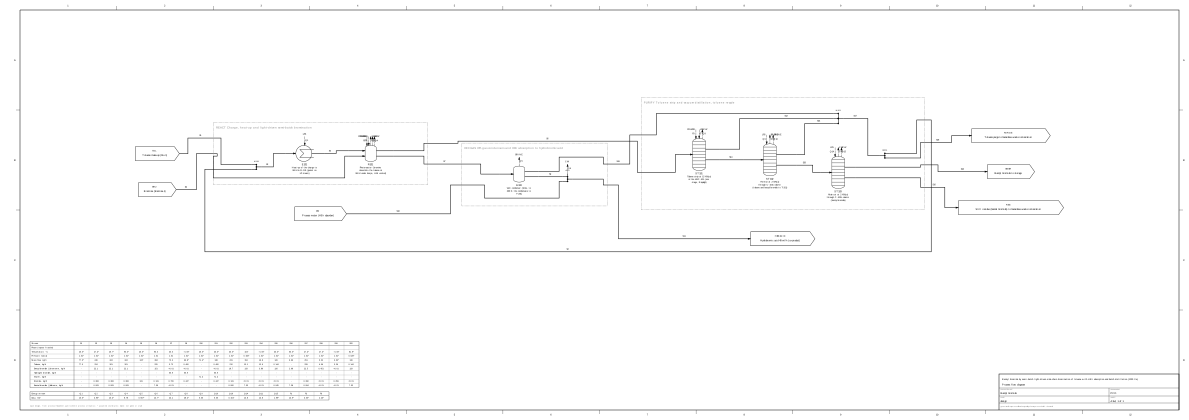
Bromine is dosed at a constant rate over 5 h into toluene (4 mol per mol of bromine, the recycled toluene counted) at 363 K in a glass-lined photoreactor with immersion lamps, and the free-radical chain brominates the side chain: C7H8 + Br2 -> C7H7Br + HBr, and in series C7H7Br + Br2 -> C7H6Br2 + HBr (the route PubChem's HSDB names for benzyl bromide, bromine and toluene under light; US 3 528 899 A describes the dosing at the rate the bromine reacts). The HBr leaves the liquid as it forms, saturated with the content's vapour (about 0.9 mol per mol, mostly toluene), through a reflux condenser that returns the vapour to the reactor and a brine vent condenser whose condensate is recycled, and is absorbed in water to 48 wt% hydrobromic acid, 1.094 kg per kg of product (a co-product). The crude is stripped of most of its toluene at 15 kPa(a), then distilled at 2 kPa(a) in the same batch still through a packed column of about 5 theoretical stages: a forerun (toluene with some benzyl bromide, reflux ratio 2) that goes back with the stripped toluene to the next batch, 2 % of it purged, and the main cut (reflux ratio 0.5), 99.85 wt% benzyl bromide with 0.11 wt% toluene and 0.04 wt% benzal bromide in the model (an upper bound: ring-brominated toluenes and condensation products are not modelled). The benzal bromide residue goes to incineration. Yields 90.2 % on the bromine and 87.7 % on the toluene make-up (US 3 528 899 A, Example I: about 90 % on toluene); both follow from an ASSUMED ratio of the two rate constants.
The batch is modelled with cheme-as-code's semi-batch reactor with a gas vent that carries the liquid's vapour through a vent condenser (reactor: semibatch, batch.vent with vapour and condenser, core ADRs 0050, 0054 and 0062), its batch still (still:, one Rayleigh stage for the strip, ADR 0055) with a column for the forerun and the main cut (still.column, Diwekar's shortcut, ADR 0061) and the batch recipe (process/recipe.yaml, ADRs 0051, 0052 and 0057): the dosing, post-reaction and distillation times come from the models, the photoreactor is the bottleneck (cycle 7.03 h, 1127 batches a year), the recipe sizes it (4 m3) and checks its jacket, and the flowsheet's flows are the recipe's year averages; the toluene recycle is converged at its tear stream by cheme process propagate. The light-driven rate is an ASSUMED effective rate law (core has no photochemical rate): the bromine accumulates to 1.7 % at the end of the dosing and the cooling-failure temperature stays 20 K below the boiling point of toluene; a 100 times slower reaction (weak or failed lamps) would exceed it. See DESIGN.md for every assumption.