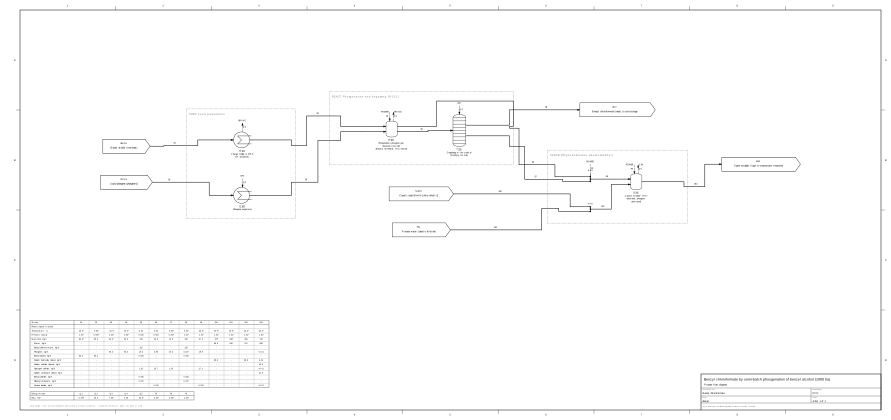
Benzyl alcohol is charged to an enamelled 2.5 m3 reactor, cooled to 278 K, and phosgene from the site's phosgene unit (1.27 mol per mol of alcohol, the ratio of US 6 696 590 B2 Ex. 3) is evaporated and dosed into it as a gas over 10 h at 50 kPa(a), without base or solvent. The alcohol reacts to benzyl chloroformate and HCl; HCl leaves the liquid as it forms (95 % of it, the rest dissolved), 5 % of the dosed phosgene passes straight to the vent, and two side reactions make the impurities the patent reports (benzyl chloride with CO2, dibenzyl carbonate). The crude, holding about 11 wt% dissolved phosgene, is degassed in the same vessel at 20 kPa(a) to 0.05 mol% phosgene and leaves as the product: 99.2 wt% benzyl chloroformate, 0.51 wt% benzyl chloride, 0.26 wt% dibenzyl carbonate, 98.9 % yield on the alcohol. It is not distilled (the chloroformate decomposes on heating). The reactor's vent and the degassing gas pass the vacuum pump to a caustic scrubber that absorbs the HCl and destroys the phosgene; the spent liquor (NaCl, Na2CO3) goes to wastewater treatment. No HCl or phosgene is recovered.
The batch is modelled with cheme-as-code's semi-batch reactor with a vent and a partly absorbed gas dose (core ADR 0050, 0054), a batch still for the degassing (ADR 0055) and the batch recipe over three steps of one vessel (ADR 0051, 0052, 0057): the dosing, post-reaction and degassing times come from the models, the reactor is the bottleneck (cycle 14.0 h, 565 batches a year on a dedicated train), the recipe sizes the vessel and checks its jacket, and gives the vent's peak gas rate and the scrubber's load per batch (429 kg of vent gas, 233 kg of degassing gas). The kinetics are ASSUMED (no open data): a fast second-order reaction, dosing-controlled; the phosgene's heat of solution is the dose's (core ADR 0063), the heats of reaction on the dissolved basis. Thermal screening: dT_ad 494 K (the side reaction to benzyl chloride run on all the alcohol, with the dose's heat of solution; 323.4 K for the main reaction alone), accumulation at most 17 % (the deliberate phosgene excess, at the end of the dosing), MTSR 357 K (set by the side reaction to dibenzyl carbonate, counted on purpose; 294.1 K for the main reaction alone) against an MTT of 281 K (the boiling point of phosgene, which the excess would boil off). The gas a cooling failure releases at the MTSR, 3219 m3/h by the screening, is 18.6 times what the vacuum pump vents (173 m3/h), and 21.9 times (3788 m3/h, phosgene vapour 0.15 of it) with the liquid's vapour on a trial with core 1.10.0's vent vapour: a design finding for a dosing interlock and an emergency relief to the scrubber. The vent and scrubber are the safety-critical path; no class without a TD24. See DESIGN.md for every assumption.