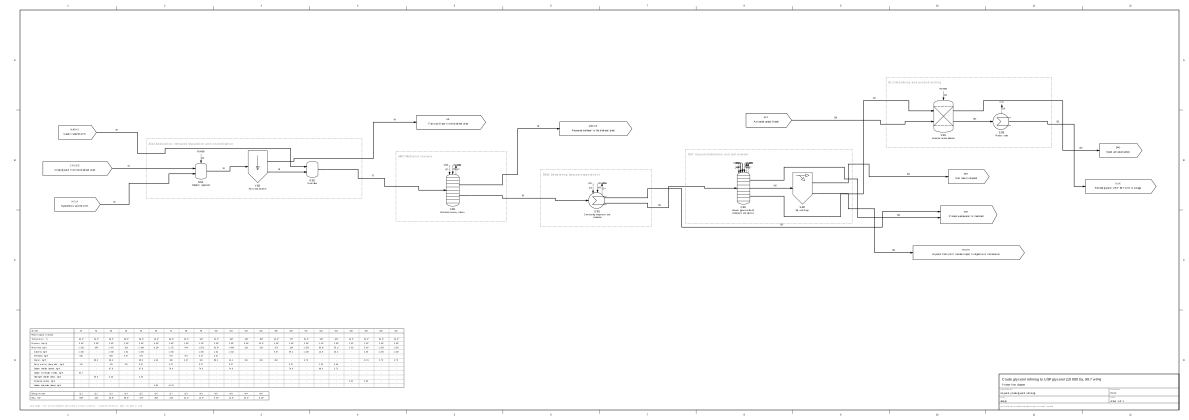
Refining of the crude glycerol phase of a biodiesel plant to USP-grade glycerol (99.7 wt%): HCl acidulation, fatty-layer separation, neutralisation, methanol recovery, vacuum dewatering, vacuum distillation with salt removal and activated carbon bleaching. Concept stage, sourced feed, assumed separation parameters.
Research outputNot engineering advice and not an approved design: do not use it for construction, operation or safety decisions. What this means
Overview
The glycerol phase of a sodium-methylate catalysed biodiesel plant (about 60 wt% glycerol,
29 wt% methanol, 8 wt% fatty matter and the catalyst; Thompson & He 2006) is acidulated with
32 wt% hydrochloric acid: the catalyst becomes NaCl and methanol, the soaps split, and the
freed fatty matter is decanted as a layer returned to the biodiesel plant. The glycerol phase
is neutralised with caustic soda, the methanol is distilled off at atmospheric pressure and
returned, and the remaining water is evaporated under vacuum. A vacuum still (1.5 kPa(a),
448 K, live steam) distils the glycerol; the salt crystallises in the still residue and is
separated by a centrifuge, the residue liquor (glycerol foots) leaves as waste. The
distillate is bleached and deodorised with activated carbon and cooled.
All separator splits and duties are concept estimates from an independent balance
(scripts/glycerol_balance.py) on assumed design parameters; no phase equilibrium, salt
solubility or enthalpy model is qualified for these mixtures in core. See DESIGN.md.
ASSUMED feed composition built on Thompson & He (2006) soybean-oil crude glycerol; industrial variability is wide (glycerol 30-80 wt%, Attarbachi et al. 2024 Table 1) (D-004).
ASSUMED acidulation with 10 % excess HCl to pH about 3-4, then neutralisation with NaOH to pH about 7 (D-005).
ASSUMED 97 % of fatty acids and FAME to the fatty-acid layer; the layer holds 5 wt% methanol and 1 wt% glycerol (D-006).
ASSUMED methanol recovery 99.5 % at 99.5 wt%, reflux ratio 1.0, bottoms about 425 K on MP steam (D-007).
ASSUMED dewatering to 1 wt% water at 10 kPa(a), 403 K (Raoult estimate, D-008).
ASSUMED vacuum still at 1.5 kPa(a), 448 K, live steam 0.10 kg/kg glycerol fed, 95 % of glycerol to the distillate, 0.5 % to the vacuum condensate; two booster ejectors with 1.5 kg MP motive steam per kg vapour to an intercondenser at 8 kPa(a), liquid-ring vacuum pump for the non-condensables (D-009).
ASSUMED 90 % of the residue salt separated as crystals holding 0.25 kg liquor per kg (D-010).
ASSUMED duties from a lumped latent plus sensible heat balance (scripts/glycerol_balance.py); no property package covers the streams (D-012).
WaterFeedstockWater of the 32 wt% hydrochloric acid and the 50 wt% caustic soda. Activated carbon (feed:ACF) and the fatty layer co-product (product:FAL) have no registry entry yet
Out
GlycerolMain productproduct:GLYC, refined glycerol USP 99.7 wt% to storage
MethanolCo-productproduct:MEOHR, recovered methanol to the biodiesel plant, 0.539 kg/kg
WastewaterWasteproduct:WW, evaporator and vacuum intercondenser condensates (with the ejector motive steam) with about 0.7 wt% methanol and 1.7 wt% glycerol
Utilities:Electricity (feed:POWER: pumps, agitators, liquid-ring vacuum pumps, salt centrifuge (50 kWh/t, ASSUMED)), Steam (feed:LPS (heat, kWh) and feed:LSTM (live steam, kg): LP steam 450 kPa(a); feed:MPS (heat, kWh) and feed:MSTM (ejector motive steam, kg): MP steam 1000 kPa(a); feed:HPS (heat, kWh): HP steam 3000 kPa(a)), Cooling water (product:CW, 25/35 C (ASSUMED))
Each reaction's page has the conversion, heat of reaction, catalyst and sources this process states, next to those of other processes with the same reaction. All reactions
Life cycle assessment
–kg CO2-eqPreliminarypartial, 15 data gaps
Climate change per 1 kg Refined glycerol USP 99.7 wt%, cradle-to-gate
No factors. No contribution is characterised, so no factor stands behind any number.
Main contributors
Method and data
Goal
Preliminary foreground (gate-to-gate) life cycle inventory of USP-grade glycerol refined from biodiesel crude glycerol at the concept stage: which raw materials, utilities, co-products, emissions and wastes the balanced flowsheet implies per kg of refined glycerol, ready to be linked to background datasets later. Flows are concept estimates on assumed separation and utility parameters (DESIGN.md D-006 to D-012).
Functional unit
1 kg Refined glycerol USP 99.7 wt% (1 kg GLYC)
Boundary
cradle-to-gate
Allocation
shares
Characterisation
Factors kept with the process · GWP100
Data quality
No factors
Result
partial screening carbon footprint · 15 data gaps
Scenario
Climate change (kg CO2-eq)
baseline
no total (data gaps)
Inventory per 1 kg Refined glycerol USP 99.7 wt% (18 flows)
Flow
Phase
Direction
Quantity
Unit
Provenance
Crude glycerol from the biodiesel plant
operation
input
1.538
kg
assumed
Hydrochloric acid 32 wt%
operation
input
0.1016
kg
assumed
Caustic soda 50 wt%
operation
input
0.006485
kg
assumed
Activated carbon (fresh)
operation
input
0.001754
kg
assumed
LP steam 450 kPa(a), live stripping steam to the still
operation
input
0.09184
kg
assumed
MP steam 1000 kPa(a), motive steam of the still vacuum ejectors
operation
input
0.1555
kg
assumed
MP steam 1000 kPa(a) to the methanol column reboiler (condensate returned)
operation
input
0.3757
kWh
assumed
LP steam 450 kPa(a) to the dewatering evaporator (condensate returned)
operation
input
0.02501
kWh
assumed
HP steam 3000 kPa(a) to the still reboiler (condensate returned)
operation
input
0.2604
kWh
assumed
Electric power
operation
input
0.0436
kWh
assumed
Refined glycerol USP 99.7 wt% to storage
operation
output
1
kg
calculated
Recovered methanol to the biodiesel plant
operation
output
0.5392
kg
assumed
Fatty-acid layer to the biodiesel plant
operation
output
0.145
kg
assumed
Salt cake to disposal
operation
output
0.05863
kg
assumed
Glycerol foots (still residue liquor) to digestion or incineration
operation
output
0.0385
kg
assumed
Spent activated carbon
operation
output
0.0035
kg
assumed
Process wastewater to treatment
operation
output
0.324
kg
assumed
Cooling water return
operation
output
0.8042
kWh
assumed
Computed by ChemE-as-Code from lca/README.md, lca/dataset.yaml, lca/factors.yaml, lca/gaps.csv, lca/inventory.csv, lca/lca.yaml, lca/mappings.yaml, lca/results.csv, lca/results.md, lca/uncertainty.csv.
Download it for Brightway, openLCA and other tools.
In the LCI database: system model, datasets and KPIs against the benchmarks
In the LCI database
Status
Preliminary 6 unmapped exchanges. Some exchanges have no background mapping yet: they are exported unlinked and count no burden, so the inventory is incomplete.
KPI benchmark positions: not available (no benchmarked KPI for this process's datasets).
Maturity and review
Design maturity Concept (claimed): An idea or first flowsheet; numbers are rough. Concept BFD/PFD with closed mass, component and element balances (cheme validate clean, cheme process streams: 5 blocks, 9 steps, reactive balances by extents). The crude glycerol composition is sourced (Thompson & He 2006); all separator outlets and duties are specified values of an independent balance on assumed parameters. No property package or electrolyte route covers glycerol-methanol-water-NaCl, so energy closure is not evaluable in core. cheme maturity: balanced level blocked by the specified separator values (no sourced model); sourced level blocked by assumed feed flows. The gate-to-gate LCI is preliminary, with every background unmapped. `cheme maturity` supports no level and warns cheme.maturity-claim-exceeds on the `maturity: concept` claim, the lowest value of the manifest; the warning stays until the feed flow basis is accepted as sourced (DESIGN.md section 6). Agent review reviews/2026-10-28-pfd-lci-review.md answered (PROGRESS.md); no human review.
Calculation maturity, from the checked evidenceNot assessed
The process has no maturity report (cheme maturity, checks/maturity.json), so no calculation maturity is established.
No level shownThe design maturity (Concept) is the manifest's claim, not evidence. A level appears here once the process's repository holds a current report from cheme maturity --write.
Artifact completeness
Which deliverables exist. They never raise a calculation maturity level: a drawing from unchecked numbers is still unchecked.
Not reported without a maturity report.
Independent review
Not independently reviewed
No independent engineering review yet. Automated checks passing is not a review.
Set by people only. Reaching a calculation maturity level or passing automated checks is not an independent review or an approval.
Where the evidence comes from
Report
processes/glycerol-1/checks/maturity.json(not in the library)
Attarbachi, T. et al. (2024) Experimental scale-up and techno-economic assessment of low-grade glycerol purification from waste-based biorefinery. Ind. Eng. Chem. Res. (CC BY 4.0): section 1 (industrial acidulation to pH ~3, tricanter, neutralisation, methanol column), Table 1 (crude compositions), energy discussion (reboiler heat and plant energy references) · doi:10.1021/acs.iecr.3c03868
The Crude Glycerol Challenge: Purification Technologies and Possible Valorization Pathways in the Biodiesel Industry (2026). Molecules 31(11), 1841, section 4.1 (vacuum distillation: 10-30 mbar, feed water limit, scraped-wall evaporator for 2-5 wt% salt, polymerisation and acrolein limits) · doi:10.3390/molecules31111841
Recovery and utilization of crude glycerol, a biodiesel byproduct (2022). RSC Advances (CC BY-NC 3.0), Table 1 and text (purified glycerol traded at 99.5-99.7 %) · doi:10.1039/d2ra05090k
Yang, F.; Hanna, M. A.; Sun, R. (2012) Value-added uses for crude glycerol - a byproduct of biodiesel production. Biotechnology for Biofuels 5, 13 (CC BY 2.0): context, composition variability · doi:10.1186/1754-6834-5-13
Ullmann's Encyclopedia of Industrial Chemistry: Glycerol (route reference lead from issue #186; not read in this run) · doi:10.1002/14356007.a12_477.pub2
How to cite
For the data, cite the Process Atlas paper; for the platform that builds and checks it, the ChemE-as-Code paper.
Schweidtmann, A. M. & Weber, J. M. (2026, in preparation). Process Atlas: an open, git-native, reproducible library and life cycle inventory of chemical processes (working title).
For this process: "Refined glycerol (USP) from biodiesel crude glycerol (10 000 t/a, concept)", ChemE-as-Code process library, version c3ab348.
BibTeX
@unpublished{schweidtmann_process_atlas,
  author = {Schweidtmann, Artur M. and Weber, Jana M.},
  title = {{Process Atlas: an open, git-native, reproducible library and life cycle inventory of chemical processes (working title)}},
  year = {2026},
  url = {https://atlas.cheme-as-code.org},
  note = {in preparation}
}
Schweidtmann, A. M. (2026, in preparation). ChemE-as-Code: An Open-Source Platform for AI-Accelerated Chemical Process Engineering (working title).
BibTeX
@unpublished{schweidtmann_cheme_as_code,
  author = {Schweidtmann, Artur M.},
  title = {{ChemE-as-Code: An Open-Source Platform for AI-Accelerated Chemical Process Engineering (working title)}},
  year = {2026},
  url = {https://cheme-as-code.org},
  note = {in preparation}
}