
Iodomethane from methanol, red phosphorus and iodine, batch reflux reaction and batch distillation (500 t/a)

A batch plant: iodine is dosed over 10 h into red phosphorus in methanol at its reflux temperature; the crude iodomethane is distilled off the residue, washed, dried and distilled. Concept stage, 1465 kg per batch every 23.2 h, thermal screening, preliminary LCI.

Calculation maturity: not assessedDesign maturity: Concept (research)Not independently reviewedChlorinated organicsReport a problem with this process
Research outputNot engineering advice and not an approved design: do not use it for construction, operation or safety decisions. What this means

Overview

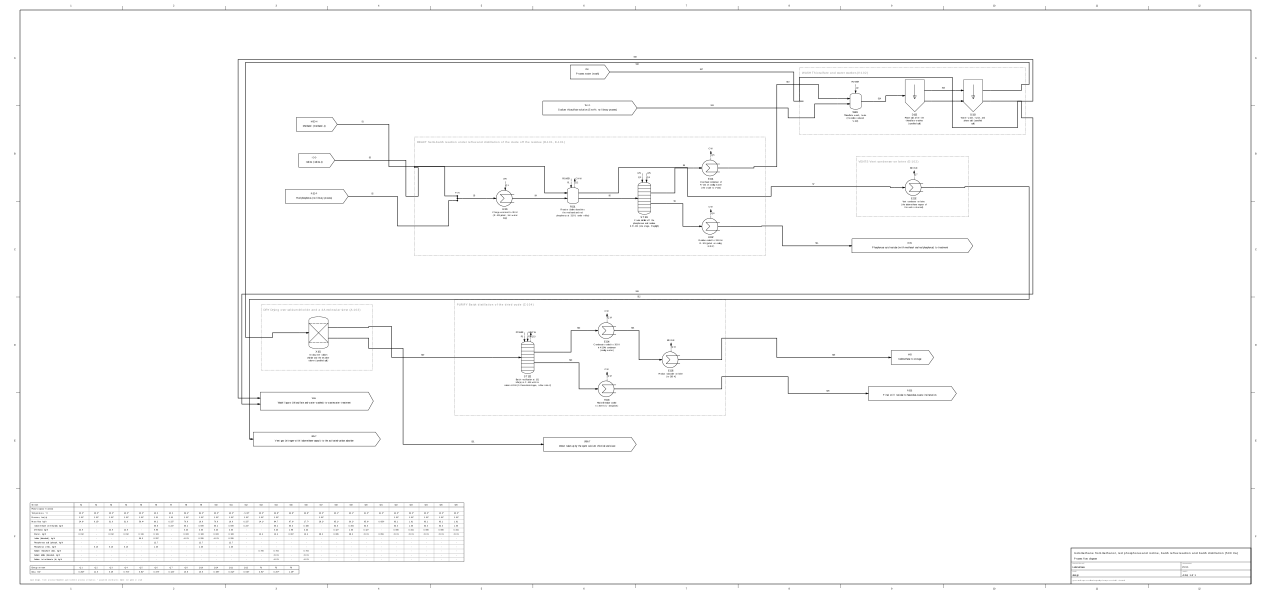
Methanol (methanol-1) and red phosphorus are charged to an enamelled reactor and warmed to 313 K; iodine (iodine-1) is dosed into the slurry over 10 h through a closed solids feeder, 6 CH3OH + 2 P + 3 I2 -> 6 CH3I + 2 H3PO3 through PI3, the batch route of CN 114195616 B (Examples 1-3: methanol, red phosphorus and iodine at about 4 : 1 : 10 by mass, total reflux at 39-45 C, the crude distilled off up to 90 C into thiosulfate solution, washed, dried and distilled to 99.5-99.7 %). The patent writes phosphoric acid as the by-product; this entry takes phosphorous acid, as the PI3 the patent names gives it (DESIGN.md D-004). The reactor runs at the end mass's measured reflux temperature under a reflux condenser, on a chilled-water jacket. The crude iodomethane (92 wt%, with methanol) is distilled off the phosphorous acid residue in the same vessel into sodium thiosulfate solution, washed twice with thiosulfate and twice with water, dried to 100 ppm water and distilled in a still with a short column; every vent goes through a brine condenser to an activated-carbon adsorber. Product 99.86 wt% iodomethane, predicted by core's batch rectification on an ideal liquid (a rigorous column would give at least this, the real liquid, with a possible azeotrope with methanol, may give less): above the patent's measured 99.5-99.7 %, a finding, not a design claim; the specification stays the patent's. Yield 95.01 % of theory on the iodine, inside the patent's 95-96 % (no basis stated) and an ASSUMED upper bound; the residue (0.31 kg per kg), the wash liquors and the adsorber take the rest of the iodine, whose recovery is a gap.

The batch is modelled with cheme-as-code's semi-batch reactor with a solid reactant and a vent (reactor: semibatch, batch.vent, core ADRs 0050 and 0054), a batch still off the residue (still:, one Rayleigh stage, ADR 0055), a batch rectification of the dried crude (still.column, 5 theoretical stages at a reflux ratio of 2, ASSUMED, with the charge's heat-up, ADRs 0061, 0063) and the batch recipe (process/recipe.yaml with units over several steps, ADRs 0051, 0052, 0057): the dosing, post-reaction, warming, heat-up and distillation times come from the models (ST102's heat-up from its model's energy at the reboiler's duty), the reactor is the bottleneck (cycle 23.2 h, 341.3 batches a year), the recipe sizes it (1.6 m3) and checks its jacket, and the flowsheet's flows are the recipe's year averages. The semi-batch and the stills write their own duties, the column's reboiler and condenser too (ADRs 0059, 0061), and the screening gives the MTSR over the batch and the gas released at the MTSR against the vent (ADR 0058). The washes and the drying are specified splits until core has a liquid-liquid model with sourced pairs; a single still stage would give 99.40 wt%, below the patent, the column on the ideal liquid 99.86 wt%, above it (D-016). The kinetics are ASSUMED: the iodine accumulates to 2.28 % at the end of the dosing, and the cooling-failure temperature (322.6 K) lies 9.4 K above the boiling point at which the reactor runs, so a cooling failure boils iodomethane off into the reflux condenser (26 to 53 kW), which is designed for it. See DESIGN.md for every assumption.
Capacity
500 t/a distilled iodomethane: 341.3 batches/a of 1465.15 kg in 7920 h on a dedicated train (63.13 kg/h year average), ASSUMED (DESIGN.md D-002, D-003, D-015)
Operation
7,920 h/a
Location
generic fine-chemicals site with methanol and iodine supply (not chosen)
Engineering gates
Concept and feasibility (no results yet)
Maintainers
Artur Schweidtmann
Design basis and assumptions (7)
  • Route of CN 114195616 B (Examples 1-3): red phosphorus and methanol, iodine, the reaction at total reflux at 39-45 C, the crude distilled off up to 90 C, washed with sodium thiosulfate solution and water, dried over calcium chloride and a 4A molecular sieve, distilled (D-001).
  • By-product phosphorous acid (6 CH3OH + 2 P + 3 I2 -> 6 CH3I + 2 H3PO3), not the phosphoric acid the patent writes (D-004).
  • The iodine is dosed as a solid over 10 h through a closed feeder, not carried in by the reflux through an iodine tank as in the source (D-004).
  • ASSUMED rate law, first order in iodine and of order 2/3 in the red phosphorus, k 5.1e-4 (m3/kmol)^(2/3)/s at 316 K, Ea 60 kJ/mol; heat of reaction -540 kJ per 3 mol iodine from CRC formation enthalpies (D-005).
  • First still (in R-101): constant relative volatility, iodomethane 6 to methanol (ASSUMED); final still: core's batch rectification ST102 with K-104, 5 theoretical stages at a reflux ratio of 2 (ASSUMED), Raoult's law with NIST Antoine constants (D-007, D-010, D-016).
  • Washes and drying are specified splits: methanol distribution 5, iodomethane at its water solubility, the organic saturated with 0.1 wt% water, dried to 100 ppm (D-008, D-009).
  • All flows are year averages of the recipe (D-003); the duties and power concept estimates (scripts/balance.py, D-011); accuracy +/-30 % not demonstrated.

From process/design-basis.yaml.

Engineering model

Loading the drawing…
Drawing of the process (preview)Open the engineering model

The interactive model (drawings, streams, 3D) is made for larger screens.

Snapshot of a3c52e4, cheme-as-code 1.6.0.

What goes in and out

In

  • IodineFeedstockIodine flakes (iodine-1, 99.8 wt% I2), 0.942 kg/kg iodomethane (stoichiometric 0.896)
  • MethanolFeedstockMethanol (methanol-1, 500 ppm water), 0.394 kg/kg (stoichiometric 0.226; 66 % excess, CN 114195616 B, Example 1)
  • PhosphorusFeedstockRed phosphorus (no library process; proxy from white phosphorus recorded, D-014), 0.097 kg/kg (stoichiometric 0.073; 27 % excess)
  • Sodium thiosulfateFeedstock5 wt% sodium thiosulfate solution for the washes, 0.224 kg/kg (ASSUMED amount; no library process)
  • WaterFeedstockProcess water for the washes, 0.447 kg/kg (ASSUMED amount)
  • NitrogenFeedstockNitrogen (asu-1) for inerting and blanketing, 12.5 kg per batch, 8.5 g/kg (ASSUMED)
  • Calcium chlorideFeedstockCalcium chloride of the dryer, 3.5 kg per batch, 2.4 g/kg (ASSUMED replacement)

Out

  • Iodomethane (methyl iodide)Main productDistilled iodomethane, 99.86 wt% (core's batch rectification on an ideal liquid, above CN 114195616 B's measured 99.5-99.7 %: a finding, the specification stays the patent's), 0.14 wt% methanol, 0.2 ppm water, to dark storage under nitrogen at 283 K
  • Phosphorous acid (phosphonic acid)WastePhosphorous acid residue with methanol, the excess red phosphorus and 1.4 % of the iodine, 0.311 kg/kg, to hazardous-waste treatment (the source describes none)
  • WastewaterWasteThiosulfate and water wash liquors, 0.759 kg/kg, with methanol, sodium salts and dissolved iodomethane, to wastewater treatment

Utilities: Electricity (0.086 kWh/kg: agitators of R-101, V-102 and C-104, the iodine feeder, the loop and transfer pumps, the vent fan (ASSUMED)), Steam (0.270 kWh/kg of LP steam 350 kPa(a) to the hot-water loops: the charge's warming, ST101 (its net boil-up from core's still model, its heat-up apart) and ST102's reboiler (the boil-up at the reflux and the charge's heat-up, from core's batch rectification)), Cooling water (0.269 kWh/kg removed by cooling water: the overhead condenser E-101, the column's condenser, the residues' cooling), Chilled water (0.183 kWh/kg removed by chilled water at 278 K: R-101's jacket, the heat of reaction (from core's semi-batch model)), Chilled water (0.0070 kWh/kg removed by brine at 258 K: the vent condenser E-102 and the product subcooler (the registry has chilled water, not brine: closest entry))

Show in the process graph

Reactions

IdAs writtenReactionOther processes
MEI6 CH4O + 2 P + 3 I2 → 6 CH3I + 2 H3PO3 · Methanol, red phosphorus and iodine to iodomethane and phosphorous acid (via PI3)6CH4O+2P+3I2gives6CH3I+2H3O3P
THIOI2 + 2 Na2O3S2 → 2 INa + Na2O6S4 · Reduction of the crude's iodine by sodium thiosulfate in the washI2+2Na2O3S2gives2NaI+Na2O6S4

Each reaction's page has the conversion, heat of reaction, catalyst and sources this process states, next to those of other processes with the same reaction. All reactions

Life cycle assessment

–kg CO2-eqPreliminarypartial, 22 data gaps

Climate change per 1 kg Iodomethane, cradle-to-gate

No factors. No contribution is characterised, so no factor stands behind any number.

Main contributors
    Method and data
    Goal
    Preliminary gate-to-gate life cycle inventory of iodomethane made by dosing iodine into a slurry of red phosphorus in methanol under reflux, distilling the crude off the phosphorous acid residue, washing it with sodium thiosulfate solution and water, drying it over calcium chloride and a 4A molecular sieve and distilling it, at the concept stage: which raw materials, utilities and wastes the batch plant exchanges per kg of iodomethane, as the foreground for a later cradle-to-gate study. No impact results: most backgrounds are not mapped yet (D-014).
    Functional unit
    1 kg Iodomethane (1 kg iodomethane (methyl iodide))
    Boundary
    cradle-to-gate
    Characterisation
    Factors kept with the process · GWP100
    Data quality
    No factors
    Result
    partial screening carbon footprint · 22 data gaps
    ScenarioClimate change (kg CO2-eq)
    baselineno total (data gaps)

    Inventory per 1 kg Iodomethane (23 flows)

    FlowPhaseDirectionQuantityUnitProvenance
    Methanol (methanol-1)operationinput0.3939kgassumed
    Red phosphorus (no library process)operationinput0.09743kgassumed
    Iodine (iodine-1)operationinput0.9416kgassumed
    Sodium thiosulfate solution (5 wt%; no library process)operationinput0.2237kgassumed
    Process water (wash)operationinput0.4474kgassumed
    Electric poweroperationinput0.08573kWhassumed
    LP steam 350 kPa(a) (to the hot-water loops)operationinput0.2702kWhassumed
    Iodomethane to storageoperationoutput1kgcalculated
    Phosphorous acid residue (with methanol and red phosphorus) to treatmentoperationoutput0.3106kgcalculated
    Final still residue to hazardous-waste incinerationoperationoutput0.03021kgcalculated
    Wash liquors (thiosulfate and water washes) to wastewater treatmentoperationoutput0.7586kgassumed
    Water taken up by the spent calcium chloride and sieveoperationoutput0.0009281kgassumed
    Vent gas (nitrogen with iodomethane vapour) to the activated-carbon adsorberoperationoutput0.00375kgcalculated
    Cooling water returnoperationoutput0.2692kWhassumed
    Chilled water return (283 K)operationoutput0.1833kWhcalculated
    Chilled brine return (263 K)operationoutput0.007022kWhassumed
    Nitrogen for inerting R-101 and the phosphorus tank and blanketing the work-upoperationinput0.008532kgassumed
    Calcium chloride of the dryer A-103operationinput0.002389kgassumed
    Disposal: Calcium chloride of the dryer A-103 (the spent calcium chloride (with its water and some iodomethane) to hazardous-waste disposal (D-009))operationoutput0.002389kgassumed
    4A molecular sieve of the dryer A-103operationinput0.002048kgassumed
    Disposal: 4A molecular sieve of the dryer A-103 (the spent sieve to hazardous-waste disposal (D-009))operationoutput0.002048kgassumed
    Activated carbon of the vent adsorber X-106operationinput0.01877kgassumed
    Disposal: Activated carbon of the vent adsorber X-106 (the spent carbon with its iodomethane to incineration with flue-gas scrubbing, or to off-site regeneration with iodomethane recovery (a variant) (D-012))operationoutput0.01877kgassumed

    Computed by ChemE-as-Code from lca/README.md, lca/dataset.yaml, lca/factors.yaml, lca/gaps.csv, lca/inventory.csv, lca/lca.yaml, lca/mappings.yaml, lca/results.csv, lca/results.md.

    In the open LCI database (cheme-as-code-atlas-preview-a3c52e4) as Iodomethane (methyl iodide), Iodomethane to storage Preliminary.

    Download it for Brightway, openLCA and other tools.

    In the LCI database: system model, datasets and KPIs against the benchmarks

    In the LCI database

    Status
    Preliminary 14 unmapped exchanges. Some exchanges have no background mapping yet: they are exported unlinked and count no burden, so the inventory is incomplete.
    System model
    attributional, cut-off (methodology 1.1.0)
    Allocation
    mass (single-output, from default) · product:MEI 100 %
    Allocation findings
    none
    Change report
    Not available: this build has no change report against an earlier release.
    Dataset pages
    Iodomethane (methyl iodide), Iodomethane to storage Preliminary

    KPI benchmark positions

    KPIValueReference rangePosition
    Iodine consumption per kg of iodomethane (red phosphorus route)
    No open source with a plant's iodine use per kg of iodomethane found (searched 2026-11-05/06: Google Patents CN 114195616 B, the dataset's basis, gives charges and yields of 95-96 % without stating their basis; PubChem HSDB names the route without consumptions; Ullmann's chapters not read, licensed). Only the stoichiometric floor, 0.894 kg/kg, is known.
    – kg/kgnot availablenot evaluated
    Methanol consumption per kg of iodomethane (red phosphorus route)
    No open source with a plant's methanol use per kg of iodomethane found (searched as for mei-specific-iodine): CN 114195616 B gives the charges of its examples, which the dataset takes as its ratio, so they are no independent reference. Only the stoichiometric floor, 0.226 kg/kg, is known.
    – kg/kgnot availablenot evaluated

    Maturity and review

    Design maturity Concept (claimed): An idea or first flowsheet; numbers are rough. Concept batch PFD with closed mass, component and element balances (cheme validate, cheme process streams: 5 blocks and 15 steps within tolerance). The semi-batch R101 with the red phosphorus as a solid reactant and a vent (from its ASSUMED rate law), the still ST101 (constant relative volatility, ASSUMED), the batch rectification ST102 (5 theoretical stages at a reflux ratio of 2, Raoult's law with NIST Antoine constants, the ideal liquid ASSUMED; its reboiler and condenser duties written), the thiosulfate's reduction of the iodine and the mixers are calculated by cheme process propagate; scripts/balance.py gives the feeds for 500 t/a, the washes' and the drying's splits, the vent fraction, the temperatures of the mixed streams, the duties the models do not write and the powers. The recipe's year-average rate of the product agrees with the flowsheet (no cheme.recipe-basis finding); the recipe sizes R-101 (1.6 m3), its jacket check passes against the log-mean chilled-water temperature, and the stills' times come from their boil-ups. Thermal screening (cheme process reactor-hazards): dT_ad 520.1 K, accumulation 2.28 %, MTSR 322.6 K against an MTT of 313.15 K (hazard.mtt: the end mass's measured temperature at total reflux, CN 114195616 B; 16 K below its ideal-liquid bubble point), so the MTSR lies above it (cheme.reactor-hazard-mtsr, a design finding of a reactor at reflux); no criticality class without a TD24 (3, 4 or 5). With k/10 the MTSR is 378.7 K, with k/100 603.8 K (DESIGN.md D-006). At the MTSR a cooling failure releases 0.19 m3/h of gas, within R-101's vent of 20 m3/h (ASSUMED); the iodomethane it boils off at the MTT, 84 to 172 m3/h, is for the reflux condenser E-101 to condense (a design finding). Preliminary gate-to-gate LCI with the per-batch nitrogen, desiccants and activated carbon; the methanol linked to methanol-1, the iodine to iodine-1 and the nitrogen to asu-1, red phosphorus and sodium thiosulfate gaps with recorded proxies, the other backgrounds gaps. cheme maturity reaches no level (assumed feeds, kinetics and separations); the claim `maturity: concept` is the lowest value of the schema, not an evidenced level. Not reviewed. Needs cheme-as-code 1.10.0.

    Calculation maturity, from the checked evidenceNot assessed

    The process has no maturity report (cheme maturity, checks/maturity.json), so no calculation maturity is established.

    No level shownThe design maturity (Concept) is the manifest's claim, not evidence. A level appears here once the process's repository holds a current report from cheme maturity --write.

    Artifact completeness

    Which deliverables exist. They never raise a calculation maturity level: a drawing from unchecked numbers is still unchecked.

    Not reported without a maturity report.

    Independent review

    Not independently reviewed

    No independent engineering review yet. Automated checks passing is not a review.

    Set by people only. Reaching a calculation maturity level or passing automated checks is not an independent review or an approval.

    Where the evidence comes from
    Report
    processes/iodomethane-1/checks/maturity.json (not in the library)
    Design basis
    process/design-basis.yaml
    Method
    How ChemE-as-Code checks the levels (requirement by requirement)

    Open items

    Sources

    Engineering project
    Iodomethane · cheme-as-code>=1.10
    Library version
    a3c52e4 (process last changed in a3c52e4)
    Drawings rendered by
    cheme 1.6.0 (pyDEXPI 2.1.0)
    Data
    Catalog record (JSON) · CC-BY-4.0
    Files
    View the files on GitHub · change history and authors

    References

    How to cite

    For the data, cite the Process Atlas paper; for the platform that builds and checks it, the ChemE-as-Code paper.

    Schweidtmann, A. M. & Weber, J. M. (2026, in preparation). Process Atlas: an open, git-native, reproducible library and life cycle inventory of chemical processes (working title).

    For this process: "Iodomethane from methanol, red phosphorus and iodine, batch reflux reaction and batch distillation (500 t/a)", ChemE-as-Code process library, version a3c52e4.

    BibTeX
    @unpublished{schweidtmann_process_atlas,
      author = {Schweidtmann, Artur M. and Weber, Jana M.},
      title = {{Process Atlas: an open, git-native, reproducible library and life cycle inventory of chemical processes (working title)}},
      year = {2026},
      url = {https://atlas.cheme-as-code.org},
      note = {in preparation}
    }

    Schweidtmann, A. M. (2026). ChemE-as-Code: An Open-Source Platform for Agentic AI in Chemical Engineering. arXiv:2611.07947. https://doi.org/10.48550/arXiv.2611.07947

    BibTeX
    @misc{schweidtmann_cheme_as_code,
      author = {Schweidtmann, Artur M.},
      title = {{ChemE-as-Code: An Open-Source Platform for Agentic AI in Chemical Engineering}},
      year = {2026},
      eprint = {2611.07947},
      archivePrefix = {arXiv},
      doi = {10.48550/arXiv.2611.07947},
      url = {https://arxiv.org/abs/2611.07947}
    }