
Methyltriphenylphosphonium bromide by semi-batch quaternisation of PPh3 with methyl bromide in toluene (820 t/a)

A batch plant: liquid methyl bromide is dosed into triphenylphosphine dissolved in toluene in a closed pressure vessel at 333 K, the salt precipitates, is filtered, washed with recovered toluene and vacuum-dried in a filter-dryer, and the toluene is recovered in a batch still. Concept stage, 1057.1 kg per batch every 10.20 h on a dedicated train, preliminary gate-to-gate LCI.

Calculation maturity: not assessedDesign maturity: Concept (research)Not independently reviewedChlorinated organicsReport a problem with this process
Research outputNot engineering advice and not an approved design: do not use it for construction, operation or safety decisions. What this means

Overview

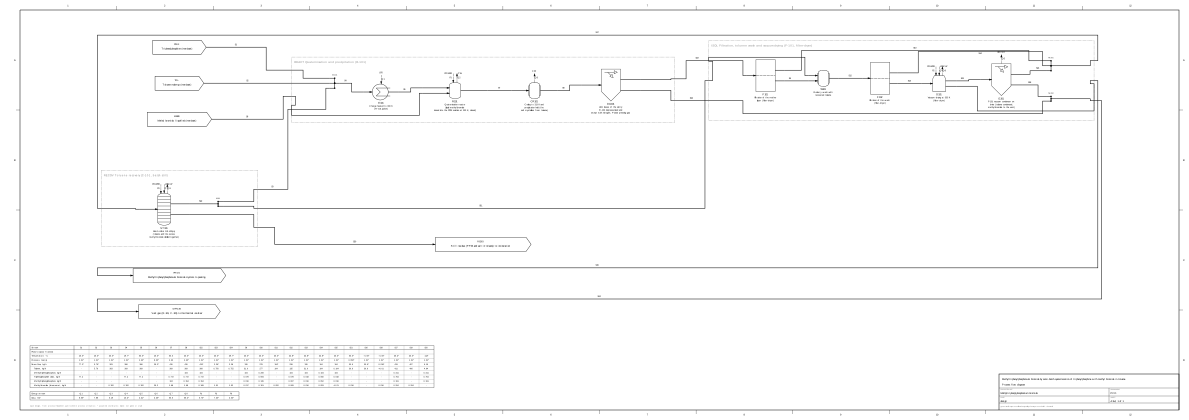
The route is the quaternisation of triphenylphosphine (PPh3) with methyl bromide, Ph3P + CH3Br -> [Ph3PCH3]Br, with no co-product (Wikipedia, which cites Wittig and Schoellkopf, Org. Synth. 40, 66 (1960): that procedure could not be read). US 3 334 144 A (read) states in its background that the salt is made by heating the phosphine with methyl bromide, usually in benzene, in a pressure vessel, at 50 C or above for a reasonable rate. Here toluene replaces benzene (ASSUMED): PPh3 at 20 wt% is dissolved in recovered toluene in the glass-lined pressure vessel R-101 and heated to 333 K, and liquefied methyl bromide is pumped into the closed, nitrogen-padded vessel over 3 h, 1.05 mol per mol PPh3 with the recycled excess. The salt separates from toluene (as from benzene in US 3 334 144 A, Example 1). After a post-reaction to 0.99 conversion of the PPh3 the slurry is cooled to 313 K, R-101 is depressurised and swept with nitrogen to the site's thermal oxidiser (90 % of the excess methyl bromide, with F-101's pressing gas, ASSUMED), and the salt is filtered, reslurry-washed with recovered toluene and vacuum-dried at 333 K in the agitated filter-dryer F-101. The mother liquor, the wash filtrate and the dryer's condensate are distilled in the batch still C-101: 98.5 % of the liquor's mass comes over as toluene with the remaining methyl bromide and is reused for the next charge and the wash; the residue (the unconverted PPh3, the dissolved salt and fines in toluene) goes to incineration.

The modelled yield is 98.5 % on PPh3 and the product 99.87 wt% salt (0.1 wt% toluene). Both are ASSUMED upper bounds: they follow from the ASSUMED 0.99 conversion and solubility, no open source of this route gives a yield, and triphenylphosphine oxide, water and other impurities are not modelled.

The batch is modelled with cheme-as-code 1.10.0: R101 is a semi-batch (reactor: semibatch) with the liquid methyl bromide as the dose; the precipitation CR101 and the reslurry wash W101 are crystallizers with the dissolved PPh3 and methyl bromide as spectators (core ADR 0056); the filter-dryer is one recipe vessel over four steps with Ruth filtration times and core's dryer to a residual moisture (core ADR 0057); the toluene recovery is core's batch still on Raoult's law (core ADR 0055). The recovered toluene's recycle is converged by propagate at the tear S11 (core ADR 0060), and the semi-batch, the crystallizer and the still write their duties (core ADR 0059), the still's with the charge's heat-up and C-101's metal and the crystallizer's with R-101's metal (core ADR 0063). The recipe gives the cycle (10.20 h, the filter-dryer the bottleneck, 776.6 batches a year), R-101's heating and cooling times with its metal, sizes R-101, F-101 and the still C-101 (6.3 m3 each) and checks R-101's jacket against the cooling water's log-mean temperature. Kinetics and the heat of reaction are ASSUMED (no open data): 14.7 % of the methyl bromide accumulates, the cooling-failure temperature reaches 339.1 K, and the MTT of the closed vessel (the temperature at which it reaches its relief set pressure, 415.3 K) is far above it; at k/100 the MTSR is 371.9 K, still below its MTT of 401.3 K. Without a TD24 core's criticality gives class 1, 2 or 5. See DESIGN.md for every assumption.
Capacity
820.9 t/a dried salt: 776.6 batches/a of 1057.10 kg in 7920 h on a dedicated train (103.66 kg/h year average), from one 6.3 m3 R-101 and the recipe's cycle, ASSUMED (DESIGN.md D-002, D-003, D-013)
Operation
7,920 h/a
Location
generic fine-chemicals site with a methyl bromide supply and a thermal oxidiser (not chosen)
Engineering gates
Concept and feasibility (no results yet)
Maintainers
Artur Schweidtmann
Design basis and assumptions (6)
  • Route: PPh3 + CH3Br -> [Ph3PCH3]Br (Wikipedia; US 3 334 144 A background: heated with methyl bromide, usually in benzene, in a pressure vessel, 50 C or above); toluene in place of benzene, 20 wt% PPh3, 1.05 mol methyl bromide per mol PPh3 in R-101 with the recycled excess, 333 K (D-001, D-004).
  • ASSUMED kinetics and heat of reaction (no open data, D-005): second order, k 5.0e-3 m3/(kmol s) at 333 K, Ea 70 kJ/mol, -100 kJ/mol to the precipitated salt; 0.99 conversion of the PPh3.
  • ASSUMED solubility of the salt 0.5 g per kg toluene, no salting-out correction (D-007); 90 % of the excess methyl bromide swept to the thermal oxidiser before and during the filtration (D-007).
  • ASSUMED filter-dryer: 99.8 % solid recovery, 0.3 kg liquor per kg cake solid, specific cake resistance 1e10 m/kg at 200 kPa; one reslurry wash with 1 kg recovered toluene per kg solid; vacuum drying at 333 K to 0.1 wt% toluene, 4 kg/(m2 h) on 12 m2 (D-008).
  • ASSUMED still: an ideal liquid (Raoult), 98.5 % of the liquor's mass distilled, PPh3 and the salt non-volatile (D-009).
  • All flows are year averages of the recipe (D-003); the recovered toluene's recycle converged by cheme process propagate at the tear S11, its flow the wash ratio, the fresh feeds at the charge ratios and the hand splits DG101 and E201 set by hand (D-006); the duties of R101, CR101 and ST101 written by their models at energy_port, the rest hand arithmetic from cheme's reports (D-010); accuracy +/-30 % not demonstrated.

From process/design-basis.yaml.

Engineering model

Loading the drawing…
Drawing of the process (preview)Open the engineering model

The interactive model (drawings, streams, 3D) is made for larger screens.

Snapshot of a3c52e4, cheme-as-code 1.6.0.

What goes in and out

In

  • TriphenylphosphineFeedstockTriphenylphosphine (merchant), 0.744 kg/kg salt; no library process makes it (proxy PCl3 + chlorobenzene + sodium recorded, D-012)
  • Bromomethane (methyl bromide)FeedstockLiquefied methyl bromide (merchant), 0.281 kg/kg salt, 1.045 mol per mol PPh3 fed; no library process makes it (proxy methanol + HBr recorded, as methylmagnesium-bromide-1, D-012)
  • TolueneFeedstockToluene make-up (btx-1), 0.056 kg/kg salt; the still recovers the rest of the 4.0 kg per kg PPh3 charged
  • NitrogenFeedstockNitrogen (asu-1) for inerting, padding, sweeping and pressing, 103 kg per batch, 0.097 kg/kg salt (ASSUMED)

Out

  • Methyltriphenylphosphonium bromideMain productDried salt to packing under nitrogen; modelled 99.87 wt%, an ASSUMED upper bound (no specification or impurity profile found, PPh3 oxide and water not modelled)

Utilities: Electricity (0.154 kWh/kg salt: agitators of R-101, F-101 and C-101, the dosing pump, the vacuum pump and transfer pumps (ASSUMED)), Steam (0.767 kWh (2.76 MJ)/kg salt of LP steam: the still (boil-up, the charge's heat-up and its metal, 0.585 kWh), the dryer (0.100 kWh) and R-101's heat-up with the PPh3's heat of solution (0.083 kWh)), Cooling water (0.703 kWh/kg salt removed by cooling water: the still's condenser and distillate cooler (0.544 kWh), the heat of quaternisation, the slurry's cool-down and the product's in F-101), Chilled water (0.042 kWh/kg salt removed by brine at 258 K: F-101's vacuum condenser (the registry has chilled water, not brine: closest entry))

Show in the process graph

Reactions

IdAs writtenReactionOther processes
QUATPh3P + CH3Br → [Ph3PCH3]Br · Quaternisation of triphenylphosphine with methyl bromideC18H15P+CH3BrgivesC19H18BrP

Each reaction's page has the conversion, heat of reaction, catalyst and sources this process states, next to those of other processes with the same reaction. All reactions

Life cycle assessment

–kg CO2-eqPreliminarypartial, 11 data gaps

Climate change per 1 kg Methyltriphenylphosphonium bromide crystals, cradle-to-gate

No factors. No contribution is characterised, so no factor stands behind any number.

Main contributors
    Method and data
    Goal
    Preliminary gate-to-gate life cycle inventory of methyltriphenylphosphonium bromide made by the semi-batch quaternisation of triphenylphosphine with liquid methyl bromide in toluene in a closed pressure vessel, the salt precipitated, filtered, washed with recovered toluene and vacuum-dried in a filter-dryer, the toluene recovered in a batch still, at the concept stage: which raw materials, utilities and wastes the batch plant exchanges per kg of dried salt, as the foreground for a later cradle-to-gate study. No impact results: most backgrounds are not mapped yet (D-012).
    Functional unit
    1 kg Methyltriphenylphosphonium bromide crystals (1 kg methyltriphenylphosphonium bromide)
    Boundary
    cradle-to-gate
    Characterisation
    Factors kept with the process · GWP100
    Data quality
    No factors
    Result
    partial screening carbon footprint · 11 data gaps
    ScenarioClimate change (kg CO2-eq)
    baselineno total (data gaps)

    Inventory per 1 kg Methyltriphenylphosphonium bromide crystals (12 flows)

    FlowPhaseDirectionQuantityUnitProvenance
    Triphenylphosphine (merchant)operationinput0.7444kgassumed
    Methyl bromide, liquefied (merchant)operationinput0.2814kgassumed
    Toluene make-up (merchant)operationinput0.05589kgassumed
    Electric poweroperationinput0.1544kWhassumed
    LP steam 350 kPa(a) (R-101 heat-up, the dryer's hot-water circuit, the still)operationinput0.7674kWhassumed
    Methyltriphenylphosphonium bromide crystals to packingoperationoutput1kgcalculated
    Vent gas (R-101, F-101) to the thermal oxidiseroperationoutput0.02195kgcalculated
    Still residue (PPh3 and salt in toluene) to incinerationoperationoutput0.05974kgcalculated
    Cooling water returnoperationoutput0.7028kWhassumed
    Chilled brine return (263 K)operationoutput0.04156kWhassumed
    Nitrogen for inerting and padding R-101, sweeping its headspace, pressing F-101 and breaking its vacuum, blanketing C-101operationinput0.09744kgassumed
    Disposal: Nitrogen for inerting and padding R-101, sweeping its headspace, pressing F-101 and breaking its vacuum, blanketing C-101 (through the vent header and the site's thermal oxidiser to air, unchanged (D-012))operationoutput0.09744kgassumed

    Computed by ChemE-as-Code from lca/README.md, lca/dataset.yaml, lca/factors.yaml, lca/gaps.csv, lca/inventory.csv, lca/lca.yaml, lca/mappings.yaml, lca/results.csv, lca/results.md.

    In the open LCI database (cheme-as-code-atlas-preview-a3c52e4) as Methyltriphenylphosphonium bromide crystals to packing Preliminary.

    Download it for Brightway, openLCA and other tools.

    In the LCI database: system model, datasets and KPIs against the benchmarks

    In the LCI database

    Status
    Preliminary 6 unmapped exchanges. Some exchanges have no background mapping yet: they are exported unlinked and count no burden, so the inventory is incomplete.
    System model
    attributional, cut-off (methodology 1.1.0)
    Allocation
    mass (single-output, from default) · product:PROD 100 %
    Allocation findings
    none
    Change report
    Not available: this build has no change report against an earlier release.
    Dataset pages
    Methyltriphenylphosphonium bromide crystals to packing Preliminary

    KPI benchmark positions

    KPIValueReference rangePosition
    Methyl bromide consumption per kg of methyltriphenylphosphonium bromide
    No open source with a plant's methyl bromide use per kg of the salt found (searched 2026-11-06 as for mtppb-specific-triphenylphosphine); US 3 334 144 A states only that the route needs a pressure vessel. Only the stoichiometric floor, 0.266 kg/kg, is known.
    – kg/kgnot availablenot evaluated
    Triphenylphosphine consumption per kg of methyltriphenylphosphonium bromide
    No open source with a plant's or a pilot's PPh3 use per kg of methyltriphenylphosphonium bromide found (searched 2026-11-06: Google Patents US 3 334 144 A read, its own dibromomethane route with 30 % conversion and no yield of the methyl bromide route; Wikipedia, Methyltriphenylphosphonium bromide, the route only; web search for the salt's production, which gave supplier pages and one laboratory patent example on another route, CN 107840792 A, not read; Org. Synth. 40, 66 (1960) blocked by a browser check, not read). Only the stoichiometric floor, 0.734 kg/kg, is known.
    – kg/kgnot availablenot evaluated

    Maturity and review

    Design maturity Concept (claimed): An idea or first flowsheet; numbers are rough. Concept batch PFD with closed mass, component and element balances (cheme validate: 3 blocks, 14 steps). Every material stream is calculated by cheme process propagate from the feeds and the recycle: the semi-batch R101 from its ASSUMED rate law, the precipitation CR101 and the wash W101 as crystallizers with spectators on an ASSUMED solubility with no salting-out correction, the filters as specified splits, the dryer D101 to an ASSUMED residual moisture, the still ST101 by Rayleigh on Raoult's law; the vent losses DG101 and the vacuum condenser E201 are hand splits; the recycled toluene is converged by propagate at the tear S11 (Wegstein, 3 iterations; core 1.9.0). The duties of R101, CR101 and ST101 are written by their models (energy_port), the still's with the charge's heat-up and C-101's metal and CR101's with R-101's metal (core 1.10.0); R-101's heat-up with the PPh3's heat of solution and its metal, F-101's cool-down and the condensers are hand arithmetic from the stream table on their own streams; the dryer's is core's model. The recipe takes the dosing, post-reaction, heating and cooling (with R-101's metal), filtration, drying and boil-up times from the models (cheme process recipe, no cheme.recipe-basis finding); the still's heat-up time is hand arithmetic at its boil-up rate. Thermal screening (cheme process reactor-hazards): dT_ad 46.0 K, accumulation 14.7 %, MTSR 339.1 K against a hand MTT of 415.3 K for the closed vessel (core 1.9.0's default, 307.3 K, its Clausius-Clapeyron estimate of pure methyl bromide's boiling point at 230 kPa(a) with the 384 K heat of vaporization of the materials, 300.0 K by their vapour pressure, does not describe it); no vent and no gas formed, so no gas release; no criticality class without a TD24 from calorimetry (never estimated). The kinetics are assumed: at k/100 the accumulation is 85 % and the cycle 293 h. Preliminary gate-to-gate LCI with nitrogen as a per-batch consumable; toluene and nitrogen linked to btx-1 and asu-1, PPh3 and methyl bromide gaps with their proxy recorded. Not reviewed. Needs cheme-as-code 1.10.0.

    Calculation maturity, from the checked evidenceNot assessed

    The process has no maturity report (cheme maturity, checks/maturity.json), so no calculation maturity is established.

    No level shownThe design maturity (Concept) is the manifest's claim, not evidence. A level appears here once the process's repository holds a current report from cheme maturity --write.

    Artifact completeness

    Which deliverables exist. They never raise a calculation maturity level: a drawing from unchecked numbers is still unchecked.

    Not reported without a maturity report.

    Independent review

    Not independently reviewed

    No independent engineering review yet. Automated checks passing is not a review.

    Set by people only. Reaching a calculation maturity level or passing automated checks is not an independent review or an approval.

    Where the evidence comes from
    Report
    processes/methyltriphenylphosphonium-bromide-1/checks/maturity.json (not in the library)
    Design basis
    process/design-basis.yaml
    Method
    How ChemE-as-Code checks the levels (requirement by requirement)

    Open items

    Sources

    Engineering project
    Methyltriphenylphosphonium bromide · cheme-as-code>=1.10
    Library version
    a3c52e4 (process last changed in a3c52e4)
    Drawings rendered by
    cheme 1.6.0 (pyDEXPI 2.1.0)
    Data
    Catalog record (JSON) · CC-BY-4.0
    Files
    View the files on GitHub · change history and authors

    References

    How to cite

    For the data, cite the Process Atlas paper; for the platform that builds and checks it, the ChemE-as-Code paper.

    Schweidtmann, A. M. & Weber, J. M. (2026, in preparation). Process Atlas: an open, git-native, reproducible library and life cycle inventory of chemical processes (working title).

    For this process: "Methyltriphenylphosphonium bromide by semi-batch quaternisation of PPh3 with methyl bromide in toluene (820 t/a)", ChemE-as-Code process library, version a3c52e4.

    BibTeX
    @unpublished{schweidtmann_process_atlas,
      author = {Schweidtmann, Artur M. and Weber, Jana M.},
      title = {{Process Atlas: an open, git-native, reproducible library and life cycle inventory of chemical processes (working title)}},
      year = {2026},
      url = {https://atlas.cheme-as-code.org},
      note = {in preparation}
    }

    Schweidtmann, A. M. (2026). ChemE-as-Code: An Open-Source Platform for Agentic AI in Chemical Engineering. arXiv:2611.07947. https://doi.org/10.48550/arXiv.2611.07947

    BibTeX
    @misc{schweidtmann_cheme_as_code,
      author = {Schweidtmann, Artur M.},
      title = {{ChemE-as-Code: An Open-Source Platform for Agentic AI in Chemical Engineering}},
      year = {2026},
      eprint = {2611.07947},
      archivePrefix = {arXiv},
      doi = {10.48550/arXiv.2611.07947},
      url = {https://arxiv.org/abs/2611.07947}
    }