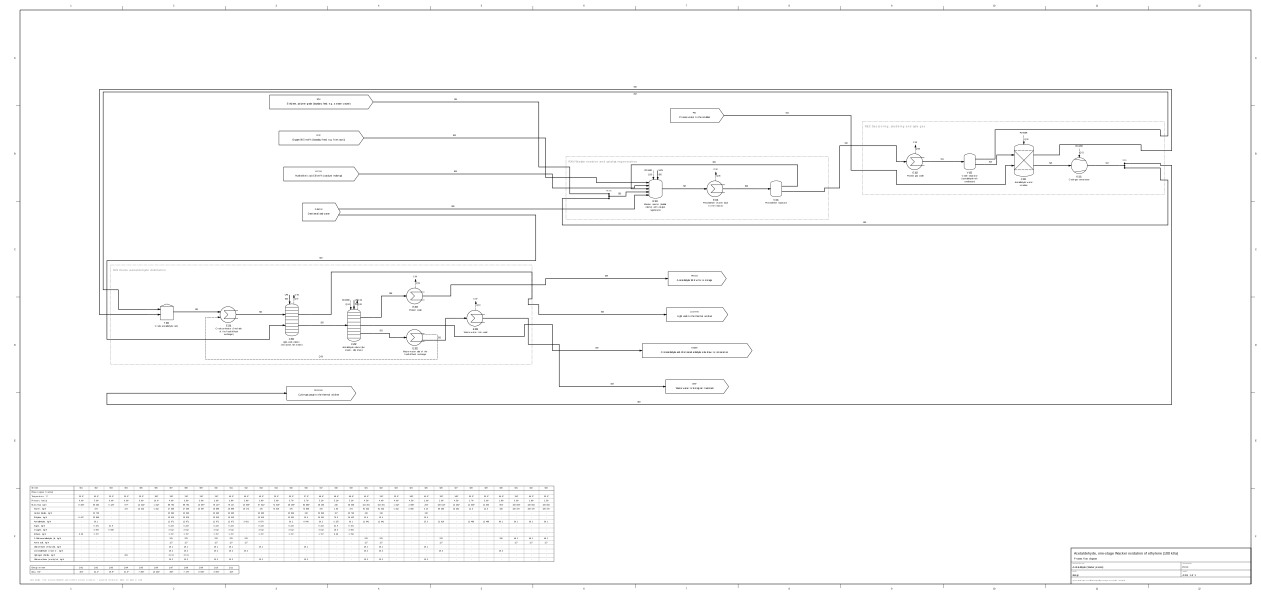
One-stage (Hoechst-Wacker) process: ethylene and 99.5 % oxygen are fed to a bubble-column reactor with the aqueous palladium/copper chloride catalyst at about 130 C and 400 kPa(a). The heat of reaction evaporates water; a precondenser returns it, a cooler condenses an acetaldehyde-rich aqueous condensate and a water scrubber recovers the rest of the acetaldehyde. The scrubbed cycle gas is recompressed and recycled; a small purge limits CO2, argon and ethane. Crude acetaldehyde (about 12 wt%) passes an extractive light-ends column (CO2, chloroethane, chloromethane) and the acetaldehyde column, which gives 99.9 wt% product overhead, a side draw of crotonaldehyde and chlorinated aldehydes, and waste water with the acetic acid at the bottom. A catalyst side stream is regenerated with direct steam.
All values are concept estimates (scripts/acet_balance.py of the engineering files): the ethylene fate follows the product distribution reported for the industrial process; water, steam and waste-water rates are scaled from the 13 t/h example of US 4,237,073; conversion per pass and the cycle-gas oxygen content are assumptions. See DESIGN.md for every assumption and gated step.