
Acetic acid by low-water iridium methanol carbonylation (60 t/h glacial acid, concept)

Liquid-phase carbonylation of methanol with carbon monoxide on an iridium/ruthenium catalyst with methyl iodide promoter, a flash heated with reactor heat, light-ends, drying and heavy-ends columns and methanol scrubbing of the vents, to glacial acetic acid. Concept stage, assumed basis.

Calculation maturity: not assessedDesign maturity: Concept (research)Not independently reviewedOxygenatesReport a problem with this process
Research outputNot engineering advice and not an approved design: do not use it for construction, operation or safety decisions. What this means

Overview

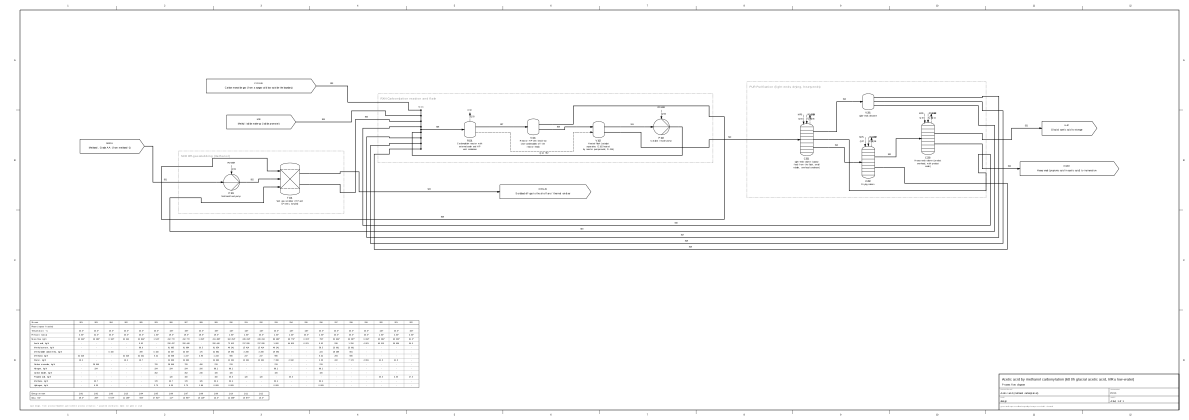
Methanol (the methanol-1 product) and carbon monoxide gas (from a syngas cold box outside the boundary) react at about 190 C and 29 bar(a) in a low-water (6 wt%) iridium/ruthenium carbonylation reactor. The reactor liquid is flashed, the flash heated by the reactor's cooling circuit (about 11 MW of the reaction heat); the catalyst solution returns to the reactor, and the flash vapour is purified in a light-ends column (methyl iodide and methyl acetate overhead, decanted and recycled), a drying column (water recycled to the reactor) and a heavy-ends column (propionic acid removed). The HP and LP vents are scrubbed with the fresh methanol before the off-gas goes to a flare or thermal oxidiser.

The reactor is a lumped stoichiometric model whose by-product ratios (CO2 and CH4 formation, each about 1 % of the carbonylation rate) come from the examples of an open patent; the flash, columns, decanter and scrubber are specified splits of a shortcut balance, and the duties are shortcut estimates. See DESIGN.md of the engineering files for every assumption and gated step.
Capacity
60 t/h glacial acetic acid, 504 kt/a (ASSUMED)
Operation
8,400 h/a
Location
generic (not chosen)
Engineering gates
Concept and feasibility (no results yet)
Maintainers
Artur Schweidtmann
Design basis and assumptions (5)
  • Reactor 463 K and 2900 kPa(a), water 6 wt%, methyl iodide 8 wt%, methyl acetate 15 wt% in the reactor liquid: design choices inside US 6,140,535 Examples 1-5 (D-003).
  • By-products from US 6,140,535 Examples 1-5: CO2 0.8 % and CH4 0.9 % of the carbonylation rate (mid values of the reported ranges); propionic acid 500 ppm(wt) of the product, ASSUMED (D-004).
  • Lumped stoichiometric reactor: catalyst cycle, methyl acetate and HI equilibria not modelled; no kinetics (D-004).
  • Flash, column, decanter and scrubber splits, reflux ratios and duties: a shortcut balance (scripts/balance.py) with rounded property data, accuracy not stated (D-006, D-008).
  • Off-gas CO 45 mol% of the non-condensables after scrubbing (D-007): sets the CO loss and so the yield on CO (96.7 %).

From process/design-basis.yaml.

Engineering model

Loading the drawing…
Drawing of the process (preview)Open the engineering model

The interactive model (drawings, streams, 3D) is made for larger screens.

Snapshot of c3ab348, cheme-as-code 1.6.0.

What goes in and out

In

  • MethanolFeedstockfeed:MEOH: methanol, Grade AA (e.g. from methanol-1), 0.539 kg/kg acetic acid
  • Carbon monoxideFeedstockfeed:COGAS: carbon monoxide gas from a syngas cold box outside the boundary, 0.488 kg/kg
  • Iodomethane (methyl iodide)Feedstockfeed:MEI: methyl iodide make-up (iodide promoter), 2.7 mg/kg
  • HydrogenReactantMinor component only (0.3 mol%, ASSUMED) of the CO feed gas feed:COGAS, consumed by the methanation and propionic acid side reactions

Out

  • Acetic acidMain productGlacial acetic acid to storage
  • Carbon dioxideWasteCO2 formed by the water-gas shift side reaction, in the off-gas product:OFFGAS to the flare / thermal oxidiser
  • MethaneWasteCH4 formed from methanol and the CO feed's CH4, in the off-gas product:OFFGAS to the flare / thermal oxidiser

Utilities: Electricity (Pumps (ASSUMED electric drives); no CO compression inside the boundary), Steam (MP steam 1100 kPa(a) to the column reboilers), Cooling water (25/35 C (ASSUMED))

Show in the process graph

Reactions

IdAs writtenReactionOther processes
CARBCH3OH + CO → CH3COOHCH4O+COgivesC2H4O2
MEOH_CH4CH3OH + H2 → CH4 + H2OCH4O+H2givesCH4+H2O
PROPCH3COOH + CO + 2 H2 → C2H5COOH + H2OC2H4O2+CO+2H2givesC3H6O2+H2O
WGSCO + H2O → CO2 + H2CO+H2OgivesCO2+H2

Each reaction's page has the conversion, heat of reaction, catalyst and sources this process states, next to those of other processes with the same reaction. All reactions

Life cycle assessment

–kg CO2-eqPreliminarypartial, 8 data gaps

Climate change per 1 kg Glacial acetic acid, cradle-to-gate

No factors. No contribution is characterised, so no factor stands behind any number.

Main contributors
    Method and data
    Goal
    Preliminary gate-to-gate life cycle inventory of glacial acetic acid by low-water iridium methanol carbonylation, for the process library: the foreground exchanges per kg of acetic acid at the gate (raw materials, utilities, wastes, off-gas) from the concept flowsheet, ready to be linked to background datasets later. Not an impact assessment: no background is linked.
    Functional unit
    1 kg Glacial acetic acid (1 kg acetic acid)
    Boundary
    cradle-to-gate
    Allocation
    none
    Characterisation
    Factors kept with the process · GWP100
    Data quality
    No factors
    Result
    partial screening carbon footprint · 8 data gaps
    ScenarioClimate change (kg CO2-eq)
    baselineno total (data gaps)

    Inventory per 1 kg Glacial acetic acid (9 flows)

    FlowPhaseDirectionQuantityUnitProvenance
    Methanol, Grade AA (from methanol-1)operationinput0.539kgassumed
    Carbon monoxide gas (from a syngas cold box outside the boundary)operationinput0.488kgassumed
    Methyl iodide make-up (iodide promoter)operationinput0.000002667kgassumed
    Electric poweroperationinput0.007883kWhassumed
    MP steam 1100 kPa(a)operationinput0.4518kWhassumed
    Glacial acetic acid to storageoperationoutput1kgassumed
    Scrubbed off-gas to the site flare / thermal oxidiseroperationoutput0.02568kgassumed
    Heavy ends (propionic acid in acetic acid) to incinerationoperationoutput0.00135kgassumed
    Cooling water returnoperationoutput1.092kWhassumed

    Computed by ChemE-as-Code from lca/README.md, lca/dataset.yaml, lca/factors.yaml, lca/gaps.csv, lca/inventory.csv, lca/lca.yaml, lca/mappings.yaml, lca/results.csv, lca/results.md, lca/uncertainty.csv.

    In the open LCI database (cheme-as-code-atlas-preview-c3ab348) as Glacial acetic acid to storage Preliminary.

    Download it for Brightway, openLCA and other tools.

    In the LCI database: system model, datasets and KPIs against the benchmarks

    In the LCI database

    Status
    Preliminary 5 unmapped exchanges. Some exchanges have no background mapping yet: they are exported unlinked and count no burden, so the inventory is incomplete.
    System model
    attributional, cut-off (methodology 1.1.0)
    Allocation
    none (single-output, from study) · product:HAC 100 %
    Allocation findings
    none
    Change report
    Not available: this build has no change report against an earlier release.
    Dataset pages
    Glacial acetic acid to storage Preliminary

    KPI benchmark positions: not available (no benchmarked KPI for this process's datasets).

    Maturity and review

    Design maturity Concept (claimed): An idea or first flowsheet; numbers are rough. Concept PFD with closed mass, component and element balances (cheme validate, cheme process streams: every block and step closes, the reactor's four extents explain every component change). cheme maturity reaches no level: the capacity and the CO gas composition are assumed, and the flash, columns, decanter and scrubber are specified values of an independent shortcut balance (scripts/balance.py). Core cannot qualify flashes, columns or enthalpies of the acetic acid / water / methyl iodide / methyl acetate system, so the energy balance is not evaluable in core and every duty is an ASSUMED shortcut estimate. The reactor by-product ratios come from US 6,140,535 Examples 1-5. Not reviewed. Main products and feeds are listed under chemistry with their chemicals registry entries (issue #251).

    Calculation maturity, from the checked evidenceNot assessed

    The process has no maturity report (cheme maturity, checks/maturity.json), so no calculation maturity is established.

    No level shownThe design maturity (Concept) is the manifest's claim, not evidence. A level appears here once the process's repository holds a current report from cheme maturity --write.

    Artifact completeness

    Which deliverables exist. They never raise a calculation maturity level: a drawing from unchecked numbers is still unchecked.

    Not reported without a maturity report.

    Independent review

    Not independently reviewed

    No independent engineering review yet. Automated checks passing is not a review.

    Set by people only. Reaching a calculation maturity level or passing automated checks is not an independent review or an approval.

    Where the evidence comes from
    Report
    processes/acetic-acid-1/checks/maturity.json (not in the library)
    Design basis
    process/design-basis.yaml
    Method
    How ChemE-as-Code checks the levels (requirement by requirement)

    Open items

    Sources

    Engineering project
    Acetic acid (methanol carbonylation) · cheme-as-code>=0.8
    Library version
    c3ab348 (process last changed in c3ab348)
    Drawings rendered by
    cheme 1.6.0 (pyDEXPI 2.1.0)
    Data
    Catalog record (JSON) · CC-BY-4.0
    Files
    View the files on GitHub · change history and authors

    References

    How to cite

    For the data, cite the Process Atlas paper; for the platform that builds and checks it, the ChemE-as-Code paper.

    Schweidtmann, A. M. & Weber, J. M. (2026, in preparation). Process Atlas: an open, git-native, reproducible library and life cycle inventory of chemical processes (working title).

    For this process: "Acetic acid by low-water iridium methanol carbonylation (60 t/h glacial acid, concept)", ChemE-as-Code process library, version c3ab348.

    BibTeX
    @unpublished{schweidtmann_process_atlas,
      author = {Schweidtmann, Artur M. and Weber, Jana M.},
      title = {{Process Atlas: an open, git-native, reproducible library and life cycle inventory of chemical processes (working title)}},
      year = {2026},
      url = {https://atlas.cheme-as-code.org},
      note = {in preparation}
    }

    Schweidtmann, A. M. (2026, in preparation). ChemE-as-Code: An Open-Source Platform for AI-Accelerated Chemical Process Engineering (working title).

    BibTeX
    @unpublished{schweidtmann_cheme_as_code,
      author = {Schweidtmann, Artur M.},
      title = {{ChemE-as-Code: An Open-Source Platform for AI-Accelerated Chemical Process Engineering (working title)}},
      year = {2026},
      url = {https://cheme-as-code.org},
      note = {in preparation}
    }