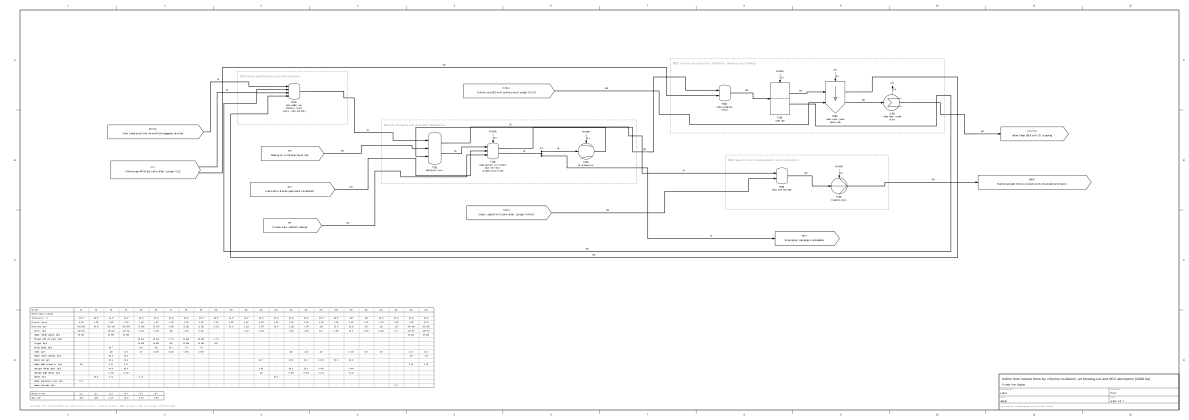
Iodine from natural iodide brine by chlorine oxidation, air blowing-out and SO2 absorption (1000 t/a)
An Oklahoma-type formation brine with 300 mg/kg iodide is acidified, chlorinated and blown out with circulating air; the iodine is absorbed in HI/H2SO4 liquor with SO2, re-liberated with chlorine, filtered, melted under sulfuric acid and flaked; the spent brine is neutralised and reinjected. Concept stage, assumed basis, preliminary gate-to-gate inventory.
Research outputNot engineering advice and not an approved design: do not use it for construction, operation or safety decisions. What this means
Overview
Raw brine (462 t/h, 300 mg/kg iodine as iodide, the average of the Woodward trench brines of
northwest Oklahoma) is acidified to about pH 2.4 by the plant's own recycled acid liquors and
chlorinated to an oxidation-potential end point. A packed tower blows the liberated iodine out
into a closed air loop (130 Nm3 air per m3 brine, 5 % purge); a second tower absorbs it in a
circulating hydriodic/sulfuric acid liquor into which SO2 is injected. A bleed of the liquor is
chlorinated again, the iodine precipitates, is filtered, melted under concentrated sulfuric
acid and flaked (99.8 wt% I2). Filtrate and spent melter acid return to the brine head; the
stripped brine is neutralised with caustic and pumped back into the formation. Overall
recovery 90 %.
All values are concept estimates. The route and its steps follow open patent backgrounds and
the Oklahoma Geological Survey; the design parameters (chlorine excess, stripping fraction,
air ratio, absorber and precipitation yields) are ASSUMED and come from the independent script
scripts/iodine_balance.py, whose neutral-molecule liquor basis is not an electrolyte model;
see DESIGN.md of the engineering files for every assumption and gated step.
Capacity
1000 t/a iodine flakes, 125 kg/h (ASSUMED)
Operation
8,000 h/a
Location
generic (Oklahoma-type brine; site not chosen)
Engineering gates
Concept and feasibility (no results yet)
Maintainers
Artur Schweidtmann
Design basis and assumptions (8)
ASSUMED brine acidified with the recycled filtrate and spent melter acid to pH about 2.4 (ideal estimate), inside the pH 1-3 of the blowing-out effluent (US 9,994,448 B2) and below the pH 3 above which iodine liberation is incomplete (US 1,897,031) (D-004).
ASSUMED chlorine 5 % over the iodide-to-iodine stoichiometry, dosed to an oxidation-potential end point; 98 % of the iodide oxidised (D-004).
ASSUMED 92 % of the liberated iodine blown out with 130 Nm3 circulating air per m3 brine at 313 K (US 1,897,031: 90-100 % removal in tower blowing-out); excess chlorine and CO2 completely stripped (D-005).
ASSUMED closed air loop between the blowing-out tower and the absorber with 5 % purge; 99.5 % of the iodine absorbed in HI/H2SO4 liquor with 2 % excess SO2; bleed at 10 wt% HI (D-005).
ASSUMED 99.5 % of the bleed's HI oxidised to iodine by chlorine and 99 % of the iodine precipitated; cake with 10 wt% mother liquor; filtrate recycled to the brine head (D-006).
ASSUMED melting under 98.5 wt% sulfuric acid, 0.2 kg H2SO4 per kg iodine, spent acid recycled to the brine head (D-006).
ASSUMED neutralisation of the spent brine's strong acid with 50 wt% caustic to neutral before reinjection at 3100 kPa(a) (D-009).
Overall recovery 90 % follows from these (cheme process streams; scripts/iodine_balance.py). The yields were chosen within sourced ranges so that the overall recovery equals the 90 % that US 2013/0243684 A1 states (about 30 mg/L returned then follows by arithmetic): a calibration to the patent, not an independent check (D-006).
Each reaction's page has the conversion, heat of reaction, catalyst and sources this process states, next to those of other processes with the same reaction. All reactions
Life cycle assessment
No footprint assessed yet; the process is part of the life-cycle inventory below.
Download it for Brightway, openLCA and other tools.
In the LCI database: system model, datasets and KPIs against the benchmarks
In the LCI database
Status
Preliminary 2 unmapped exchanges. Some exchanges have no background mapping yet: they are exported unlinked and count no burden, so the inventory is incomplete.
System model
attributional, cut-off (methodology 1.1.0)
Allocation
mass (single-output, from default) · product:IODINE 100 %
Allocation findings
none
Change report
Not available: this build has no change report against an earlier release.
KPI benchmark positions: not available (no benchmarked KPI for this process's datasets).
Maturity and review
Design maturity Concept (claimed): An idea or first flowsheet; numbers are rough. Concept PFD with closed mass, component and element balances (cheme validate, cheme process streams, cheme assess lca --balance: every element within 0.01 %). Only the brine iodine content (300 mg/kg, Oklahoma Geological Survey; US Bureau of Mines, Minerals Yearbook 1987) is sourced; the route steps follow patent backgrounds (US 2013/0243684 A1, US 4,282,324, US 1,897,031, US 9,994,448 B2); every flow, conversion and duty is ASSUMED or comes from scripts/iodine_balance.py. The yields were chosen within sourced ranges so that the overall recovery equals the 90 % that US 2013/0243684 A1 states (about 30 mg/kg iodine left then follows by arithmetic): the recovery is calibrated to the patent, not an independent check of the model. Energy closure is not evaluable in core (no electrolyte enthalpies). Not reviewed. Main products and feeds are listed under chemistry with their chemicals registry entries (issue #251).
Calculation maturity, from the checked evidenceNot assessed
The process has no maturity report (cheme maturity, checks/maturity.json), so no calculation maturity is established.
No level shownThe design maturity (Concept) is the manifest's claim, not evidence. A level appears here once the process's repository holds a current report from cheme maturity --write.
Artifact completeness
Which deliverables exist. They never raise a calculation maturity level: a drawing from unchecked numbers is still unchecked.
Not reported without a maturity report.
Independent review
Not independently reviewed
No independent engineering review yet. Automated checks passing is not a review.
Set by people only. Reaching a calculation maturity level or passing automated checks is not an independent review or an approval.
Where the evidence comes from
Report
processes/iodine-1/checks/maturity.json(not in the library)
Iodine and Iodine Compounds. Ullmann's Encyclopedia of Industrial Chemistry (Wiley-VCH); route reference lead, not audited in this run · doi:10.1002/14356007.a14_381.pub2
For the data, cite the Process Atlas paper; for the platform that builds and checks it, the ChemE-as-Code paper.
Schweidtmann, A. M. & Weber, J. M. (2026, in preparation). Process Atlas: an open, git-native, reproducible library and life cycle inventory of chemical processes (working title).
For this process: "Iodine from natural iodide brine by chlorine oxidation, air blowing-out and SO2 absorption (1000 t/a)", ChemE-as-Code process library, version c3ab348.
BibTeX
@unpublished{schweidtmann_process_atlas,
  author = {Schweidtmann, Artur M. and Weber, Jana M.},
  title = {{Process Atlas: an open, git-native, reproducible library and life cycle inventory of chemical processes (working title)}},
  year = {2026},
  url = {https://atlas.cheme-as-code.org},
  note = {in preparation}
}
Schweidtmann, A. M. (2026, in preparation). ChemE-as-Code: An Open-Source Platform for AI-Accelerated Chemical Process Engineering (working title).
BibTeX
@unpublished{schweidtmann_cheme_as_code,
  author = {Schweidtmann, Artur M.},
  title = {{ChemE-as-Code: An Open-Source Platform for AI-Accelerated Chemical Process Engineering (working title)}},
  year = {2026},
  url = {https://cheme-as-code.org},
  note = {in preparation}
}