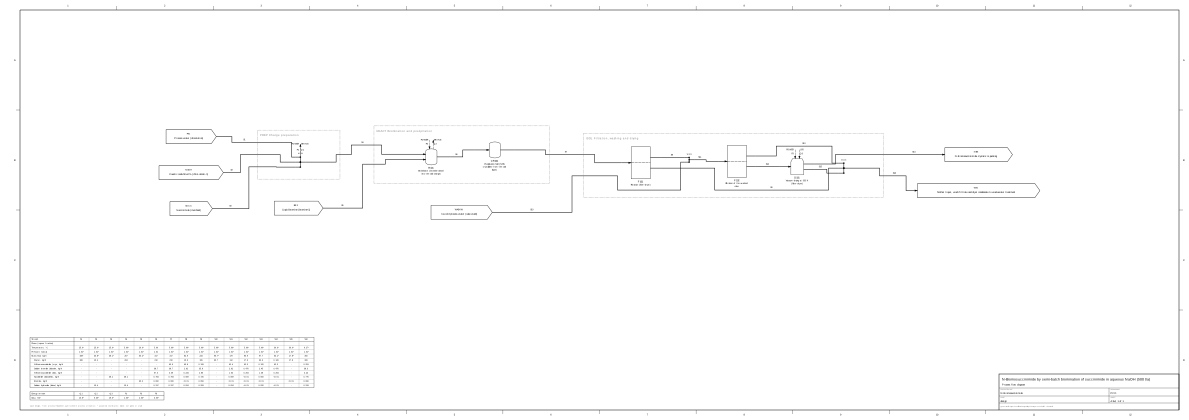
Succinimide and caustic soda (1.02 mol each per mol of bromine) are dissolved in water (30 mol per mol of bromine) and cooled to 278 K. Liquid bromine is dosed into the stirred charge over 2 h and reacts with the succinimide anion to N-bromosuccinimide and sodium bromide, the caustic route US 2 971 960 describes; the NBS precipitates from the cold liquor, which keeps 14.7 g per kg of water in solution. The slurry is filtered, the cake is reslurried with 1.5 kg of ice water per kg and filtered again, and dried at 333 K under vacuum in an agitated filter-dryer (two units, taking the batches in turn). The product is 99.0 wt% NBS with 0.75 wt% NaBr and 0.2 wt% water; the yield is 93.2 % on bromine. The mother liquor (15 wt% NaBr), the wash filtrate and the dryer condensate go to wastewater treatment: the bromide is not recovered.
The batch is modelled with cheme-as-code's semi-batch reactor (reactor: semibatch, core ADR 0050) and batch recipe (process/recipe.yaml, core ADR 0051): the dosing and post-reaction times come from the model, the brominator is the bottleneck (cycle 5.3 h, 1495 batches a year on a dedicated train), the recipe sizes the brominator (2 m3), and the flowsheet's flows are the recipe's year averages. The bromination's kinetics and heat of reaction are ASSUMED (no open data): a fast second-order reaction, so the bromine accumulates little (3.75 % at most, at the end of the dosing, as the imide's excess runs low) and the cooling-failure temperature stays within 1 K of the process temperature; this must be confirmed by reaction calorimetry. See DESIGN.md for every assumption.