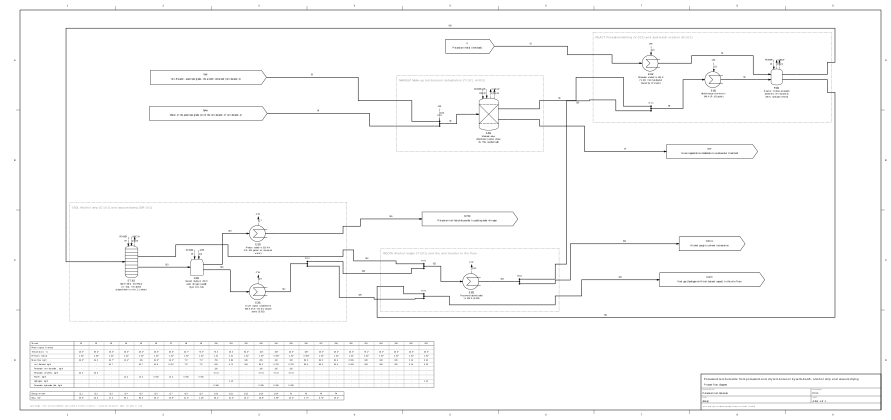
The route is the classic one: potassium metal with dry tert-butanol in excess (Wikipedia, Potassium tert-butoxide; Organic Syntheses, Coll. Vol. 4, 132 and Coll. Vol. 5, 1060, where the molten metal disperses in the stirred alcohol and dissolves at a rate set by the stirring, the alcohol refluxing and hydrogen leaving), with the excess alcohol distilled off and the solid heated (Wikipedia; US 4 577 045 A dries its product at 160 C and 10 mbar). The KOH route with azeotropic water removal (US 4 577 045 A, US 5 053 560 A) and the amalgam route (US 6 150 569 A) are recorded as alternatives (DESIGN.md D-001). Per mol of potassium 8.6 mol of tert-butanol are charged (Organic Syntheses, Coll. Vol. 4, 132), so that the alkoxide stays dissolved at 16.6 wt% (US 4 577 045 A runs its solution at 10-18 wt%, ASSUMED to hold at 348 K). The make-up arrives as the azeotrope with 11.76 wt% water (US 5 053 560 A); tert-butanol-1 counts the alcohol contained and leaves out the drying past the azeotrope, so this plant dries it on a vapour-phase 3A molecular sieve (ASSUMED design, a specified split from scripts/makeup_drying.py) to 0.1 wt% water, which the potassium then takes to KOH. The modelled product is 99.47 wt% KOtBu, 0.23 wt% KOH and 0.30 wt% tert-butanol, an upper bound on the assay (the metal's sodium, moisture picked up in handling and any decomposition are not modelled; no open product specification was read). The modelled yield is 99.5 % on potassium (the rest is KOH) and 89.5 % on the tert-butanol bought: 5.7 % of it goes to the flare (with the hydrogen and the dryer's nitrogen bleed), 3.4 % with the purge, 1 % with the sieve's regeneration and 0.4 % with the product.
The batch is modelled with cheme-as-code 1.10.0: the reactor R101 is a semi-batch (reactor: semibatch) whose hydrogen leaves by a vent as it forms (batch.vent, core ADR 0054), saturated with the alcohol's vapour through a vent condenser at 308 K, on tempered water at 303/313 K so that no alcohol freezes on its tubes, whose condensate returns (vent vapour and condenser, core ADR 0062); the still is core's batch still with the charge's heat-up and the vessel's metal (core ADRs 0055, 0063), its reboiler and condenser duties written by the model (core ADRs 0059, 0061); the paddle dryer is core's dryer to a residual alcohol content (core ADR 0057); the alcohol loop converges at its tear (core ADR 0060). The recipe gives the cycle (6.586 h, R-101 the bottleneck, 1202 batches a year), sizes the vessels and checks R-101's jacket. Kinetics and heats of reaction are ASSUMED (no open data): the dispersed metal accumulates to 3.1 % and the cooling-failure temperature reaches 350.1 K against an MTT of 355.45 K (tert-butanol's boiling point), the gas released with the liquid's vapour 133.4 m3/h against an ASSUMED vent capacity of 200 m3/h (core ADR 0058); a ten times slower rate takes the MTSR to 366.9 K, above the MTT: the alcohol would boil in a cooling failure. The hydrogen and the potassium's reaction with water are the plant's main hazards (DESIGN.md D-011).