
Alumina by the Bayer process (3000 t/d smelter-grade alumina, concept)

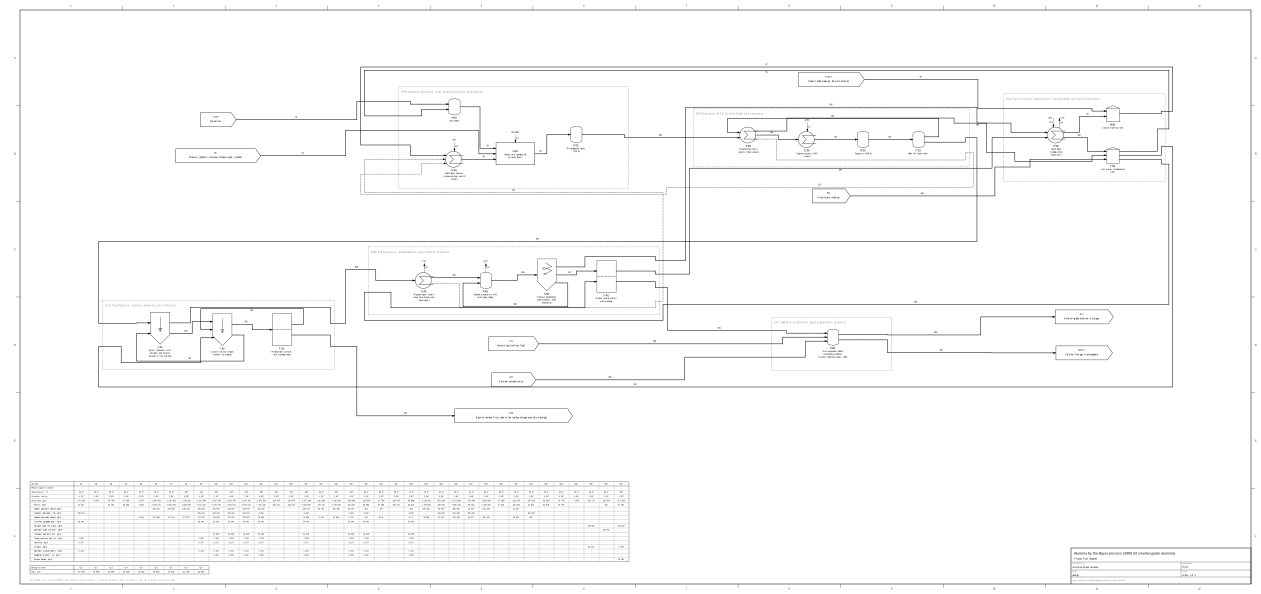
Smelter-grade alumina from Guinean gibbsitic bauxite by the Bayer process: low-temperature caustic digestion, red mud settling, washing and filtration, seeded gibbsite precipitation, spent liquor evaporation and gas suspension calcination; caustic and lime make-up, bauxite residue and calciner CO2 explicit. Concept stage, assumed liquor basis.

Calculation maturity: not assessedDesign maturity: Concept (research)Not independently reviewedAluminiumReport a problem with this process
Research outputNot engineering advice and not an approved design: do not use it for construction, operation or safety decisions. What this means

Overview

Bauxite (Debele/Balaya plateau type, 54.7 wt% Al2O3, 0.76 wt% SiO2, sourced assay) is ground in spent liquor with milk of lime, pre-desilicated at 373 K and digested at 418 K, where the gibbsite dissolves as sodium aluminate. The blow-off is flashed (the flash vapour preheats the slurry), the residue settles, is washed counter-currently and leaves as filter cake for dry stacking. The pregnant liquor is cooled and seeded; gibbsite precipitates, is classified (seed recycle), filtered, washed and calcined with natural gas to alumina. The spent liquor is evaporated, made up with caustic soda and returned to the mill: the defining recycle.

All flows are concept estimates from an independent sequential balance on assumed liquor ratios (A/C 0.70 blow-off, 0.38 spent; caustic 250 g/L as Na2CO3), washing and cake parameters: no caustic aluminate speciation or gibbsite solubility is calculated. Lime dose and electricity are IAI 2019 global averages; calciner energy is a sourced specific energy (cheme process furnace refuses gibbsite). See DESIGN.md.
Capacity
3000 t/d smelter-grade alumina (ASSUMED normalisation basis)
Operation
8,400 h/a
Location
generic (not chosen)
Engineering gates
Concept and feasibility (no results yet)
Maintainers
Artur Schweidtmann
Design basis and assumptions (8)
  • ASSUMED low-temperature digestion at 418 K (gibbsitic bauxite; 413-423 K per ICSOBA 2024 paper AA05), 98 % of the gibbsite dissolved, diaspore/boehmite and quartz not attacked (D-004).
  • ASSUMED liquor: spent caustic 250 g/L as Na2CO3, A/C 0.38 spent and 0.70 at blow-off, density 1.30 kg/L for every liquor (D-004, D-006).
  • ASSUMED kaolinite fully converted to DSP carried as hydroxysodalite Na8Al6Si6O24(OH)2; all lime leaves as TCA (D-004).
  • ASSUMED settler underflow 2.0, washer underflow 1.0 and residue cake 0.43 kg liquor/kg solids; 6 ideal CCD stages at wash ratio 1.6 (D-005).
  • ASSUMED seed charge 250 g/L, slurries 1 kg liquor/kg hydrate, hydrate cake 8 wt% free water, hydrate wash 0.25 kg/kg; occluded soda sets the product's 0.40 % Na2O (D-006).
  • ASSUMED heat model: liquor cp 3.35 and solids cp 1.0 kJ/kg K, 3 flash/regenerative stages with 5 K approach, 70 % of the pregnant liquor cooler duty recovered, evaporator economy 3.0 (D-007).
  • ASSUMED calciner specific energy 2.8 GJ/t alumina LHV (ICSOBA 2017 paper AA22: about 2.72 GJ/t for gas suspension calciners), air excess 1.15 (D-008).
  • No electrolyte thermodynamics: liquors are carried as neutral NaOH + NaAlO2 + H2O; no property package covers the streams; carbonate, oxalate, organics and other impurities are not carried (D-006).

From process/design-basis.yaml.

Engineering model

Loading the drawing…
Drawing of the process (preview)Open the engineering model

The interactive model (drawings, streams, 3D) is made for larger screens.

Snapshot of c3ab348, cheme-as-code 1.6.0.

What goes in and out

In

  • BauxiteFeedstockfeed:BX: gibbsitic bauxite, crushed, 2.19 kg/kg alumina
  • Calcium oxideFeedstockfeed:LIME: quicklime, 0.052 kg/kg
  • Sodium hydroxideFeedstockfeed:NAOH: caustic soda make-up, 50 wt% solution, counted by mass of the solution
  • MethaneFeedstockfeed:NG: calciner natural gas, taken as methane (D-008)
  • WaterFeedstockFresh water make-up to the hot water tank
  • AirFeedstockCalciner combustion air

Out

Utilities: Electricity, Steam (MP steam 1000 kPa(a), digestion heaters, counted as heat delivered), Steam (LP steam 450 kPa(a), liquor heater trim and evaporators, counted as heat delivered), Cooling water (25/35 C (ASSUMED))

Show in the process graph

Reactions

IdAs writtenReactionOther processes
CALC2 Al(OH)3(s) → Al2O3(s) + 3 H2O(g) · Hydrate calcination2Al(OH)3givesAl2O3+3H2O
COMBCH4 + 2 O2 → CO2 + 2 H2O(g) · Natural gas combustion (calciner)CH4+2O2givesCO2+2H2O9 other processes
DESIL3 Al2Si2O5(OH)4(s) + 8 NaOH(aq) → Na8Al6Si6O24(OH)2(s) + 9 H2O(l) · Desilication (kaolinite to sodalite-type desilication product)3Al2Si2O5(OH)4+8NaOHgivesDSP+9H2O
DIGAl(OH)3(s) + NaOH(aq) → NaAlO2(aq) + 2 H2O(l) · Gibbsite digestionAl(OH)3+NaOHgivesNaAlO2+2H2O
PRECNaAlO2(aq) + 2 H2O(l) → Al(OH)3(s) + NaOH(aq) · Seeded gibbsite precipitationNaAlO2+2H2OgivesAl(OH)3+NaOH
SLAKECaO(s) + H2O(l) → Ca(OH)2(s) · Lime slakingCaO+H2OgivesCaH2O22 other processes
SODA2 NaOH → Na2O(s) + H2O(g) · Occluded soda fixed as Na2O in the calciner2NaOHgivesNa2O+H2O
TCA3 Ca(OH)2(s) + 2 NaAlO2(aq) + 4 H2O(l) → Ca3Al2(OH)12(s) + 2 NaOH(aq) · Lime in aluminate liquor to tricalcium aluminate3CaH2O2+2NaAlO2+4H2OgivesCa3Al2(OH)12+2NaOH

Each reaction's page has the conversion, heat of reaction, catalyst and sources this process states, next to those of other processes with the same reaction. All reactions

Life cycle assessment

Footprint not publishedThe process changed since the LCA was last run; its values return once it is run again. Method, functional unit and inventory are below.
Method and data
Goal
Preliminary foreground (gate-to-gate) life cycle inventory of smelter-grade alumina by the Bayer process at the concept stage: which raw materials, utilities, emissions and wastes the balanced flowsheet implies per kg of product, ready to be linked to background datasets later. Flows are concept estimates on assumed design parameters (DESIGN.md D-003..D-008).
Functional unit
1 kg Smelter-grade alumina (1 kg aluminium oxide)
Boundary
cradle-to-gate
Allocation
none
Characterisation
Factors kept with the process · GWP100
Data quality
Published factors
Result
partial screening carbon footprint · 10 data gaps

Inventory per 1 kg Smelter-grade alumina (17 flows)

FlowPhaseDirectionQuantityUnitProvenance
Bauxite, gibbsitic (Guinea, Debele type), crushedoperationinput2.193kgassumed
Quicklimeoperationinput0.052kgassumed
Caustic soda make-up, 50 wt% solutionoperationinput0.03096kgassumed
Fresh water make-upoperationinput0.1342kgassumed
Natural gas (calciner fuel)operationinput0.056kgassumed
Calciner combustion airoperationinput1.11kgassumed
MP steam 1000 kPa(a) to the digestion heaters (condensate returned)operationinput0.462kWhassumed
LP steam 450 kPa(a) to the liquor heater and the evaporators (condensate returned)operationinput0.2096kWhassumed
Electric poweroperationinput0.152kWhassumed
Smelter-grade alumina to storageoperationoutput1kgassumed
Bauxite residue filter cake to the residue storage area (dry stacking)operationoutput0.7585kgassumed
Calciner flue gas to atmosphereoperationoutput1.818kgassumed
Cooling water returnoperationoutput0.567kWhassumed
CO2 to the environmentoperationoutput0.1536kgassumed
H2O to the environmentoperationoutput0.7779kgassumed
N2 to the environmentoperationoutput0.8533kgassumed
O2 to the environmentoperationoutput0.03351kgassumed

Computed by ChemE-as-Code from lca/README.md, lca/dataset.yaml, lca/factors.yaml, lca/gaps.csv, lca/inventory.csv, lca/lca.yaml, lca/mappings.yaml, lca/results.csv, lca/results.md, lca/uncertainty.csv.

In the open LCI database (cheme-as-code-atlas-preview-c3ab348) as Aluminium oxide, Smelter-grade alumina to storage Preliminary.

Download it for Brightway, openLCA and other tools.

In the LCI database: system model, datasets and KPIs against the benchmarks

In the LCI database

Status
Preliminary 3 unmapped exchanges. Some exchanges have no background mapping yet: they are exported unlinked and count no burden, so the inventory is incomplete.
System model
attributional, cut-off (methodology 1.1.0)
Allocation
none (single-output, from study) · product:ALU 100 %
Allocation findings
none
Change report
Not available: this build has no change report against an earlier release.
Dataset pages
Aluminium oxide, Smelter-grade alumina to storage Preliminary

KPI benchmark positions: not available (no benchmarked KPI for this process's datasets).

Maturity and review

Design maturity Concept (claimed): An idea or first flowsheet; numbers are rough. Concept BFD/PFD with closed mass, component and element balances (cheme validate, cheme process streams: 6 blocks, 19 steps, reactive balances by extents for 8 reactions). All flows and compositions are specified values of an independent balance (scripts/bayer_balance.py) on assumed design parameters; no electrolyte speciation or gibbsite solubility is calculated, and no property package covers the liquors and solids, so energy closure is not evaluable in core: the duties are a lumped script estimate. The calciner uses a sourced specific energy (gibbsite calcination is refused by cheme process furnace, core's furnace energy covers limestone only). The gate-to-gate LCI is preliminary, with every background unmapped. Not reviewed.

Calculation maturity, from the checked evidenceNot assessed

The process has no maturity report (cheme maturity, checks/maturity.json), so no calculation maturity is established.

No level shownThe design maturity (Concept) is the manifest's claim, not evidence. A level appears here once the process's repository holds a current report from cheme maturity --write.

Artifact completeness

Which deliverables exist. They never raise a calculation maturity level: a drawing from unchecked numbers is still unchecked.

Not reported without a maturity report.

Independent review

Not independently reviewed

No independent engineering review yet. Automated checks passing is not a review.

Set by people only. Reaching a calculation maturity level or passing automated checks is not an independent review or an approval.

Where the evidence comes from
Report
processes/alumina-1/checks/maturity.json (not in the library)
Design basis
process/design-basis.yaml
Method
How ChemE-as-Code checks the levels (requirement by requirement)

Open items

Sources

Engineering project
Alumina (Bayer process) · cheme-as-code>=0.8
Library version
c3ab348 (process last changed in c3ab348)
Drawings rendered by
cheme 1.6.0 (pyDEXPI 2.1.0)
Data
Catalog record (JSON) · CC-BY-4.0
Files
View the files on GitHub · change history and authors

References

How to cite

For the data, cite the Process Atlas paper; for the platform that builds and checks it, the ChemE-as-Code paper.

Schweidtmann, A. M. & Weber, J. M. (2026, in preparation). Process Atlas: an open, git-native, reproducible library and life cycle inventory of chemical processes (working title).

For this process: "Alumina by the Bayer process (3000 t/d smelter-grade alumina, concept)", ChemE-as-Code process library, version c3ab348.

BibTeX
@unpublished{schweidtmann_process_atlas,
  author = {Schweidtmann, Artur M. and Weber, Jana M.},
  title = {{Process Atlas: an open, git-native, reproducible library and life cycle inventory of chemical processes (working title)}},
  year = {2026},
  url = {https://atlas.cheme-as-code.org},
  note = {in preparation}
}

Schweidtmann, A. M. (2026, in preparation). ChemE-as-Code: An Open-Source Platform for AI-Accelerated Chemical Process Engineering (working title).

BibTeX
@unpublished{schweidtmann_cheme_as_code,
  author = {Schweidtmann, Artur M.},
  title = {{ChemE-as-Code: An Open-Source Platform for AI-Accelerated Chemical Process Engineering (working title)}},
  year = {2026},
  url = {https://cheme-as-code.org},
  note = {in preparation}
}