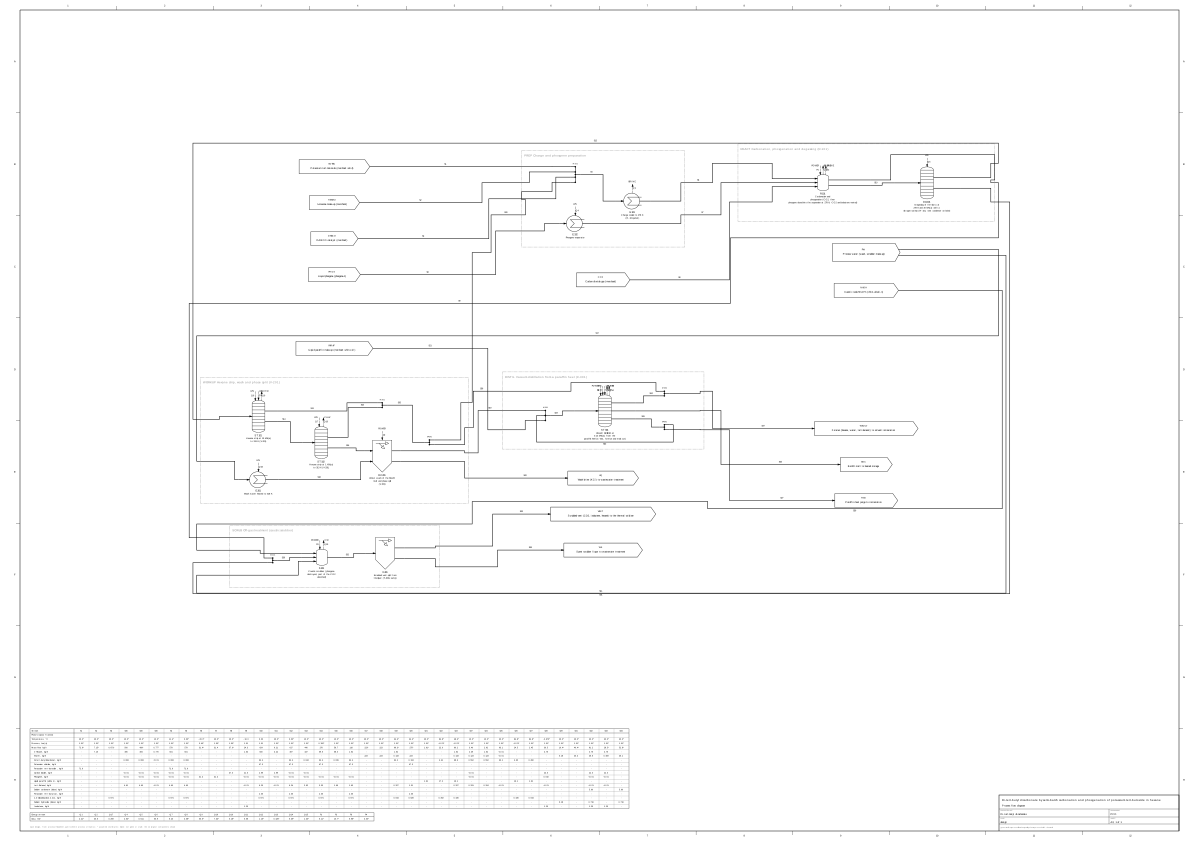
The route is the one-pot phosgene route of EP 0 256 559 A2 (Mitsubishi Kasei, 1986/1988): per mol of potassium tert-butoxide 1.3 mol of CO2 (US 5 151 542 A, Example 1: 4 mol on 3) and 0.49 mol of phosgene (EP Examples 6-7 use 0.54; a 2 % deficit on the net reaction's 0.5 is ASSUMED, so that no phosgene is left for the work-up), with 1.2 mol% DABCO (EP Example 1). The carbonate forms from the suspended alkoxide and the dissolved CO2 (85 % of the dose taken up, the rest vented); the phosgene and the amine give Boc2O, KCl and CO2 directly (the patent's point: no tricarbonate is isolated), 7 % of the phosgene going to a lumped side path to tert-butanol, isobutene and CO2 (ASSUMED). The patent's own example runs in THF; hexane, an aliphatic hydrocarbon within its claimed solvents and the Sumitomo patent's solvent, is ASSUMED here so that the KCl is washed out with water after the solvent strip and no THF must be swapped out. The slurry is degassed with a nitrogen sweep, the hexane stripped at 15 and then 1 kPa(a) at up to 313 K (both patents keep Boc2O below 50 C when the solvent is removed), the melt washed with warm water and split from the KCl brine, and the Boc2O distilled at 0.13 kPa(a) from a liquid paraffin, which EP 0 256 559 A2 adds to suppress decomposition; the heel returns to the next batch with a 10 % purge. The modelled yield is 89.4 % on the alkoxide and 91.2 % on phosgene: below the 91.0 % EP 0 256 559 A2's Example 1 gives by mass (149 g from 1.5 mol, its purity not stated in the text), so that source bounds it from above. The modelled product is 99.98 wt% Boc2O, an upper bound: di-tert-butyl carbonate, the tricarbonate and other by-products are not modelled (US 5 151 542 A reports 98.6 to 99.7 % for its route).
The batch is modelled with cheme-as-code 1.10.0: R101 is a semi-batch (reactor: semibatch) with two gas doses (dosing.absorbed, with their heats of solution, core ADR 0063) and a vent for the CO2 and isobutene (batch.vent, core ADR 0054) that carries the slurry's hexane and phosgene vapour through R-101's vent condenser (vent.vapour, vent.condenser, ADR 0062); the degassing and the three distillations are core's batch stills (ADR 0055), the first strip with its charge's heat-up; both recycles, the recovered hexane and the paraffin heel, are tear streams converged by propagate (ADR 0060); the semi-batch's, its vent condenser's and the stills' duties come from their models (ADR 0059). The recipe gives the cycle (10.39 h, R-101 the bottleneck, 762.5 batches a year), sizes R-101, V-201 (12.5 m3 each) and C-301 (1.6 m3) and checks R-101's jacket (98.4 kW against the model's 73.8 kW peak). Kinetics and heats of reaction are ASSUMED (no open data): the phosgene accumulates 2.7 % at the end of its dosing (36.1 % at k/100); the MTSR is 279.5 K against an MTT of 333.15 K, the decomposition limit (Boc2O's precursors gave vigorous gas at 60-70 C, US 5 151 542 A), and a cooling failure releases at most 24.5 m3/h of gas with its vapour against the vent's 50 m3/h (52.9 m3/h at k/100, 1.06 of it: a design finding). No TD24 is known: no class. See DESIGN.md for every assumption.