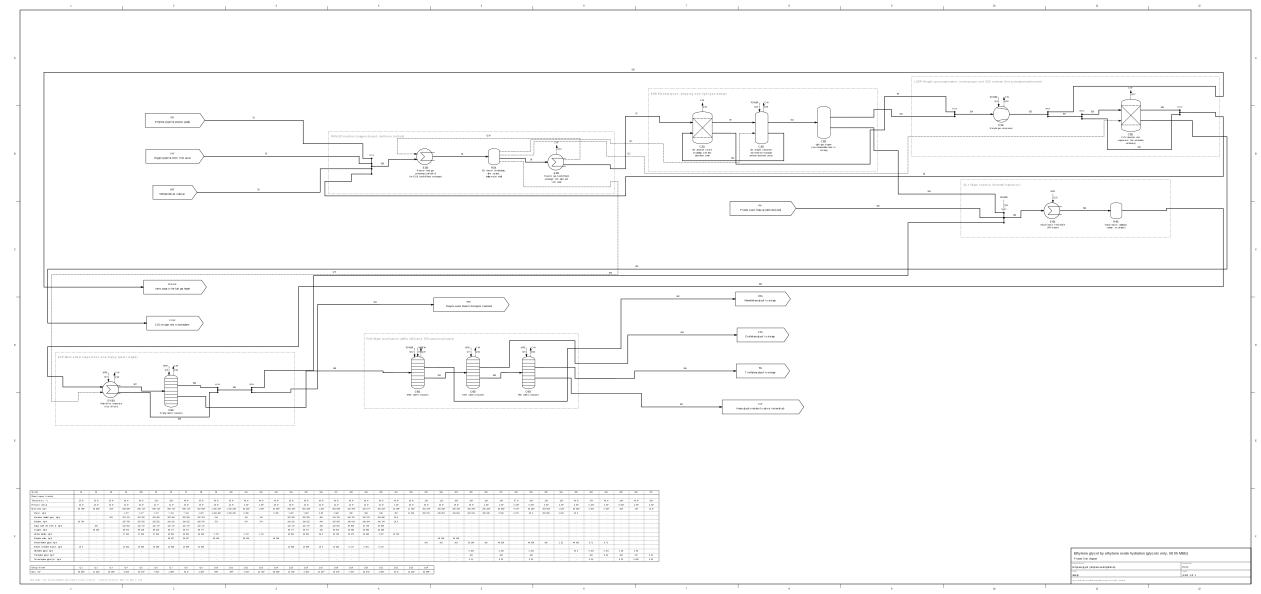
Ethylene and pipeline oxygen to ethylene oxide over silver with methane ballast, water absorption and stripping, hot-carbonate CO2 removal, thermal hydration with excess water, multi-effect evaporation and vacuum distillation to MEG, DEG and TEG. Concept stage, assumed basis, preliminary gate-to-gate inventory.
Research outputNot engineering advice and not an approved design: do not use it for construction, operation or safety decisions. What this means
Overview
A glycols-only EO/EG plant (no high-purity EO product). Fresh ethylene, oxygen (the library's
asu-1 GOX) and methane ballast join the recycle gas; the multitubular EO reactor converts 9 %
of the ethylene per pass at 85 % selectivity (inside the ranges of the EU BREF on large volume
organic chemicals, 2017) and raises steam on its shell. EO is absorbed in water and stripped,
a slip stream of the recycle gas loses its CO2 in hot potassium carbonate, and 0.15 % of the
gas is purged to fuel. The aqueous EO is hydrated with 20 mol water per mol EO without
catalyst; the water is removed in a four-effect evaporator and a drying column and recycled
with a bleed; vacuum columns give MEG, DEG and TEG and a small heavy glycols residue.
All flows come from an independent sequential balance (scripts/eg_balance.py) on assumed
parameters; cheme closes every block and step balance and checks the reactors by elements.
Duties are a lumped estimate: no property package covers the streams. See
DESIGN.md of the engineering files for every assumption and gated step.
Capacity
1200 t/d MEG (50 t/h; ASSUMED normalisation basis)
Operation
8,000 h/a
Location
generic (not chosen)
Engineering gates
Concept and feasibility (no results yet)
Maintainers
Artur Schweidtmann
Design basis and assumptions (6)
ASSUMED per-pass ethylene conversion 9 % and EO selectivity 85 mol% (BREF LVOC 2017 7.2.1.1.1: 8-10 % and 75-90 %), D-004.
ASSUMED inerts purge 0.15 % of the recycle gas (BREF 7.2.2.1: 0.1-0.2 %), CO2 removal 90 % of the slip stream by hot potassium carbonate, D-004.
ASSUMED water:EO 20 mol/mol at the glycol reactor inlet, full EO conversion, relative rate of EO with glycols vs water 2.0 per mol (consecutive model), D-005; result 92.0 wt% MEG in the glycols (BREF 7.2.2.5: 75-92 wt%).
ASSUMED 0.5 % bleed of the recycle water, 4-effect evaporation (economy 3.2), vacuum drying and three vacuum glycol columns, D-005, D-008.
No property package covers EO-water-glycol or the loop gas: duties from a lumped estimate in scripts/eg_balance.py (D-007, D-008).
Carbon dioxideEmissionCO2 of the ethylene burnt in the EO reactor, vented from the carbonate regenerator
WastewaterWaste0.5 % bleed of the recycle water (0.1 wt% MEG) to biological treatment
Utilities:Electricity (Recycle gas compressor, pumps, auxiliaries (ASSUMED electric drives)), Steam (MP steam 2800 kPa(a) import (heat delivered) net of the steam raised in the EO reactor and used in the plant), Cooling water (25/35 C (ASSUMED))
Each reaction's page has the conversion, heat of reaction, catalyst and sources this process states, next to those of other processes with the same reaction. All reactions
Life cycle assessment
0.264kg CO2-eqPreliminarypartial, 11 data gaps
Climate change per 1 kg Monoethylene glycol, cradle-to-gate
Main contributors
CO2 to the environment95.9 %
CH4 to the environment4.1 %
Contributions, baseline
Each flow of the inventory into its phase, the phases into the functional unit; band widths are impacts. Hatched: a credit.
Method and data
Goal
Preliminary foreground (gate-to-gate) life cycle inventory of monoethylene glycol by direct oxidation of ethylene to ethylene oxide and thermal hydration, at the concept stage: which raw materials, utilities, emissions and wastes the balanced flowsheet implies per kg of MEG, ready to be linked to background datasets later. Flows are concept estimates on assumed design parameters inside the BREF LVOC 2017 ranges (DESIGN.md D-004 to D-008).
Functional unit
1 kg Monoethylene glycol (1 kg ethylene glycol (monoethylene glycol))
Boundary
cradle-to-gate
Characterisation
Factors kept with the process · GWP100
Data quality
Published factors
Result
partial screening carbon footprint · 11 data gaps
Scenario
Climate change (kg CO2-eq)
baseline
0.2636
Inventory per 1 kg Monoethylene glycol (20 flows)
Flow
Phase
Direction
Quantity
Unit
Provenance
Ethylene (pipeline polymer grade)
operation
input
0.548
kg
assumed
Oxygen (pipeline GOX from asu-1)
operation
input
0.5434
kg
assumed
Methane ballast make-up
operation
input
0.009254
kg
assumed
Process water make-up (demineralised)
operation
input
0.212
kg
assumed
MP steam 2800 kPa(a) import
operation
input
1.01
kWh
assumed
Electric power
operation
input
0.1244
kWh
assumed
Monoethylene glycol to storage
operation
output
1
kg
assumed
Diethylene glycol to storage
operation
output
0.08336
kg
assumed
Triethylene glycol to storage
operation
output
0.003566
kg
assumed
Heavy glycols residue (to sale or incineration)
operation
output
0.0002686
kg
assumed
Inerts purge to the fuel gas header
operation
output
0.02358
kg
assumed
CO2 stripper vent to atmosphere
operation
output
0.2607
kg
assumed
Recycle water bleed to biological treatment
operation
output
0.02805
kg
assumed
Cooling water return
operation
output
3.144
kWh
assumed
C2H4 to the environment
operation
output
0.0003598
kg
assumed
CH4 to the environment
operation
output
0.0003598
kg
assumed
CO2 to the environment
operation
output
0.2529
kg
assumed
H2O to the environment
operation
output
0.007121
kg
assumed
Silver EO catalyst on alumina (replacement charge, averaged)
operation
input
0.000144
kg
assumed
Disposal: Silver EO catalyst on alumina (replacement charge, averaged) (silver recovery from the spent catalyst at a precious-metal reclaimer (BREF LVOC 2017 7.3.6.3))
operation
output
0.000144
kg
assumed
Computed by ChemE-as-Code from lca/README.md, lca/dataset.yaml, lca/factors.yaml, lca/gaps.csv, lca/inventory.csv, lca/lca.yaml, lca/mappings.yaml, lca/results.csv, lca/results.md, lca/uncertainty.csv.
Download it for Brightway, openLCA and other tools.
In the LCI database: system model, datasets and KPIs against the benchmarks
In the LCI database
Status
Preliminary 4 unmapped exchanges. Some exchanges have no background mapping yet: they are exported unlinked and count no burden, so the inventory is incomplete.
System model
attributional, cut-off (methodology 1.1.0)
Allocation
mass (deviation, from study) · product:DEG 7.7 %, product:MEG 92 %, product:TEG 0.33 %
Allocation findings
none
Change report
Not available: this build has no change report against an earlier release.
KPI benchmark positions: not available (no benchmarked KPI for this process's datasets).
Maturity and review
Design maturity Concept (claimed): An idea or first flowsheet; numbers are rough. Concept PFD with closed mass, component and element balances (cheme validate, cheme process streams: every block and step within tolerance; reactors checked by elements and extents). The flows are from an independent sequential balance (scripts/eg_balance.py) on ASSUMED parameters set inside the ranges of the BREF LVOC 2017 chapter 7 (per-pass conversion, EO selectivity, purge share, MEG share of the crude glycols); the glycol split rests on a consecutive-reaction model with an ASSUMED relative rate, not on sourced kinetics. Duties are a lumped estimate (latent heats, reflux ratios, evaporator economy, carbonate regeneration heat all ASSUMED); energy closure is not evaluable in core (no property package covers EO-water-glycol or the loop gas). Preliminary gate-to-gate LCI with every background unmapped (gaps). cheme maturity reaches no calculation level (feeds assumed, not sourced; reactors and separators specified, not predicted), as methanol-1; concept is the lowest level the manifest can state; the resulting warning cheme.maturity-claim-exceeds is accepted with this reason (DESIGN.md D-012). An agent review (reviews/2026-10-28-pfd-lci-review.md) found the energy estimate understated: the E-101 feed/effluent exchanger and the glycol feed heater are now modelled, and the MP steam import is 3.95 GJ/t MEG (was 1.62, D-008); the consumables are declared in the LCA (D-010). No human review yet. Main products and feeds are listed under chemistry with their chemicals registry entries (issue #251).
Calculation maturity, from the checked evidenceNot assessed
The process has no maturity report (cheme maturity, checks/maturity.json), so no calculation maturity is established.
No level shownThe design maturity (Concept) is the manifest's claim, not evidence. A level appears here once the process's repository holds a current report from cheme maturity --write.
Artifact completeness
Which deliverables exist. They never raise a calculation maturity level: a drawing from unchecked numbers is still unchecked.
Not reported without a maturity report.
Independent review
Not independently reviewed
No independent engineering review yet. Automated checks passing is not a review.
Set by people only. Reaching a calculation maturity level or passing automated checks is not an independent review or an approval.
Where the evidence comes from
Report
processes/ethylene-glycol-1/checks/maturity.json(not in the library)
Rebsdat, S.; Mayer, D. (2001) Ethylene Glycol. Ullmann's Encyclopedia of Industrial Chemistry (route lead, not audited in this run) · doi:10.1002/14356007.a10_101
How to cite
For the data, cite the Process Atlas paper; for the platform that builds and checks it, the ChemE-as-Code paper.
Schweidtmann, A. M. & Weber, J. M. (2026, in preparation). Process Atlas: an open, git-native, reproducible library and life cycle inventory of chemical processes (working title).
For this process: "Ethylene glycol by ethylene oxide hydration (glycols-only EO/EG plant, 1200 t/d MEG)", ChemE-as-Code process library, version c3ab348.
BibTeX
@unpublished{schweidtmann_process_atlas,
  author = {Schweidtmann, Artur M. and Weber, Jana M.},
  title = {{Process Atlas: an open, git-native, reproducible library and life cycle inventory of chemical processes (working title)}},
  year = {2026},
  url = {https://atlas.cheme-as-code.org},
  note = {in preparation}
}
Schweidtmann, A. M. (2026, in preparation). ChemE-as-Code: An Open-Source Platform for AI-Accelerated Chemical Process Engineering (working title).
BibTeX
@unpublished{schweidtmann_cheme_as_code,
  author = {Schweidtmann, Artur M.},
  title = {{ChemE-as-Code: An Open-Source Platform for AI-Accelerated Chemical Process Engineering (working title)}},
  year = {2026},
  url = {https://cheme-as-code.org},
  note = {in preparation}
}