
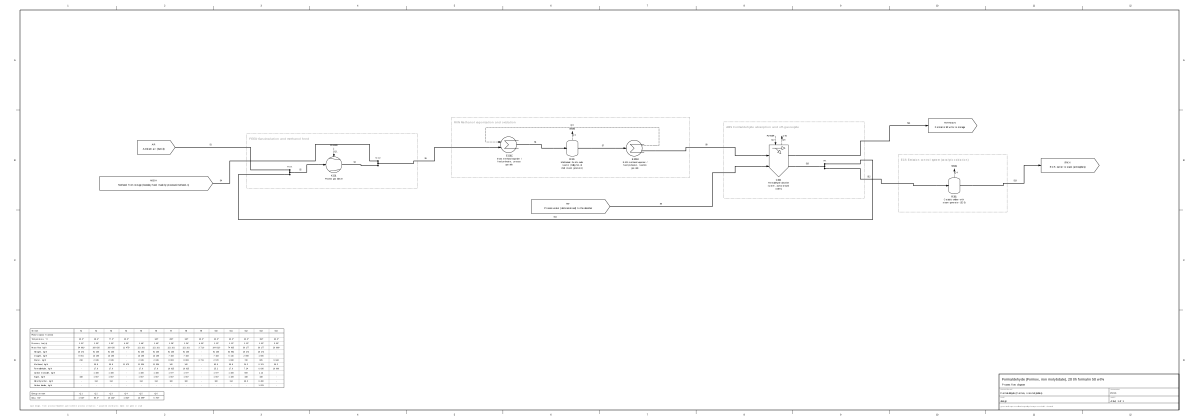
Fresh air and recycled absorber off-gas are drawn through one blower, liquid methanol is injected and vaporised against the hot reaction gas, and the 8.5 mol% methanol feed reacts in a multitubular reactor whose boiling hot-oil shell raises MP steam. The reactor is a conversion model whose per-pass conversion and selectivities (formaldehyde, CO, dimethyl ether) reproduce the open plant ranges of the EU BREF on large volume organic chemicals (2017): yield 93 % on methanol, conversion above 99 %. It is not kinetics. The absorber, the liquid-side heats and all duties come from an independent balance script; core has no qualified property method for aqueous formaldehyde, so the energy balance is not checked by cheme. Methanol is a boundary feed (processes/methanol-1 makes it in this library).
Formaldehyde by methanol oxidation over iron molybdate (Formox type, 20 t/h formalin 50 wt%)
Methanol is vaporised into a recycle-diluted air stream, oxidised over an iron molybdate catalyst below the explosion limit, and the formaldehyde absorbed in water to 50 wt% formalin; the vent is cleaned in a catalytic oxidiser and both the reactor and the oxidiser raise steam. Concept stage, assumed basis, preliminary gate-to-gate inventory.
Overview
- Capacity
- 20 t/h formalin 50 wt% = 80 000 t/a HCHO (100 %) at 8000 h/a (ASSUMED)
- Operation
- 8,000 h/a
- Location
- generic (not chosen)
- Engineering gates
- Concept and feasibility (no results yet)
- Maintainers
- Artur Schweidtmann
Design basis and assumptions (8)
- Route: metal oxide (Formox type) partial oxidation of methanol with excess air below the lower explosion limit, off-gas recycle, absorption in water, catalytic oxidation of the vent (ECS) (D-001).
- Reactor model: conversion reactor with a per-pass methanol conversion and selectivities chosen to reproduce the plant yield of 93 % on methanol (BREF LVOC 2017 Table 6.10: 91-94 %) and a plant methanol conversion of 99.3 % (BREF s. 6.2.3: > 99 mol%); not kinetics (D-004).
- ASSUMED reactor inlet 8.5 mol% methanol (EPA-450/4-91-012: 5-10 vol%) and absorber off-gas 6.0 mol% O2 (BREF Table 6.6: 5-7 %); these two fix the fresh air and the recycle (D-005).
- ASSUMED blower 100.5 -> 150 kPa(a), isentropic efficiency 0.75, motor 0.95 (D-007).
- ASSUMED reactor outlet 553.15 K, reaction gas to absorber 403.15 K, absorber off-gas 303.15 K and 112 kPa(a) saturated with water, product 333.15 K (D-005, D-006).
- ASSUMED heat of solution of gaseous formaldehyde in water 62 kJ/mol, to be sourced (D-006).
- ASSUMED ECS conversions CO 99.8 %, HCHO 99.5 %, CH3OH 99.5 %, DME 99.0 %; stack 423.15 K (D-008).
- All flows, temperatures and duties are concept estimates; the energy balance rests on ideal-gas enthalpies and assumed liquid-side heats, not on a qualified property method (D-009).
From process/design-basis.yaml.
Engineering model
What goes in and out
In
Out
- FormaldehydeMain productFormalin 50 wt% to storage, counted by mass of the solution
- Carbon dioxideEmissionFossil CO2 from the catalytic oxidation of CO, DME, methanol and formaldehyde in the ECS
Utilities: Electricity (Process gas blower and pumps (ASSUMED electric drives)), Steam (MP steam 1500 kPa(a) exported (ASSUMED level)), Cooling water (25/35 C (ASSUMED), absorber coolers)
Reactions
| Id | As written | Reaction | Other processes |
|---|---|---|---|
| CO_OX | CO + 1/2 O2 → CO2 | 2CO+O2gives2CO2 | 7 other processes |
| DME_COMB | CH3OCH3 + 3 O2 → 2 CO2 + 3 H2O | C2H6O+3O2gives2CO2+3H2O | |
| DME_FORM | 2 CH3OH → CH3OCH3 + H2O | 2CH4OgivesC2H6O+H2O | 2 other processes |
| FORMOX | CH3OH + 1/2 O2 → CH2O + H2O | 2CH4O+O2gives2CH2O+2H2O | |
| HCHO_COMB | CH2O + O2 → CO2 + H2O | CH2O+O2givesCO2+H2O | |
| HCHO_OX | CH2O + 1/2 O2 → CO + H2O | 2CH2O+O2gives2CO+2H2O | |
| MEOH_COMB | CH3OH + 3/2 O2 → CO2 + 2 H2O | 2CH4O+3O2gives2CO2+4H2O | 1 other process |
Each reaction's page has the conversion, heat of reaction, catalyst and sources this process states, next to those of other processes with the same reaction. All reactions
Life cycle assessment
0.0512kg CO2-eqPreliminarypartial, 9 data gaps
Climate change per 1 kg Formalin 50 wt%, gate-to-gate
- CO2 to the environment100 %
Each flow of the inventory into its phase, the phases into the functional unit; band widths are impacts. Hatched: a credit.
Method and data
- Goal
- Preliminary gate-to-gate life cycle inventory of formalin 50 wt% from the concept design of a metal oxide (Formox type) plant: every foreground exchange per kg of formalin from the balanced flowsheet, for the library's LCI dataset. No background is linked yet: every input and the exported steam are declared gaps with the background activity they should connect to, so no impact result is claimed.
- Functional unit
- 1 kg Formalin 50 wt% (1 kg formaldehyde)
- Boundary
- gate-to-gate
- Characterisation
- Factors kept with the process · GWP100
- Data quality
- Published factors
- Result
- partial screening carbon footprint · 9 data gaps
| Scenario | Climate change (kg CO2-eq) |
|---|---|
| baseline | 0.05116 |
Inventory per 1 kg Formalin 50 wt% (24 flows)
| Flow | Phase | Direction | Quantity | Unit | Provenance |
|---|---|---|---|---|---|
| Ambient air (humid) | operation | input | 1.75 | kg | assumed |
| Methanol from storage (boundary feed; made by processes/methanol-1) | operation | input | 0.5737 | kg | assumed |
| Process water (demineralised) to the absorber | operation | input | 0.1856 | kg | assumed |
| Electric power | operation | input | 0.0845 | kWh | assumed |
| Formalin 50 wt% to storage | operation | output | 1 | kg | assumed |
| ECS outlet to stack (atmosphere) | operation | output | 1.509 | kg | calculated |
| MP steam export 1500 kPa(a) (hot-oil steam generator and ECS steam generator) | operation | output | 0.5613 | kWh | assumed |
| Cooling water return | operation | output | 0.655 | kWh | assumed |
| AR to the environment | operation | output | 0.02241 | kg | calculated |
| CH3OH to the environment | operation | output | 0.00000604 | kg | calculated |
| CO to the environment | operation | output | 0.00005692 | kg | calculated |
| CO2 to the environment | operation | output | 0.05116 | kg | calculated |
| DME to the environment | operation | output | 0.00002302 | kg | calculated |
| H2O to the environment | operation | output | 0.04125 | kg | calculated |
| HCHO to the environment | operation | output | 0.000001811 | kg | calculated |
| N2 to the environment | operation | output | 1.314 | kg | calculated |
| O2 to the environment | operation | output | 0.08024 | kg | calculated |
| NOX to the environment (estimated) | operation | output | 0.00001197 | kg | estimated |
| Iron molybdate reactor catalyst (R-101) | operation | input | 0.00003 | kg | assumed |
| Disposal: Iron molybdate reactor catalyst (R-101) (metal recovery of Fe and Mo at a reclaimer (BREF s. 6.3.5); the inert carrier is disposed of by the reclaimer) | operation | output | 0.00003 | kg | assumed |
| Noble-metal ECS catalyst (R-301) | operation | input | 0.0000075 | kg | assumed |
| Disposal: Noble-metal ECS catalyst (R-301) (platinum recovery (BREF Table 6.11: recycled)) | operation | output | 0.0000075 | kg | assumed |
| Oil and filters (heat-transfer oil top-up, lubricants, gas and product filters) | operation | input | 0.00003 | kg | assumed |
| Disposal: Oil and filters (heat-transfer oil top-up, lubricants, gas and product filters) (incineration of waste oil and filters (BREF s. 6.3.5: reclaimer or incineration)) | operation | output | 0.00003 | kg | assumed |
Computed by ChemE-as-Code from lca/README.md, lca/dataset.yaml, lca/factors.yaml, lca/gaps.csv, lca/inventory.csv, lca/lca.yaml, lca/mappings.yaml, lca/results.csv, lca/results.md, lca/uncertainty.csv.
In the open LCI database (cheme-as-code-atlas-preview-c3ab348) as Formaldehyde, Formalin 50 wt% to storage Preliminary.
Download it for Brightway, openLCA and other tools.
In the LCI database: system model, datasets and KPIs against the benchmarks
In the LCI database
- Status
- Preliminary 5 unmapped exchanges. Some exchanges have no background mapping yet: they are exported unlinked and count no burden, so the inventory is incomplete.
- System model
- attributional, cut-off (methodology 1.1.0)
- Allocation
- mass (single-output, from default) · product:FORMALIN 100 %
- Allocation findings
- none
- Change report
- Not available: this build has no change report against an earlier release.
- Dataset pages
- Formaldehyde, Formalin 50 wt% to storage Preliminary
KPI benchmark positions: not available (no benchmarked KPI for this process's datasets).
Maturity and review
Design maturity Concept (claimed): An idea or first flowsheet; numbers are rough. Concept PFD with closed mass, component and element balances (cheme validate, cheme process streams); the reactor and ECS outlets are calculated by cheme from the stated conversion and selectivities, and cheme's reactor duties reproduce the script's (R101 10.14 MW, R301 1.08 MW). The absorber outlets, the recycle split and every duty come from scripts/formox_balance.py with ideal-gas enthalpies and assumed liquid-side heats (heat of solution of formaldehyde ASSUMED); core cannot evaluate the energy balance (no property package covers the O2/H2O/organics gas or aqueous formaldehyde). Capacity, air humidity, reactor inlet methanol, temperatures and pressures are assumed. Not reviewed. Main products and feeds are listed under chemistry with their chemicals registry entries (issue #251).
Calculation maturity, from the checked evidenceNot assessed
The process has no maturity report (cheme maturity, checks/maturity.json), so no calculation maturity is established.
cheme maturity --write.Artifact completeness
Which deliverables exist. They never raise a calculation maturity level: a drawing from unchecked numbers is still unchecked.
Not reported without a maturity report.
Independent review
Not independently reviewed
No independent engineering review yet. Automated checks passing is not a review.
Set by people only. Reaching a calculation maturity level or passing automated checks is not an independent review or an approval.
Where the evidence comes from
- Report
processes/formaldehyde-1/checks/maturity.json(not in the library)- Design basis
process/design-basis.yaml- Method
- How ChemE-as-Code checks the levels (requirement by requirement)
Open items
0 open items · 0 closed
New action itemNew engineering holdNew technical queryNew design changeAll issues
Sources
- Engineering project
- Formaldehyde (Formox, iron-molybdate) · cheme-as-code>=0.8
- Library version
- c3ab348 (process last changed in c3ab348)
- Drawings rendered by
- cheme 1.6.0 (pyDEXPI 2.1.0)
- Data
- Catalog record (JSON) · CC-BY-4.0
- Files
- View the files on GitHub · change history and authors
References
- European Commission JRC (2017) Best Available Techniques (BAT) Reference Document for the Production of Large Volume Organic Chemicals, EUR 28882 EN, chapter 6 Formaldehyde
- US EPA (1991) Locating and Estimating Air Emissions from Sources of Formaldehyde (Revised), EPA-450/4-91-012
- Reuss, G. et al. Formaldehyde. Ullmann's Encyclopedia of Industrial Chemistry (route reference lead; not audited in this run) · doi:10.1002/14356007.a11_619
How to cite
For the data, cite the Process Atlas paper; for the platform that builds and checks it, the ChemE-as-Code paper.
Schweidtmann, A. M. & Weber, J. M. (2026, in preparation). Process Atlas: an open, git-native, reproducible library and life cycle inventory of chemical processes (working title).
For this process: "Formaldehyde by methanol oxidation over iron molybdate (Formox type, 20 t/h formalin 50 wt%)", ChemE-as-Code process library, version c3ab348.
BibTeX
@unpublished{schweidtmann_process_atlas,
  author = {Schweidtmann, Artur M. and Weber, Jana M.},
  title = {{Process Atlas: an open, git-native, reproducible library and life cycle inventory of chemical processes (working title)}},
  year = {2026},
  url = {https://atlas.cheme-as-code.org},
  note = {in preparation}
}Schweidtmann, A. M. (2026, in preparation). ChemE-as-Code: An Open-Source Platform for AI-Accelerated Chemical Process Engineering (working title).
BibTeX
@unpublished{schweidtmann_cheme_as_code,
  author = {Schweidtmann, Artur M.},
  title = {{ChemE-as-Code: An Open-Source Platform for AI-Accelerated Chemical Process Engineering (working title)}},
  year = {2026},
  url = {https://cheme-as-code.org},
  note = {in preparation}
}