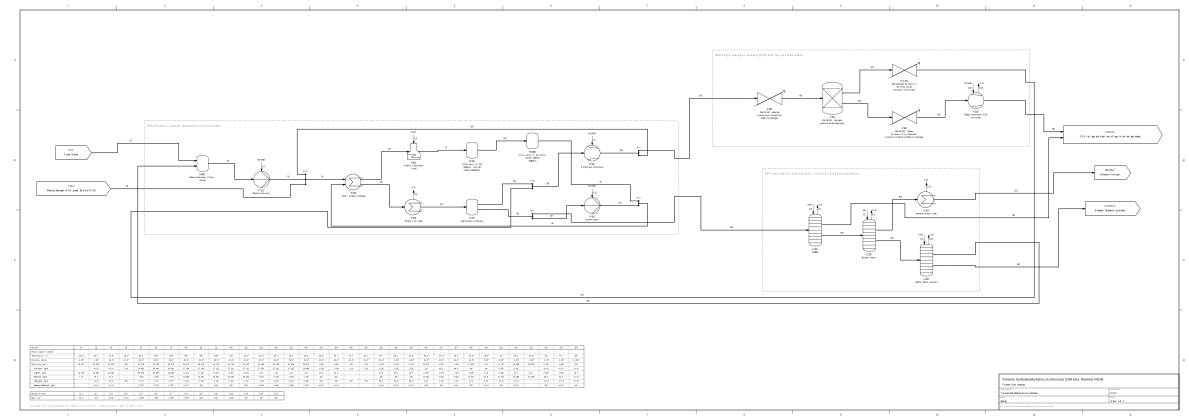
Toluene hydrodealkylation to benzene (100 kt/a, thermal HDA)
Thermal hydrodealkylation of toluene with hydrogen to benzene: adiabatic reactor, quench, HP separator, hydrogen recycle with purge and purge hydrogen recovery (PSA), stabiliser, benzene and toluene columns with toluene recycle and a biphenyl by-product. Concept stage, assumed basis, preliminary LCI (cradle-to-gate study, foreground inventory only).
Research outputNot engineering advice and not an approved design: do not use it for construction, operation or safety decisions. What this means
Overview
Fresh and recycled toluene are pumped, mixed with PSA-grade make-up hydrogen (99.9 mol%) and
recycle gas at a hydrogen-to-aromatics ratio of 5, preheated against the reactor effluent and
in a fired heater to 895 K, and react adiabatically at about 3.4 MPa (outlet 936 K). The
reactor model takes 75 % toluene conversion per pass, the per-pass conversion of a published
thermal HDA process (US 3,291,849), and the biphenyl reaction to equilibrium at the outlet. The
effluent is quenched with separator liquid, cooled and separated at 313 K; a purge of the
compressed recycle gas (40 mol% H2) removes the methane. A pressure swing adsorption unit
recovers 75 % of the purge's hydrogen at 99.9 mol% into the recycle compressor suction, and
its tail gas is compressed into the fuel gas header. The liquid is
stabilised, benzene (99.9 mol%) is taken overhead in the benzene column and cooled to 313 K,
and the vacuum toluene column returns toluene to the reactor and leaves biphenyl as bottoms.
All values are concept estimates. The separator, column and duty values come from a DWSIM
simulation of the whole plant (Peng-Robinson). ChemE-as-Code has not yet qualified that
property package for this mixture, so the simulation is a cross-check of an independent
balance script, not validated data; see DESIGN.md of the engineering files (D-014, D-020 to D-024) for every
assumption and gated step. Designed independently: no flowsheet data of the IDAES HDA examples are used.
Capacity
100 kt/a benzene (ASSUMED)
Operation
8,000 h/a
Location
generic (not chosen)
Automated checks
7 of 8 pass (Concept and feasibility gates)
Maintainers
Artur Schweidtmann
Design basis and assumptions (9)
ASSUMED thermal (non-catalytic) HDA: adiabatic reactor, inlet 895.15 K and 3450 kPa(a), outlet temperature from the energy balance (D-004).
Toluene conversion per pass 0.75, the per-pass conversion of a published thermal HDA reactor (US 3,291,849, D-021); biphenyl at chemical equilibrium at the reactor outlet (formation data of process/materials.yaml), which gives a benzene selectivity of 0.973: a conversion and equilibrium model, not kinetics. The equilibrium bounds the biphenyl make only, not the selectivity loss: heavier polyaromatics and hydrocracking are excluded (the next assumption), so 0.973 is optimistic. US 3,607,960 Example 1 reports 94.5 % for its primary reactors at 85 % conversion per pass, a higher conversion than R-101's (process/reaction-evidence.yaml O2); the TEA carries it as a scenario (D-021). The 0.75 is the patent reactor's value adopted as R-101's design value; R-101's volume and residence time are not designed to it. The recalled Douglas (1988) correlation of D-005 is no longer used (I-06).
ASSUMED loop specifications: H2/aromatics 5 mol/mol at the reactor inlet, purge gas 40 mol% H2 (D-007).
ASSUMED quench of the reactor effluent to 893.15 K with separator liquid (quench pump P-102); separator 313.15 K, 3250 kPa(a) (D-004, D-022).
Benzene product cooled to 313.15 K in the product cooler E-207 (D-022).
ASSUMED columns: stabiliser 800 kPa(a) with partial condenser at 313.15 K, L/D 1; benzene column 150/170 kPa(a), 99.5 % benzene recovery; toluene column 30/45 kPa(a) (vacuum), 2 mol% toluene in the biphenyl; reflux 1.3 x Underwood minimum, at least 0.5 (D-008).
ASSUMED no other side reactions (heavier polyaromatics, hydrocracking to light paraffins, methylbiphenyls, coke): not modelled, because no source read in full gives their split; US 3,607,960 reports 'polyphenyls (primarily diphenyl) and higher boiling polymers' in the effluent of a primary thermal zone (D-005, D-021).
All flows, temperatures and duties are concept estimates from an unqualified property method (Peng-Robinson in thermo, D-006); accuracy not stated.
Each reaction's page has the conversion, heat of reaction, catalyst and sources this process states, next to those of other processes with the same reaction. All reactions
Life cycle assessment
No footprint assessed yet; the process is part of the life-cycle inventory below.
KPI benchmark positions: not available (no benchmarked KPI for this process's datasets).
Maturity and review
Design maturity Concept (claimed): An idea or first flowsheet; numbers are rough. Concept PFD with closed mass, component and element balances (cheme validate, cheme process streams), simulated as a whole plant in DWSIM (Peng-Robinson, converged in 13 recycle iterations with the purge hydrogen PSA, D-024). The simulated plant's energy audit closes (residual 0.88 kW against a tolerance of 28.0 kW), but that closure includes 17.4 kW of heat to the isothermal biphenyl step that has no energy stream (a model artefact, D-021) and -4.39 kW stated by the PSA, a specified split (a DWSIM component separator whose recoveries come from a published range, not a prediction, D-024). cheme maturity reports calculation maturity balanced. The feeds are given from published specifications (D-020: a commercial toluene data sheet, BPCL/IS 537:2011, and a PSA hydrogen purity of 99.9 mol%, Matijasevic and Petric 2016). Their flows follow from the design capacity, which is itself ASSUMED (I-04). The reactor R-101 is modelled as a conversion step at the 75 % per-pass toluene conversion of a published thermal HDA reactor (US 3,291,849, adopted as the design value), followed by the biphenyl reaction at chemical equilibrium on the declared formation data (D-021). That equilibrium bounds the biphenyl make only, so the modelled benzene selectivity of 0.973 is optimistic: a published patent example reports 94.5 % at a higher conversion, and the TEA carries it as a scenario. Predictive fails on three requirements: model-basis (R101 is a specified conversion; no readable thermal HDA kinetics with units and range, and no homogeneous kinetic reactor in core), property-regime (core has not benchmarked Peng-Robinson for aromatics with hydrogen and methane) and formation-data (DWSIM's own formation data in the biphenyl equilibrium step). The stabiliser and the benzene column are DWSIM shortcut columns; their product fractions miss 1 by up to 1.7e-4 (core#130). The LCI is a cradle-to-gate study with the foreground inventory only, every background open (8 gaps): no impact result, and no LCA result passed to the catalog (lca.source none). Not reviewed. Main products and feeds are listed under chemistry with their chemicals registry entries (issue #251).
Calculation maturity, from the checked evidenceNot assessed
The process has no maturity report (cheme maturity, checks/maturity.json), so no calculation maturity is established.
No level shownThe design maturity (Concept) is the manifest's claim, not evidence. A level appears here once the process's repository holds a current report from cheme maturity --write.
Artifact completeness
Which deliverables exist. They never raise a calculation maturity level: a drawing from unchecked numbers is still unchecked.
Not reported without a maturity report.
Independent review
Not independently reviewed
No independent engineering review yet. Automated checks passing is not a review.
Set by people only. Reaching a calculation maturity level or passing automated checks is not an independent review or an approval.
Where the evidence comes from
Report
processes/hda-1/checks/maturity.json(not in the library)
For the data, cite the Process Atlas paper; for the platform that builds and checks it, the ChemE-as-Code paper.
Schweidtmann, A. M. & Weber, J. M. (2026, in preparation). Process Atlas: an open, git-native, reproducible library and life cycle inventory of chemical processes (working title).
For this process: "Toluene hydrodealkylation to benzene (100 kt/a, thermal HDA)", ChemE-as-Code process library, version c3ab348.
BibTeX
@unpublished{schweidtmann_process_atlas,
  author = {Schweidtmann, Artur M. and Weber, Jana M.},
  title = {{Process Atlas: an open, git-native, reproducible library and life cycle inventory of chemical processes (working title)}},
  year = {2026},
  url = {https://atlas.cheme-as-code.org},
  note = {in preparation}
}
Schweidtmann, A. M. (2026, in preparation). ChemE-as-Code: An Open-Source Platform for AI-Accelerated Chemical Process Engineering (working title).
BibTeX
@unpublished{schweidtmann_cheme_as_code,
  author = {Schweidtmann, Artur M.},
  title = {{ChemE-as-Code: An Open-Source Platform for AI-Accelerated Chemical Process Engineering (working title)}},
  year = {2026},
  url = {https://cheme-as-code.org},
  note = {in preparation}
}