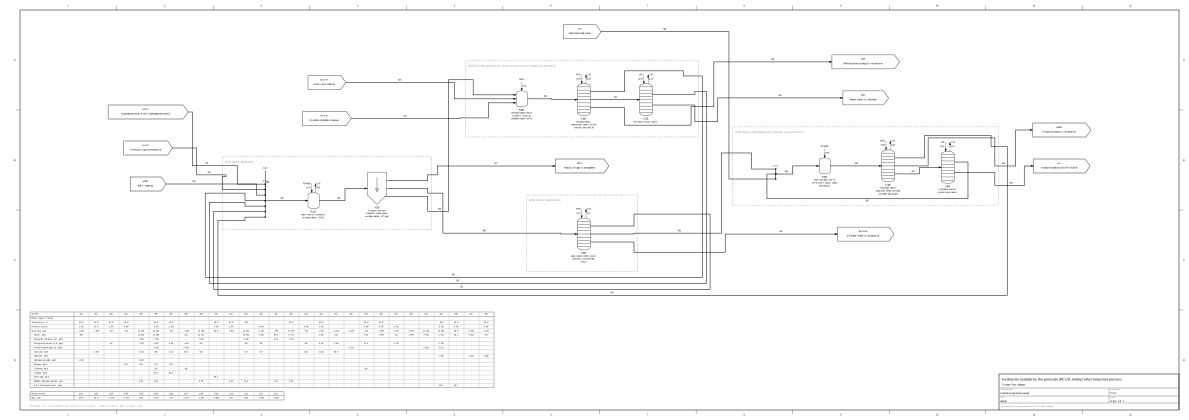
Hydrazine hydrate by the peroxide process (PCUK, methyl ethyl ketazine route, 16 kt/a)
Ammonia is oxidised by hydrogen peroxide in the presence of methyl ethyl ketone to the ketazine, which separates as an organic phase, is distilled and hydrolysed under pressure to hydrazine hydrate; the ketone is recycled. Concept stage, assumed basis, preliminary gate-to-gate LCI per kg hydrazine hydrate (64 wt% N2H4), foreground only.
Research outputNot engineering advice and not an approved design: do not use it for construction, operation or safety decisions. What this means
Overview
Hydrogen peroxide (70 wt%), anhydrous ammonia and methyl ethyl ketone (MEK, fresh and
recycled) react at about 50 C in an aqueous working solution activated by acetamide/ammonium
acetate with disodium phosphate. The methyl ethyl ketazine is insoluble in the working
solution and is decanted; the off-gas (oxygen from peroxide decomposition, nitrogen) is
vented after a condenser/scrubber. The spent working solution is heated above 130 C in a
regeneration column that removes the reaction and peroxide water and the excess ammonia; the
ammonia is recovered and returned, and the activator is made up with acetic acid. The azine
phase is distilled: excess MEK returns overhead and a side draw bleeds the 2-butanol formed
by a side reaction. The azine is hydrolysed with water by reactive distillation at about
9 bar(a): MEK leaves overhead to the reactors, pyrazolines are purged from the column, and a
dilute hydrazine hydrate (30 wt%) leaves the bottom and is concentrated to 64 wt% N2H4
(100 % hydrazine hydrate) in a further column whose water is returned to hydrolysis.
All values are concept estimates: yields, ratios and the working-solution figures are
ASSUMED inside the ranges and examples of the cited patents; the regeneration steam is a
patent example scaled to this design, the other duties hand estimates. See DESIGN.md for
every assumption and gated step.
ASSUMED azine synthesis at 323 K, about 150 kPa(a), in the activated working solution; inlet MEK/H2O2 2.2 and NH3/H2O2 2.5 mol/mol (patent ranges 0.2-5 and 0.1-10, preferred 1.5-4) (D-003).
ASSUMED H2O2 fully converted; per kmol H2O2: 0.85 kmol azine, 0.03 kmol 2-butanol (0.06 kmol H2O2), the rest (0.09 kmol) decomposed to O2 and water. Azine yield inside the 81-82 % (US 6,562,311 Ex. 4-5) to 'up to 90 %' (US 6,562,311, US 6,605,265) range; a sourced range check, not kinetics (D-004).
ASSUMED working solution circulation 11 kg per kg H2O2, make-up 60 kg acetic acid and 3 kg Na2HPO4 per t H2O2 (US 6,605,265 Ex. 1) (D-005).
Working-solution regeneration steam 10.5 t of 18 bar(a) steam per t H2O2, scaled from US 6,605,265 Ex. 1 (D-010).
ASSUMED hydrolysis by reactive distillation at about 900 kPa(a), bottoms 30 wt% hydrazine hydrate, 0.5 % of the azine lost to pyrazolines (US 6,562,311 stage (f); US 12,134,558) (D-007).
ASSUMED other column duties, reactor cooling and power: hand estimates (D-010).
Accuracy: concept estimate; no property method qualified for the mixture (D-011).
WaterFeedstockDemineralised make-up water to the azine hydrolysis, 1.45 kg per kg hydrate
Out
HydrazineMain productHydrazine hydrate, 64 wt% N2H4, counted by mass of the hydrate
WastewaterWasteReaction and peroxide water after ammonia recovery, 2.2 kg per kg hydrate
OxygenEmissionReactor off-gas: O2 from peroxide decomposition and N2 from the 2-butanol side reaction, with traces of NH3 and MEK
Utilities:Electricity (0.05 kWh per kg hydrate, ASSUMED hand estimate (pumps, agitators)), Steam (MP steam 2000 kPa(a), 6.2 kWh per kg hydrate: working-solution regeneration (US 6,605,265 Ex. 1, scaled), azine and hydrolysis columns), Steam (LP steam 500 kPa(a), 2.0 kWh per kg hydrate: ammonia recovery and hydrate concentration), Nitrogen (Headspace inerting sweep of the azine reactors and decanter, 0.32 kg per kg hydrate (O2 at most 8 mol% in the vent, ASSUMED, D-015); gaseous site/pipeline nitrogen, so the Atlas links the GAN market, not liquid nitrogen), Cooling water (25/35 C (ASSUMED), 9.4 kWh rejected per kg hydrate)
Each reaction's page has the conversion, heat of reaction, catalyst and sources this process states, next to those of other processes with the same reaction. All reactions
Life cycle assessment
No footprint assessed yet; the process is part of the life-cycle inventory below.
Download it for Brightway, openLCA and other tools.
In the LCI database: system model, datasets and KPIs against the benchmarks
In the LCI database
Status
Preliminary 6 unmapped exchanges. Some exchanges have no background mapping yet: they are exported unlinked and count no burden, so the inventory is incomplete.
System model
attributional, cut-off (methodology 1.1.0)
Allocation
mass (single-output, from default) · product:HH 100 %
Allocation findings
none
Change report
Not available: this build has no change report against an earlier release.
KPI benchmark positions: not available (no benchmarked KPI for this process's datasets).
Maturity and review
Design maturity Concept (claimed): An idea or first flowsheet; numbers are rough. Concept PFD (4 blocks, 11 steps, 3 recycle loops: MEK, working solution, ammonia; water loop in hydrolysis) with closed mass, component and element balances (cheme validate, cheme process streams: every block and step ok); reactor outlets calculated by cheme from selectivity/conversion specifications, every separator specified (scripts/balance.py). Consumptions per kg N2H4: H2O2 (100 %) 1.25 kg (85 % azine yield on H2O2, patent range 81 to about 90 %; 1.32 kg at 81 %, 1.12 kg at 95 %), NH3 1.13 kg, MEK make-up 0.12 kg. The reactor and decanter headspaces are inerted with 0.32 kg N2 per kg hydrate (O2 at most 8 mol% in the vent, ASSUMED). Steam 8.2 kWh per kg hydrate, of which the working-solution regeneration (a single patent example, scaled) is 55 %; the hydrolysis column steam is a lower bound (hydrolysis heat not counted), a high variant adds up to 1.1 kWh of MP steam per kg hydrate (+18 % MP steam). No energy balance: no property package covers the aqueous hydrazine/MEK/amide mixture (cheme process props --coverage). cheme maturity reaches no level. The LCI is foreground only, every background a gap (15 gaps plus 2 uncharacterised emissions): no impact result (lca.source none). Not reviewed. Main products and feeds are listed under chemistry with their chemicals registry entries (issue #251).
Calculation maturity, from the checked evidenceNot assessed
The process has no maturity report (cheme maturity, checks/maturity.json), so no calculation maturity is established.
No level shownThe design maturity (Concept) is the manifest's claim, not evidence. A level appears here once the process's repository holds a current report from cheme maturity --write.
Artifact completeness
Which deliverables exist. They never raise a calculation maturity level: a drawing from unchecked numbers is still unchecked.
Not reported without a maturity report.
Independent review
Not independently reviewed
No independent engineering review yet. Automated checks passing is not a review.
Set by people only. Reaching a calculation maturity level or passing automated checks is not an independent review or an approval.
Where the evidence comes from
Report
processes/hydrazine-1/checks/maturity.json(not in the library)
Schirmann, J.-P., Bourdauducq, P. Hydrazine. Ullmann's Encyclopedia of Industrial Chemistry, Wiley-VCH (issue #141 lead; not audited in this run) · doi:10.1002/14356007.a13_177
For the data, cite the Process Atlas paper; for the platform that builds and checks it, the ChemE-as-Code paper.
Schweidtmann, A. M. & Weber, J. M. (2026, in preparation). Process Atlas: an open, git-native, reproducible library and life cycle inventory of chemical processes (working title).
For this process: "Hydrazine hydrate by the peroxide process (PCUK, methyl ethyl ketazine route, 16 kt/a)", ChemE-as-Code process library, version c3ab348.
BibTeX
@unpublished{schweidtmann_process_atlas,
  author = {Schweidtmann, Artur M. and Weber, Jana M.},
  title = {{Process Atlas: an open, git-native, reproducible library and life cycle inventory of chemical processes (working title)}},
  year = {2026},
  url = {https://atlas.cheme-as-code.org},
  note = {in preparation}
}
Schweidtmann, A. M. (2026, in preparation). ChemE-as-Code: An Open-Source Platform for AI-Accelerated Chemical Process Engineering (working title).
BibTeX
@unpublished{schweidtmann_cheme_as_code,
  author = {Schweidtmann, Artur M.},
  title = {{ChemE-as-Code: An Open-Source Platform for AI-Accelerated Chemical Process Engineering (working title)}},
  year = {2026},
  url = {https://cheme-as-code.org},
  note = {in preparation}
}