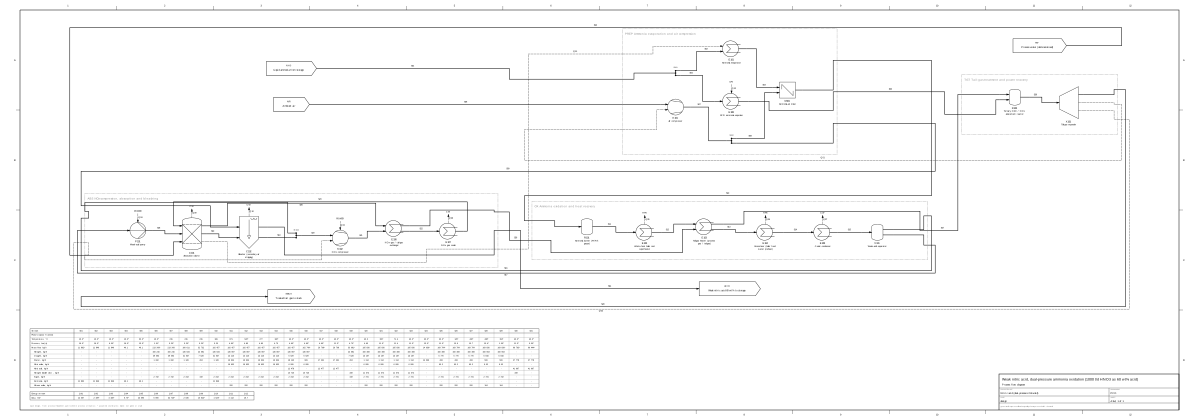
Weak nitric acid by dual-pressure ammonia oxidation (1000 t/d HNO3 as 60 wt% acid)
Dual-pressure Ostwald process: ammonia burned with air over Pt/Rh gauze at about 0.5 MPa, heat recovered to HP steam, nitrous gas compressed and absorbed in water at about 1.1 MPa to 60 wt% nitric acid, tail gas treated for N2O and NOx and expanded. Concept stage, assumed basis.
Research outputNot engineering advice and not an approved design: do not use it for construction, operation or safety decisions. What this means
Overview
Liquid ammonia is evaporated against the absorber's chilled-water loop and mixed with
compressed air to 10 mol% NH3. The adiabatic Pt/Rh gauze converts it completely: 95.5 % to NO
(assumed selectivity), N2O at the IPCC 2006 default for medium-pressure combustion plants
(7 kg N2O per t HNO3), the rest to N2. A waste-heat boiler, tail-gas heater and economiser
recover the heat; the cooler-condenser forms weak acid. The NOx compressor raises the gas to
absorption pressure; the absorber and bleacher are a specification model (60 wt% product,
500 ppmv NOx in the tail gas), not a reactive-absorption model. A tertiary reactor decomposes
N2O to the IPCC default for plants with tail-gas N2O destruction (2.5 kg per t HNO3) and
reduces NOx with ammonia; the expander drives the compressor train.
All values are concept estimates from an independent balance script whose property method is
not qualified by ChemE-as-Code for nitrous gas and aqueous nitric acid; see
DESIGN.md of the engineering files for every assumption and gated step.
ASSUMED dual-pressure scheme: ammonia oxidation at about 0.5 MPa(a), absorption at about 1.1 MPa(a) (D-003).
ASSUMED burner feed 10.0 mol% NH3 in air; complete NH3 conversion; NO selectivity 0.955 (D-005).
N2O formed at the gauze from the IPCC 2006 default for medium-pressure combustion plants, 7 kg N2O / t HNO3 (Vol. 3 Ch. 3 Table 3.3, p. 3.23); the rest of the unselective NH3 to N2 (D-005).
ASSUMED cooler-condenser weak acid 42 wt%, gas leaving with 0.9 mol% water and NO2/(NO+NO2) = 0.5 (D-007).
ASSUMED absorber specification model: tail gas 500 ppmv NOx (as NO), 3.0 mol% O2, 0.4 mol% H2O; raw acid 0.5 wt% dissolved NOx (as NO2) stripped in the bleacher by secondary air (D-008).
Tertiary tail-gas treatment at 703 K: N2O destruction to the IPCC default 2.5 kg N2O / t HNO3 for tail-gas N2O destruction (Table 3.3), SCR of 90 % of the NO with NH3, no slip (ASSUMED, D-009).
ASSUMED isentropic efficiencies: air compressor 0.85, NOx compressor 0.80, tail-gas expander 0.85; drive and gear losses neglected (D-011).
All flows, temperatures and duties are concept estimates from an unqualified property method (D-010); accuracy not stated.
WaterFeedstockDemineralised process water to the absorber
Out
Nitric acidMain productWeak nitric acid 60 wt% to storage, counted by mass of the acid (1.667 kg per kg HNO3)
SteamCo-productHP steam 4000 kPa(a), 673 K exported (0.71 kWh heat per kg HNO3)
NitrogenEmissionTreated tail gas (N2 with 3 mol% O2); its N2O (2.5 g/kg HNO3) and NO (0.22 g/kg) have no registry entries yet
Utilities:Electricity (Compressor-train motor deficit and pump (ASSUMED electric motor on the train)), Steam (LP steam 450 kPa(a) to the SCR ammonia vaporiser), Cooling water (25/35 C (ASSUMED))
Each reaction's page has the conversion, heat of reaction, catalyst and sources this process states, next to those of other processes with the same reaction. All reactions
Life cycle assessment
Footprint not publishedThe process changed since the LCA was last run; its values return once it is run again. Method, functional unit and inventory are below.
Method and data
Goal
Preliminary cradle-to-gate life cycle inventory of weak nitric acid (60 wt%) from a dual-pressure Ostwald plant at concept stage, per kg of contained HNO3, with every background still open: only the foreground exchanges from the balanced flowsheet are quantified, the backgrounds (ammonia above all) are gaps to be linked later. It shows the direct N2O and NOx emissions with tertiary abatement; the unabated alternative is given in DESIGN.md D-009. Not a product carbon footprint: the climate-change result is the direct N2O emission of the plant only (D-014).
Functional unit
1 kg Weak nitric acid 60 wt% (1 kg nitric acid)
Boundary
cradle-to-gate
Allocation
shares
Characterisation
Factors kept with the process · GWP100
Data quality
Published factors
Result
partial screening carbon footprint · 6 data gaps
Inventory per 1 kg Weak nitric acid 60 wt% (19 flows)
Flow
Phase
Direction
Quantity
Unit
Provenance
Liquid ammonia from storage
operation
input
0.2854
kg
assumed
Ambient air
operation
input
5.12
kg
assumed
Process water (demineralised)
operation
input
0.3369
kg
assumed
Electric power
operation
input
0.1005
kWh
assumed
LP steam 450 kPa(a)
operation
input
0.0004006
kWh
calculated
Weak nitric acid 60 wt% to storage
operation
output
1.667
kg
assumed
Treated tail gas to stack
operation
output
4.076
kg
assumed
HP steam export (4000 kPa(a), 673 K)
operation
output
0.7075
kWh
calculated
Cooling water return
operation
output
1.128
kWh
assumed
AR to the environment
operation
output
0.06556
kg
assumed
H2O to the environment
operation
output
0.01215
kg
assumed
HNO3 to the environment
operation
output
0
kg
assumed
N2 to the environment
operation
output
3.856
kg
assumed
N2O to the environment
operation
output
0.0025
kg
assumed
NH3 to the environment
operation
output
0
kg
assumed
NO to the environment
operation
output
0.0002164
kg
assumed
NO2 to the environment
operation
output
0
kg
assumed
O2 to the environment
operation
output
0.1396
kg
assumed
Pt/Rh gauze metal lost to the process gas
operation
input
0.00000015
kg
assumed
Computed by ChemE-as-Code from lca/README.md, lca/dataset.yaml, lca/factors.yaml, lca/gaps.csv, lca/inventory.csv, lca/lca.yaml, lca/mappings.yaml, lca/results.csv, lca/results.md.
KPI benchmark positions: not available (no benchmarked KPI for this process's datasets).
Maturity and review
Design maturity Concept (claimed): An idea or first flowsheet; numbers are rough. Concept PFD with closed mass, component and element balances (cheme validate, cheme process streams: every block and step closes, reaction extents explain every composition change). cheme maturity reaches no level: the capacity, feeds and the burner NO selectivity are assumed, and the separator, absorber and bleacher outlets and all duties come from the independent script scripts/hno3_balance.py (ideal-gas enthalpies, assumed heat of mixing of the acid), which core cannot qualify (no property package for nitrous gas with water or aqueous nitric acid, no reactive-absorption model: core's property-package qualification and electrolyte support). Energy closure is not evaluable in core; the script closes its own energy balance to 7 kW of 62 MW. The N2O formation and abated emission rest on the IPCC 2006 default factors (Table 3.3), not on plant data. Preliminary cradle-to-gate LCI with every background open (foreground only, gaps), see DESIGN.md D-014. Not reviewed. Main products and feeds are listed under chemistry with their chemicals registry entries (issue #251).
Calculation maturity, from the checked evidenceNot assessed
The process has no maturity report (cheme maturity, checks/maturity.json), so no calculation maturity is established.
No level shownThe design maturity (Concept) is the manifest's claim, not evidence. A level appears here once the process's repository holds a current report from cheme maturity --write.
Artifact completeness
Which deliverables exist. They never raise a calculation maturity level: a drawing from unchecked numbers is still unchecked.
Not reported without a maturity report.
Independent review
Not independently reviewed
No independent engineering review yet. Automated checks passing is not a review.
Set by people only. Reaching a calculation maturity level or passing automated checks is not an independent review or an approval.
Where the evidence comes from
Report
processes/nitric-acid-1/checks/maturity.json(not in the library)
For the data, cite the Process Atlas paper; for the platform that builds and checks it, the ChemE-as-Code paper.
Schweidtmann, A. M. & Weber, J. M. (2026, in preparation). Process Atlas: an open, git-native, reproducible library and life cycle inventory of chemical processes (working title).
For this process: "Weak nitric acid by dual-pressure ammonia oxidation (1000 t/d HNO3 as 60 wt% acid)", ChemE-as-Code process library, version c3ab348.
BibTeX
@unpublished{schweidtmann_process_atlas,
  author = {Schweidtmann, Artur M. and Weber, Jana M.},
  title = {{Process Atlas: an open, git-native, reproducible library and life cycle inventory of chemical processes (working title)}},
  year = {2026},
  url = {https://atlas.cheme-as-code.org},
  note = {in preparation}
}
Schweidtmann, A. M. (2026, in preparation). ChemE-as-Code: An Open-Source Platform for AI-Accelerated Chemical Process Engineering (working title).
BibTeX
@unpublished{schweidtmann_cheme_as_code,
  author = {Schweidtmann, Artur M.},
  title = {{ChemE-as-Code: An Open-Source Platform for AI-Accelerated Chemical Process Engineering (working title)}},
  year = {2026},
  url = {https://cheme-as-code.org},
  note = {in preparation}
}