
p-Toluenesulfonyl chloride by semi-batch chlorosulfonation of toluene with a drown-out quench (1000 t/a)

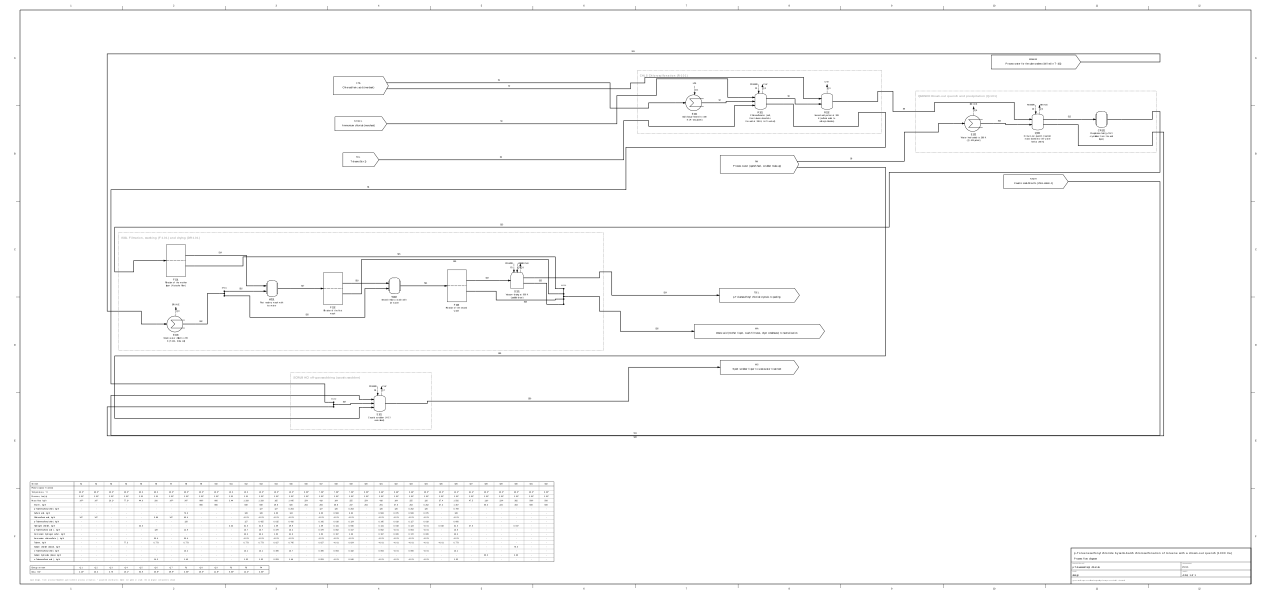
A batch plant: toluene is dosed into chlorosulfonic acid with ammonium chloride (HCl vented to a scrubber), a second acid portion gives the sulfonyl chlorides, and the mass is drowned in cold water, where p-TsCl precipitates, is filtered, washed and vacuum-dried. Concept stage, 1749 kg per batch every 13.85 h on a dedicated train, preliminary gate-to-gate LCI.

Calculation maturity: not assessedDesign maturity: Concept (research)Not independently reviewedChlorinated organicsReport a problem with this process
Research outputNot engineering advice and not an approved design: do not use it for construction, operation or safety decisions. What this means

Overview

The route is the salt-modified chlorosulfonation of DE 1 912 956 A1 (Hoechst, 1969, Example 1): per mol of toluene 1.5 mol of chlorosulfonic acid and 0.45 mol of ammonium chloride are charged, the salt is added in portions (HCl escapes), toluene is dosed at 338 K, the mass is cooled to 308 K, a second 1.5 mol of acid is added and held for 1 h, and the mass is drowned in water. The salt raises the para share of the sulfonation to 90 % (the patent's p-content). The sulfonic acids go 90 % to the sulfonyl chlorides (ASSUMED); the rest stays in the waste acid. In the quench the excess acid and the ammonium chlorosulfate hydrolyse, p-TsCl precipitates (assumed solubility 0.5 g per kg water), and the ortho isomer, an oil above 10 C, stays with the liquor. Two reslurry washes with ice water and vacuum drying at 308 K give the product. The modelled assay is 99.7 wt% p-TsCl, an upper bound: the cake's o-TsCl retention is not modelled (DESIGN.md L-4), and the source's crude has 90 % para. The modelled yield is 78.8 % on toluene. That is above the patent's 77 % of theory as para compound in its crude (an ASSUMED better in-mass conversion, DESIGN.md D-005); calibrated to the patent, it would be about 76 %. The HCl of both vents (0.38 kg per kg product) is neutralised in a caustic scrubber; 12.6 kg of dilute waste acid (8 wt% H2SO4, 2 wt% HCl) per kg product goes to neutralisation.

The batch is modelled with cheme-as-code 1.10.0: the chlorosulfonator R101 and the quench Q101 are semi-batches (reactor: semibatch) with an HCl vent (batch.vent, core ADR 0054); the precipitation and the two reslurry washes are crystallizers with the liquor's other solutes as spectators (core ADR 0056); the Nutsche filter is one recipe vessel over five steps with Ruth filtration times and the paddle dryer core's dryer to a residual moisture (core ADR 0057). The recipe gives the cycle (13.85 h, R-101 the bottleneck, 571.8 batches a year), sizes the vessels, checks the jackets and reports the scrubber load per batch (657 kg HCl). The heats of R101, R102 and Q101 come from their models (core ADR 0059), the quench's with the dilution heat of the dosed acids (a dose's heat of solution, core ADR 0063). Kinetics and heats of reaction are ASSUMED (no open data): the sulfonation accumulates 1.7 % of the toluene and its cooling-failure temperature reaches 343.6 K against an MTT of 383.75 K (toluene's boiling point), with 60 m3/h of HCl released against a vent of 150 m3/h (core ADR 0058); a 100 times slower rate would exceed both the MTT and the vent. See DESIGN.md for every assumption.
Capacity
1000 t/a dried p-TsCl: 571.8 batches/a of 1748.95 kg in 7920 h on a dedicated train (126.26 kg/h year average), ASSUMED (DESIGN.md D-002, D-003, D-013)
Operation
7,920 h/a
Location
generic fine-chemicals site with a chlorosulfonic acid supply (not chosen)
Engineering gates
Concept and feasibility (no results yet)
Maintainers
Artur Schweidtmann
Design basis and assumptions (6)
  • Route: ammonium chloride and toluene into chlorosulfonic acid at 60-70 C, a second acid portion at 35 C, the mass drowned in ice water (DE 1 912 956 A1, Example 1; D-001); per mol toluene 1.5 + 1.5 mol ClSO3H and 0.45 mol NH4Cl (D-004).
  • ASSUMED kinetics and heats of reaction (no open data, D-005): fast second-order sulfonation in the patent's 90 : 10 para share, -100 kJ/mol; 90 % of the sulfonic acids to the sulfonyl chlorides in the second stage (above the patent's crude: 78.8 % para product against its 77 %, D-005); the quench heats effective values to the dilute liquor.
  • ASSUMED solubility of p-TsCl 0.5 g per kg water in the acid liquor (insoluble and reactive, PubChem), no salting-out correction (D-007).
  • ASSUMED filters: 99.8 % solid recovery, 0.3 kg liquor per kg cake solid, specific cake resistance 1e10 m/kg at 200 kPa; two reslurry washes with 2 kg ice water per kg solid (D-007).
  • ASSUMED vacuum drying at 308 K to 0.2 wt% volatiles, 70 % thermal efficiency, a mean drying rate of 3 kg/(m2 h) on 15 m2 (D-008).
  • All flows are year averages of the recipe (D-003); the dryer's heat from cheme's dryer model, the heats of R101, R102 and Q101 from their models (written by cheme process propagate, D-014; Q101's with the dosed acids' heat of solution, D-015), the other duties hand arithmetic from the stream table (D-009); accuracy +/-30 % not demonstrated.

From process/design-basis.yaml.

Engineering model

Loading the drawing…
Drawing of the process (preview)Open the engineering model

The interactive model (drawings, streams, 3D) is made for larger screens.

Snapshot of a3c52e4, cheme-as-code 1.6.0.

What goes in and out

In

  • Chlorosulfonic acidFeedstockfeed:CSA: technical chlorosulfonic acid (merchant), 2.32 kg/kg p-TsCl in two portions; no library process makes it (proxy SO3 + HCl recorded, D-012)
  • TolueneFeedstockfeed:TOL: dry toluene (btx-1), 0.612 kg/kg p-TsCl
  • Ammonium chlorideFeedstockfeed:NH4CL: technical ammonium chloride (merchant), 0.160 kg/kg p-TsCl; raises the para share (DE 1 912 956 A1)
  • Sodium hydroxideFeedstockfeed:NAOH: caustic soda 50 wt% (chlor-alkali-1) to the HCl scrubber, 0.871 kg/kg p-TsCl, counted by mass of the solution
  • WaterFeedstockQuench heel and scrubber make-up, 8.64 kg/kg p-TsCl
  • WaterFeedstockIce-cold cake washes, 4.03 kg/kg p-TsCl

Out

  • p-Toluenesulfonyl chlorideMain productDried p-TsCl crystals to packing; modelled 99.7 wt% p-TsCl, an upper bound: the cake's o-TsCl retention is not modelled (DESIGN.md L-4), the source's crude has 90 % para
  • WastewaterWasteWaste acid (mother liquor, wash filtrates, dryer condensate), 12.6 kg/kg p-TsCl: 8 wt% H2SO4, 2 wt% HCl, 2.7 wt% NH4HSO4, toluenesulfonic acids and the o-TsCl oil, to neutralisation
  • WastewaterWasteSpent scrubber liquor, 3.02 kg/kg p-TsCl, 20 wt% NaCl with excess NaOH, to wastewater treatment

Utilities: Electricity (0.193 kWh/kg p-TsCl: agitators of R-101, Q-101 and F-101, the paddle dryer, vacuum pump, scrubber pump and fan (ASSUMED)), Steam (0.340 kWh (1.22 MJ)/kg p-TsCl of LP steam: R-101's heat-up and the dryer's hot-water circuit (cheme's dryer model, the vessel's heat each batch included)), Cooling water (0.610 kWh/kg p-TsCl removed by cooling water: the heat of sulfonation, the cool-down to 308 K and the scrubber (the caustic's ASSUMED dilution heat included)), Chilled water (0.811 kWh/kg p-TsCl removed by brine at 258 K: the heel cooled, the quench heat with the dosed acids' dilution heat (Q101's model, 0.435 kWh, of it 0.127 kWh the dilution), the dryer's vacuum condenser (0.202 kWh) and the wash water chilled to 278 K (0.094 kWh) (the registry has chilled water, not brine: closest entry))

Show in the process graph

Reactions

IdAs writtenReactionOther processes
AMHNH4SO3Cl + H2O → NH4HSO4 + HCl · Hydrolysis of the ammonium chlorosulfate in the quenchAMCS+H2OgivesNH5O4S+HCl
CHLOo-CH3C6H4SO3H + HSO3Cl → o-CH3C6H4SO2Cl + H2SO4 · o-Toluenesulfonic acid to o-toluenesulfonyl chloride by excess chlorosulfonic acidC7H8O3S+ClHO3SgivesC7H7ClO2S+H2SO4
CHLPp-CH3C6H4SO3H + HSO3Cl → p-CH3C6H4SO2Cl + H2SO4 · p-Toluenesulfonic acid to p-toluenesulfonyl chloride by excess chlorosulfonic acidC7H8O3S+ClHO3SgivesC7H7ClO2S+H2SO4
HYDHSO3Cl + H2O → H2SO4 + HCl · Hydrolysis of the excess chlorosulfonic acid in the quenchClHO3S+H2OgivesH2SO4+HCl
NEUTHCl + NaOH → NaCl + H2O · Neutralisation of the off-gas HCl in the caustic scrubberHCl+NaOHgivesNaCl+H2O4 other processes
SALTNH4Cl + HSO3Cl → NH4SO3Cl + HCl · Ammonium chloride taken up by chlorosulfonic acidNH4Cl+ClHO3SgivesAMCS+HCl
SULOC7H8 + HSO3Cl → o-CH3C6H4SO3H + HCl · Sulfonation of toluene by chlorosulfonic acid, orthoC7H8+ClHO3SgivesC7H8O3S+HCl
SULPC7H8 + HSO3Cl → p-CH3C6H4SO3H + HCl · Sulfonation of toluene by chlorosulfonic acid, paraC7H8+ClHO3SgivesC7H8O3S+HCl
TSHOo-CH3C6H4SO2Cl + H2O → o-CH3C6H4SO3H + HCl · Hydrolysis of o-toluenesulfonyl chloride in the quenchC7H7ClO2S+H2OgivesC7H8O3S+HCl
TSHPp-CH3C6H4SO2Cl + H2O → p-CH3C6H4SO3H + HCl · Hydrolysis of p-toluenesulfonyl chloride in the quench (yield loss)C7H7ClO2S+H2OgivesC7H8O3S+HCl

Each reaction's page has the conversion, heat of reaction, catalyst and sources this process states, next to those of other processes with the same reaction. All reactions

Life cycle assessment

–kg CO2-eqPreliminarypartial, 15 data gaps

Climate change per 1 kg p-Toluenesulfonyl chloride crystals, cradle-to-gate

No factors. No contribution is characterised, so no factor stands behind any number.

Main contributors
    Method and data
    Goal
    Preliminary gate-to-gate life cycle inventory of p-toluenesulfonyl chloride made by the salt-modified semi-batch chlorosulfonation of toluene, a drown-out quench in water, filtration, washing and vacuum drying, with the HCl off-gas neutralised in a caustic scrubber, at the concept stage: which raw materials, utilities and wastes the batch plant exchanges per kg of dried p-TsCl, as the foreground for a later cradle-to-gate study. No impact results: most backgrounds are not mapped yet (D-012).
    Functional unit
    1 kg p-Toluenesulfonyl chloride crystals (1 kg p-Toluenesulfonyl chloride)
    Boundary
    cradle-to-gate
    Characterisation
    Factors kept with the process · GWP100
    Data quality
    No factors
    Result
    partial screening carbon footprint · 15 data gaps
    ScenarioClimate change (kg CO2-eq)
    baselineno total (data gaps)

    Inventory per 1 kg p-Toluenesulfonyl chloride crystals (16 flows)

    FlowPhaseDirectionQuantityUnitProvenance
    Chlorosulfonic acid (merchant)operationinput2.321kgassumed
    Ammonium chloride (merchant)operationinput0.1599kgassumed
    Toluene (btx-1)operationinput0.6119kgassumed
    Process water (quench heel, scrubber make-up)operationinput8.638kgassumed
    Process water for the cake washes (chilled in T-101)operationinput4.026kgassumed
    Caustic soda 50 wt% (chlor-alkali-1)operationinput0.8706kgassumed
    Electric poweroperationinput0.1932kWhassumed
    LP steam 350 kPa(a) (R-101 heating, the dryer's hot-water circuit)operationinput0.34kWhassumed
    p-Toluenesulfonyl chloride crystals to packingoperationoutput1kgcalculated
    Waste acid (mother liquor, wash filtrates, dryer condensate) to neutralisationoperationoutput12.6kgcalculated
    Spent scrubber liquor to wastewater treatmentoperationoutput3.023kgcalculated
    Cooling water returnoperationoutput0.6096kWhassumed
    Chilled brine return (263 K)operationoutput0.8107kWhassumed
    Nitrogen for inerting R-101, pressing the Nutsche filtrations and breaking the dryer's vacuumoperationinput0.1001kgassumed
    Rinse water of Q-101 and F-101 between batchesoperationinput1.144kgassumed
    Disposal: Rinse water of Q-101 and F-101 between batches (site wastewater treatment of the acidic rinse water, with the waste acid (D-010))operationoutput1.144kgassumed

    Computed by ChemE-as-Code from lca/README.md, lca/dataset.yaml, lca/factors.yaml, lca/gaps.csv, lca/inventory.csv, lca/lca.yaml, lca/mappings.yaml, lca/results.csv, lca/results.md.

    In the open LCI database (cheme-as-code-atlas-preview-a3c52e4) as p-Toluenesulfonyl chloride crystals to packing Preliminary.

    Download it for Brightway, openLCA and other tools.

    In the LCI database: system model, datasets and KPIs against the benchmarks

    In the LCI database

    Status
    Preliminary 5 unmapped exchanges. Some exchanges have no background mapping yet: they are exported unlinked and count no burden, so the inventory is incomplete.
    System model
    attributional, cut-off (methodology 1.1.0)
    Allocation
    mass (single-output, from default) · product:TSCL 100 %
    Allocation findings
    none
    Change report
    Not available: this build has no change report against an earlier release.
    Dataset pages
    p-Toluenesulfonyl chloride crystals to packing Preliminary

    KPI benchmark positions

    KPIValueReference rangePosition
    Chlorosulfonic acid consumption per kg of p-toluenesulfonyl chloride
    No open source with a plant's chlorosulfonic acid use per kg p-TsCl found (searched 2026-11-05 as for tscl-specific-toluene); the patents give laboratory ratios of about 3 (DE 1 912 956 A1) to 4 (PL 73685 B2) mol per mol toluene. Only the stoichiometric floor, 1.222 kg/kg, is known.
    – kg/kgnot availablenot evaluated
    Toluene consumption per kg of p-toluenesulfonyl chloride
    No open source with a plant's or a pilot's toluene use per kg p-TsCl found independent of the dataset (searched 2026-11-05: Google Patents DE 1 912 956 A1, the dataset's basis, PL 73685 B2 and CN 105503671 A, all laboratory examples; web search for p-toluenesulfonyl chloride production consumption figures, which gave only encyclopaedia summaries, not read where licensed). Only the stoichiometric floor, 0.483 kg/kg, is known.
    – kg/kgnot availablenot evaluated

    Maturity and review

    Design maturity Concept (claimed): An idea or first flowsheet; numbers are rough. Concept batch PFD with closed mass, component and element balances (cheme validate: 4 blocks, 17 steps). Every material stream is calculated by cheme process propagate from the feeds: the semi-batches R101 and Q101 from their ASSUMED rate laws with the HCl vented (core ADR 0054), R102 and the scrubber as conversion steps, the precipitation CR101 and the washes W101, W102 as crystallizers with spectators on an ASSUMED solubility with no salting-out correction, the filters as specified splits, the dryer D101 to an ASSUMED residual moisture with its heat from cheme's dryer model. The feeds are sized by hand for 1000 t/a (the outlets scale with them); the duties of R101, R102 and Q101 are written by the models (core ADR 0059), Q101's with the ASSUMED heat of solution of the dosed acids (core ADR 0063), and the other duties are hand arithmetic from the stream table. The recipe takes the dosing, post-reaction, heating, cooling, filtration and drying times from the models (cheme process recipe, no cheme.recipe-basis or cheme.recipe-jacket finding). Thermal screening (cheme process reactor-hazards): R101 dT_ad 238 K, accumulation 1.7 %, MTSR 343.6 K against an MTT of 383.75 K; a cooling failure's HCl up to 145.5 m3/h at the end of the salt addition (60.3 m3/h at the MTSR) against an ASSUMED vent capacity of 150 m3/h, about 3 % margin; Q101 dT_ad 39.1 K (14.2 K of it the dosed acids' heat of solution), MTSR 298.2 K against 373.1 K, 14.1 m3/h of HCl at the end of the dosing (the ASSUMED 10 % vented share; all of it about 141 m3/h); no criticality class without a TD24 from calorimetry (never estimated). The kinetics are assumed: at k/10 R101's release reaches the vent's capacity (150 m3/h), at k/100 its MTSR is 420 K and its HCl 1302 m3/h, 8.7 times the vent (a design finding: dosing and salt-addition interlocks, emergency relief from calorimetry, DESIGN.md D-014). Preliminary gate-to-gate LCI with nitrogen and rinses as per-batch consumables; toluene, caustic soda and nitrogen linked to btx-1, chlor-alkali-1 and asu-1, chlorosulfonic acid and ammonium chloride gaps with their proxy recorded. Not reviewed. Needs cheme-as-code 1.9.0.

    Calculation maturity, from the checked evidenceNot assessed

    The process has no maturity report (cheme maturity, checks/maturity.json), so no calculation maturity is established.

    No level shownThe design maturity (Concept) is the manifest's claim, not evidence. A level appears here once the process's repository holds a current report from cheme maturity --write.

    Artifact completeness

    Which deliverables exist. They never raise a calculation maturity level: a drawing from unchecked numbers is still unchecked.

    Not reported without a maturity report.

    Independent review

    Not independently reviewed

    No independent engineering review yet. Automated checks passing is not a review.

    Set by people only. Reaching a calculation maturity level or passing automated checks is not an independent review or an approval.

    Where the evidence comes from
    Report
    processes/p-toluenesulfonyl-chloride-1/checks/maturity.json (not in the library)
    Design basis
    process/design-basis.yaml
    Method
    How ChemE-as-Code checks the levels (requirement by requirement)

    Open items

    Sources

    Engineering project
    p-Toluenesulfonyl chloride · cheme-as-code>=1.10
    Library version
    a3c52e4 (process last changed in a3c52e4)
    Drawings rendered by
    cheme 1.6.0 (pyDEXPI 2.1.0)
    Data
    Catalog record (JSON) · CC-BY-4.0
    Files
    View the files on GitHub · change history and authors

    References

    How to cite

    For the data, cite the Process Atlas paper; for the platform that builds and checks it, the ChemE-as-Code paper.

    Schweidtmann, A. M. & Weber, J. M. (2026, in preparation). Process Atlas: an open, git-native, reproducible library and life cycle inventory of chemical processes (working title).

    For this process: "p-Toluenesulfonyl chloride by semi-batch chlorosulfonation of toluene with a drown-out quench (1000 t/a)", ChemE-as-Code process library, version a3c52e4.

    BibTeX
    @unpublished{schweidtmann_process_atlas,
      author = {Schweidtmann, Artur M. and Weber, Jana M.},
      title = {{Process Atlas: an open, git-native, reproducible library and life cycle inventory of chemical processes (working title)}},
      year = {2026},
      url = {https://atlas.cheme-as-code.org},
      note = {in preparation}
    }

    Schweidtmann, A. M. (2026). ChemE-as-Code: An Open-Source Platform for Agentic AI in Chemical Engineering. arXiv:2611.07947. https://doi.org/10.48550/arXiv.2611.07947

    BibTeX
    @misc{schweidtmann_cheme_as_code,
      author = {Schweidtmann, Artur M.},
      title = {{ChemE-as-Code: An Open-Source Platform for Agentic AI in Chemical Engineering}},
      year = {2026},
      eprint = {2611.07947},
      archivePrefix = {arXiv},
      doi = {10.48550/arXiv.2611.07947},
      url = {https://arxiv.org/abs/2611.07947}
    }