
Soda ash by the Solvay ammonia-soda process (1000 t/d light ash, concept)

Synthetic soda ash from brine and limestone by the Solvay process: lime kiln, brine ammoniation, carbonation, filtration, steam calcination and ammonia recovery with milk of lime; CaCl2 distiller waste and kiln CO2 explicit. Concept stage, assumed basis.

Calculation maturity: not assessedDesign maturity: Concept (research)Not independently reviewedSoda ashReport a problem with this process
Research outputNot engineering advice and not an approved design: do not use it for construction, operation or safety decisions. What this means

Overview

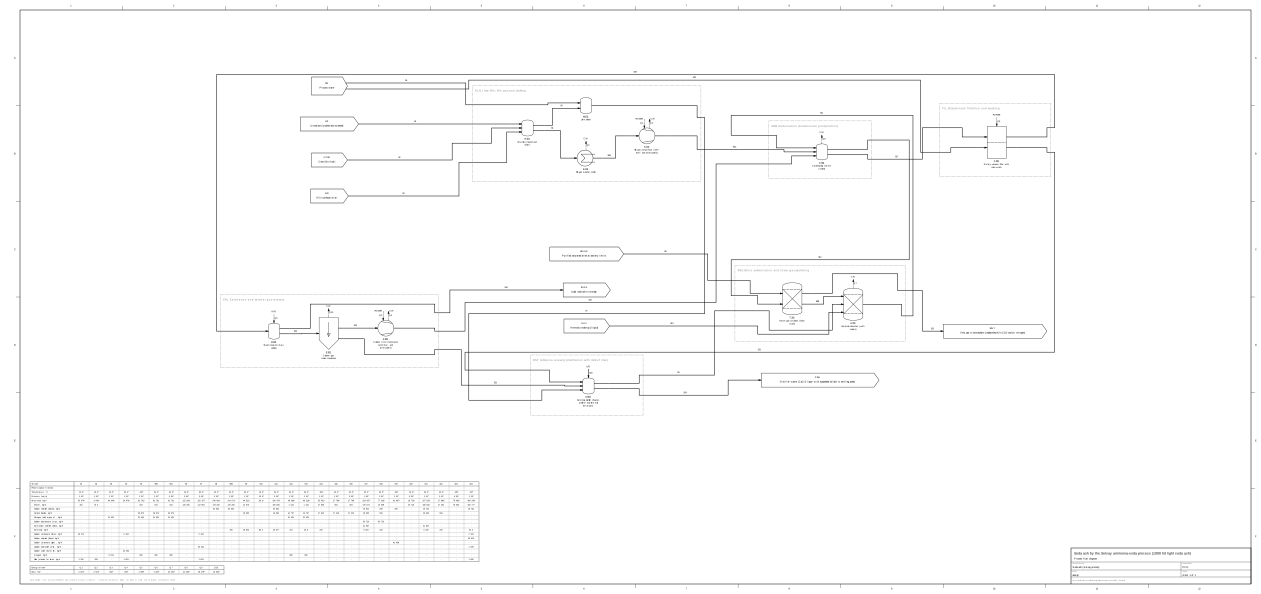
Limestone is burnt with coke in a mixed-feed shaft kiln; the kiln gas (about 37 mol% CO2) and the CO2 recovered from the calciner are compressed to the carbonating towers. Purified brine is ammoniated with the gas of the ammonia distiller and carbonated; sodium bicarbonate precipitates, is filtered, washed and calcined with HP steam to light soda ash. The mother liquor is distilled with milk of lime from the slaker and live steam; the ammonia returns to the absorber, the CaCl2 liquor leaves as distiller waste. Overall CaCO3 + 2 NaCl -> Na2CO3 + CaCl2.

All values are concept estimates from an independent sequential balance with assumed design parameters (sodium utilisation, ammonia ratio, cake moisture, losses): no electrolyte or solid-liquid equilibrium is calculated. The kiln heat use is the lime BREF value for the kiln type. See DESIGN.md for every assumption and gated step.
Capacity
1000 t/d light soda ash (ASSUMED normalisation basis)
Operation
8,000 h/a
Location
generic (not chosen)
Engineering gates
Concept and feasibility (no results yet)
Maintainers
Artur Schweidtmann
Design basis and assumptions (8)
  • ASSUMED sodium utilisation of the carbonating towers 0.73 (NaHCO3 precipitated / NaCl fed), inside the range the Solvay literature reports (D-006).
  • ASSUMED NH3/NaCl 1.10 mol/mol in the ammoniated brine; CO2/free NH3 1.0 in the mother liquor (D-006).
  • ASSUMED washed cake 15 wt% liquid; wash water 0.30 kg/kg dry cake; NH4Cl fully washed out (D-006).
  • ASSUMED ammonia losses 2.0 kg/t soda ash: 0.5 to the vent, 1.5 with the distiller waste (D-006).
  • ASSUMED lime 5 % over the NH4Cl stoichiometry; degree of calcination 0.95; milk of lime 20 wt% Ca(OH)2 (D-004, D-006).
  • ASSUMED kiln heat use 4.0 GJ/t lime (mid-range of the lime BREF for mixed-feed shaft kilns), combustion air excess 1.10 (D-004).
  • ASSUMED duties from a lumped enthalpy balance on formation enthalpies and constant heat capacities; compressor isentropic efficiency 0.75; auxiliary power 35 kWh/t (D-008).
  • No electrolyte thermodynamics: liquors are carried as neutral molecules; no property package covers the streams (D-007).

From process/design-basis.yaml.

Engineering model

Loading the drawing…
Drawing of the process (preview)Open the engineering model

The interactive model (drawings, streams, 3D) is made for larger screens.

Snapshot of c3ab348, cheme-as-code 1.6.0.

What goes in and out

In

  • LimestoneFeedstockfeed:LST: crushed and screened limestone, 1.08 kg/kg soda ash
  • Metallurgical cokeFeedstockfeed:COKE: coke, kiln fuel
  • Sodium chlorideFeedstockfeed:BRINE: purified saturated brine (26 wt-% NaCl) at battery limits, counted by mass of the brine
  • AmmoniaFeedstockfeed:NH3: liquid ammonia make-up
  • WaterFeedstockProcess water for slaking and cake washing (the brine water enters with feed:BRINE)
  • AirFeedstockKiln combustion air

Out

  • Sodium carbonateMain productLight soda ash to storage
  • WastewaterWasteDistiller waste: CaCl2 and NaCl liquor with suspended CaCO3, Ca(OH)2 and insolubles, ~11 t/t soda ash
  • Carbon dioxideEmissionUnabsorbed kiln CO2 (calcination and coke) in the vent gas, ~0.31 t/t soda ash

Utilities: Electricity, Steam (LP steam 450 kPa(a), live steam to the distiller), Steam (HP steam 3000 kPa(a) to the calciner), Cooling water (25/35 C (ASSUMED))

Show in the process graph

Reactions

IdAs writtenReactionOther processes
BICARB2 NaHCO3(s) → Na2CO3(s) + CO2(g) + H2O(g) · Bicarbonate calcination (steam calciner)2NaHCO3givesNa2CO3+CO2+H2O
CALCCaCO3(s) → CaO(s) + CO2(g) · Limestone calcination (lime kiln)CaCO3givesCaO+CO21 other process
CARBNaCl(aq) + NH3(aq) + CO2(g) + H2O(l) → NaHCO3(s) + NH4Cl(aq) · Carbonation and bicarbonate precipitation (carbonating towers)NaCl+NH3+CO2+H2OgivesNaHCO3+NH4Cl
COMBC(s) + O2 → CO2 · Coke combustion (lime kiln)C+O2givesCO2
DISTCa(OH)2(s) + 2 NH4Cl(aq) → CaCl2(aq) + 2 NH3(g) + 2 H2O(l) · Ammonia liberation with milk of lime (distiller)CaH2O2+2NH4ClgivesCaCl2+2NH3+2H2O
SLAKECaO(s) + H2O(l) → Ca(OH)2(s) · Lime slakingCaO+H2OgivesCaH2O22 other processes

Each reaction's page has the conversion, heat of reaction, catalyst and sources this process states, next to those of other processes with the same reaction. All reactions

Life cycle assessment

0.306kg CO2-eqpartial, 10 data gaps

Climate change per 1 kg Light soda ash, cradle-to-gate

Main contributors
  • CO2 to the environment100 %
Contributions, baseline
0.3062 kg CO2-eq0.3062 kg CO2-eqCO2 to the environment0.3062 kg CO2-eqCO2 to the environment: 0.3062 kg CO2-eqOperation0.3062 kg CO2-eqOperation: 0.3062 kg CO2-eq1 kg Light soda ash0.3062 kg CO2-eq1 kg Light soda ash: 0.3062 kg CO2-eq

Each flow of the inventory into its phase, the phases into the functional unit; band widths are impacts. Hatched: a credit.

Method and data
Goal
Preliminary foreground (gate-to-gate) life cycle inventory of light soda ash by the Solvay process at the concept stage: which raw materials, utilities, emissions and wastes the balanced flowsheet implies per kg of product, ready to be linked to background datasets later. Flows are concept estimates on assumed design parameters (DESIGN.md D-006, D-008).
Functional unit
1 kg Light soda ash (1 kg sodium carbonate)
Boundary
cradle-to-gate
Allocation
none
Characterisation
Factors kept with the process · GWP100
Data quality
Published factors
Result
partial screening carbon footprint · 10 data gaps
ScenarioClimate change (kg CO2-eq)
baseline0.3062

Inventory per 1 kg Light soda ash (18 flows)

FlowPhaseDirectionQuantityUnitProvenance
Limestone (crushed and screened)operationinput1.082kgassumed
Coke (kiln fuel)operationinput0.08755kgassumed
Kiln combustion airoperationinput0.9827kgassumed
Purified saturated brine at battery limitsoperationinput5.781kgassumed
Ammonia make-up (liquid)operationinput0.001999kgassumed
Process wateroperationinput3.48kgassumed
LP steam 450 kPa(a), live steam to the distilleroperationinput1.884kgassumed
HP steam 3000 kPa(a) to the calciner (condensate returned)operationinput0.6763kWhassumed
Electric poweroperationinput0.1119kWhassumed
Light soda ash to storageoperationoutput1kgassumed
Distiller waste (CaCl2 liquor with suspended solids) to settling pondsoperationoutput11.19kgassumed
Vent gas to atmosphere (unabsorbed kiln CO2 and air nitrogen)operationoutput1.109kgassumed
Cooling water returnoperationoutput1.466kWhassumed
CO2 to the environmentoperationoutput0.3062kgassumed
H2O to the environmentoperationoutput0.02746kgassumed
N2 to the environmentoperationoutput0.7543kgassumed
NH3 to the environmentoperationoutput0.0005003kgassumed
O2 to the environmentoperationoutput0.02076kgassumed

Computed by ChemE-as-Code from lca/README.md, lca/dataset.yaml, lca/factors.yaml, lca/gaps.csv, lca/inventory.csv, lca/lca.yaml, lca/mappings.yaml, lca/results.csv, lca/results.md, lca/uncertainty.csv.

In the open LCI database (cheme-as-code-atlas-preview-c3ab348) as Sodium carbonate, Light soda ash to storage.

Download it for Brightway, openLCA and other tools.

In the LCI database: system model, datasets and KPIs against the benchmarks

In the LCI database

System model
attributional, cut-off (methodology 1.1.0)
Allocation
none (single-output, from study) · product:SODA 100 %
Allocation findings
none
Change report
Not available: this build has no change report against an earlier release.
Dataset pages
Sodium carbonate, Light soda ash to storage

KPI benchmark positions: not available (no benchmarked KPI for this process's datasets).

Maturity and review

Design maturity Concept (claimed): An idea or first flowsheet; numbers are rough. Concept BFD/PFD with closed mass, component and element balances (cheme validate, cheme process streams: 6 blocks, 12 steps, reactive balances by extents). All flows and compositions are specified values of an independent balance (scripts/solvay_balance.py) on assumed design parameters; no electrolyte speciation or reciprocal-salt equilibrium is calculated, and no property package covers the liquors and solids, so energy closure is not evaluable in core: the duties are a lumped script estimate. The kiln uses the specific-energy fallback of cheme process furnace (Cantera not available in this installation). The gate-to-gate LCI is preliminary, with every background unmapped. Not reviewed.

Calculation maturity, from the checked evidenceNot assessed

The process has no maturity report (cheme maturity, checks/maturity.json), so no calculation maturity is established.

No level shownThe design maturity (Concept) is the manifest's claim, not evidence. A level appears here once the process's repository holds a current report from cheme maturity --write.

Artifact completeness

Which deliverables exist. They never raise a calculation maturity level: a drawing from unchecked numbers is still unchecked.

Not reported without a maturity report.

Independent review

Not independently reviewed

No independent engineering review yet. Automated checks passing is not a review.

Set by people only. Reaching a calculation maturity level or passing automated checks is not an independent review or an approval.

Where the evidence comes from
Report
processes/soda-ash-1/checks/maturity.json (not in the library)
Design basis
process/design-basis.yaml
Method
How ChemE-as-Code checks the levels (requirement by requirement)

Open items

Sources

Engineering project
Soda ash (Solvay process) · cheme-as-code>=0.8
Library version
c3ab348 (process last changed in c3ab348)
Drawings rendered by
cheme 1.6.0 (pyDEXPI 2.1.0)
Data
Catalog record (JSON) · CC-BY-4.0
Files
View the files on GitHub · change history and authors

References

  • Thieme, C. (2000) Sodium Carbonates. Ullmann's Encyclopedia of Industrial Chemistry (route reference lead; production sections not audited in this run) · doi:10.1002/14356007.a24_299
  • European Commission JRC (2013) Best Available Techniques Reference Document for the Production of Cement, Lime and Magnesium Oxide, Schorcht et al., EUR 26129 EN, Table 2.23 (kiln heat use by type) · doi:10.2788/12850
  • European Commission (2007) Reference Document on Best Available Techniques for the Manufacture of Large Volume Inorganic Chemicals - Solid and Others industry (soda ash chapter; consumption and emission ranges to audit, not read in this run)
  • EMEP/EEA air pollutant emission inventory guidebook, chapter 2.B.7 Soda ash (vented CO2 range per t soda ash; cross-check only)
  • Wagman, D. D. et al. (1982) The NBS tables of chemical thermodynamic properties. J. Phys. Chem. Ref. Data 11, Suppl. 2 (formation enthalpies; values to be checked)

How to cite

For the data, cite the Process Atlas paper; for the platform that builds and checks it, the ChemE-as-Code paper.

Schweidtmann, A. M. & Weber, J. M. (2026, in preparation). Process Atlas: an open, git-native, reproducible library and life cycle inventory of chemical processes (working title).

For this process: "Soda ash by the Solvay ammonia-soda process (1000 t/d light ash, concept)", ChemE-as-Code process library, version c3ab348.

BibTeX
@unpublished{schweidtmann_process_atlas,
  author = {Schweidtmann, Artur M. and Weber, Jana M.},
  title = {{Process Atlas: an open, git-native, reproducible library and life cycle inventory of chemical processes (working title)}},
  year = {2026},
  url = {https://atlas.cheme-as-code.org},
  note = {in preparation}
}

Schweidtmann, A. M. (2026, in preparation). ChemE-as-Code: An Open-Source Platform for AI-Accelerated Chemical Process Engineering (working title).

BibTeX
@unpublished{schweidtmann_cheme_as_code,
  author = {Schweidtmann, Artur M.},
  title = {{ChemE-as-Code: An Open-Source Platform for AI-Accelerated Chemical Process Engineering (working title)}},
  year = {2026},
  url = {https://cheme-as-code.org},
  note = {in preparation}
}