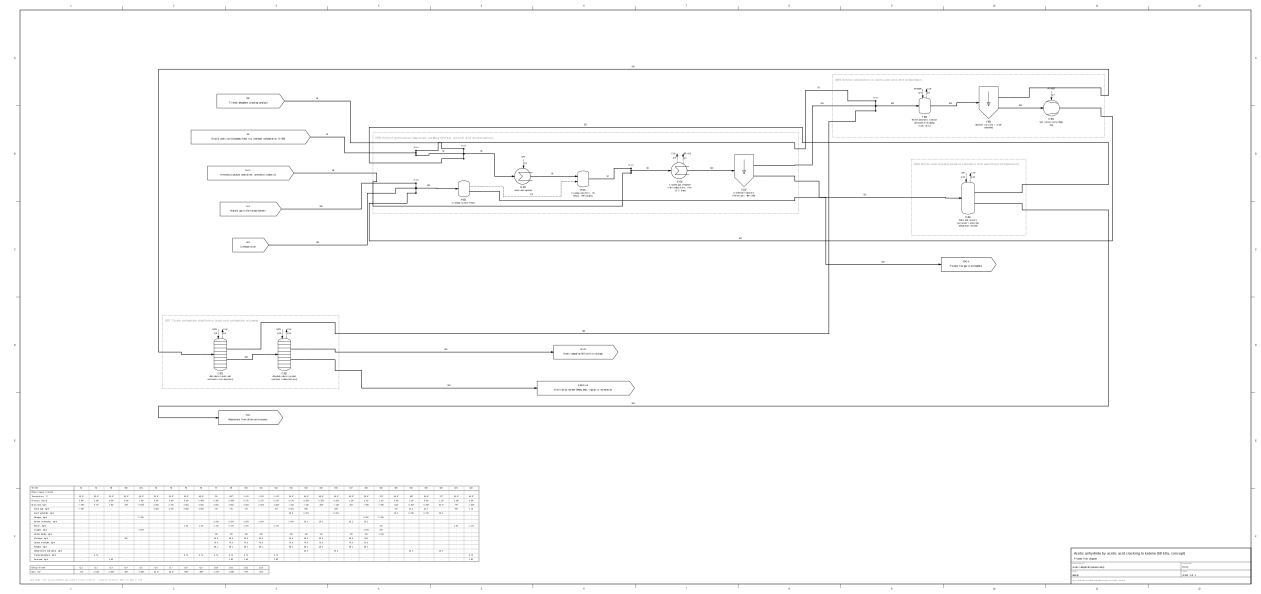
Glacial acetic acid (a boundary feed) is vaporised and cracked in a fired tubular furnace at 700 C and about 36 kPa(a) with triethyl phosphate; ammonia neutralises the catalyst at the coil outlet. The cracked gas is condensed to -5 C (cooling water, then brine), which removes the reaction water and the unconverted acid as dilute acid. The ketene is absorbed and reacted in acetic acid to crude anhydride, which an acid column and an anhydride column refine; the dilute acid is recovered (extraction and azeotropic dehydration, lumped) and recycled, and the absorber vent gas is burned in the furnace with natural gas.
The cracking conversion (0.84) and ketene selectivity (0.92) are the example of a published patent (US 4,455,439); the absorber, column and acid-recovery performances, all duties and the capacity are assumed concept values from an independent balance script. See DESIGN.md of the engineering files for every assumption and gated step.