
Acetic anhydride by the ketene route (acetic acid cracking, 50 kt/a, concept)

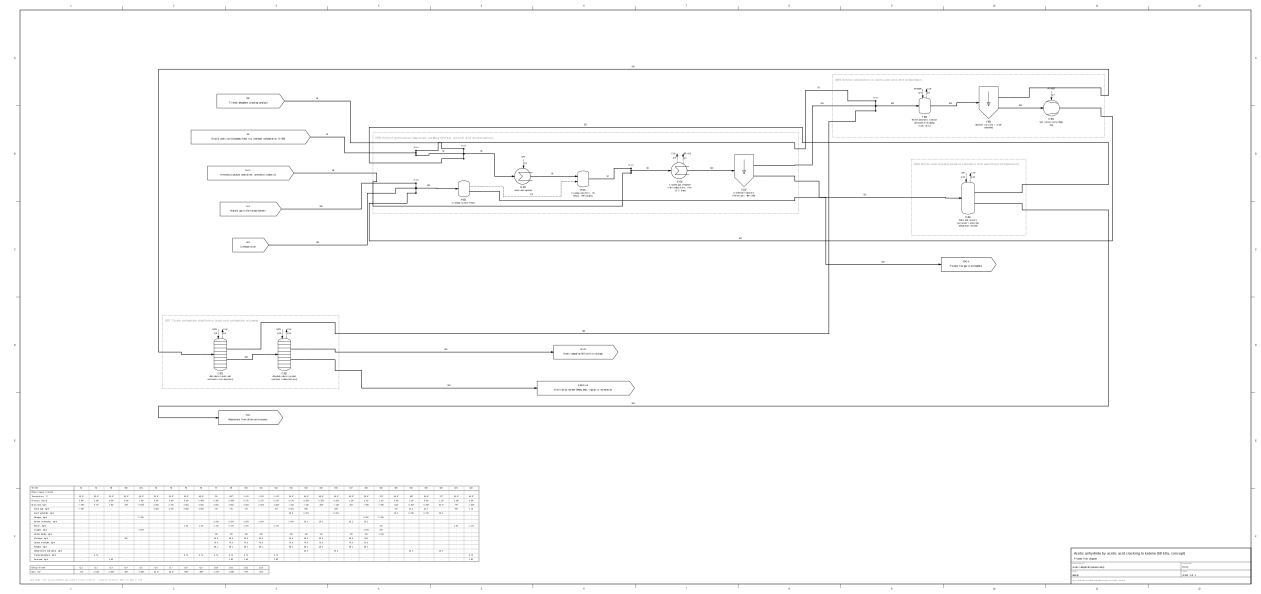
Acetic acid cracked to ketene at 700 C under vacuum with a triethyl phosphate catalyst, ketene absorbed and reacted in acetic acid, crude anhydride distilled to 99.5 wt%; the dilute acid is recovered and the vent gas fuels the furnace. Concept stage, assumed basis.

Calculation maturity: not assessedDesign maturity: Concept (research)Not independently reviewedOxygenatesReport a problem with this process
Research outputNot engineering advice and not an approved design: do not use it for construction, operation or safety decisions. What this means

Overview

Glacial acetic acid (a boundary feed) is vaporised and cracked in a fired tubular furnace at 700 C and about 36 kPa(a) with triethyl phosphate; ammonia neutralises the catalyst at the coil outlet. The cracked gas is condensed to -5 C (cooling water, then brine), which removes the reaction water and the unconverted acid as dilute acid. The ketene is absorbed and reacted in acetic acid to crude anhydride, which an acid column and an anhydride column refine; the dilute acid is recovered (extraction and azeotropic dehydration, lumped) and recycled, and the absorber vent gas is burned in the furnace with natural gas.

The cracking conversion (0.84) and ketene selectivity (0.92) are the example of a published patent (US 4,455,439); the absorber, column and acid-recovery performances, all duties and the capacity are assumed concept values from an independent balance script. See DESIGN.md of the engineering files for every assumption and gated step.
Capacity
50 kt/a acetic anhydride 99.5 wt% (ASSUMED)
Operation
8,000 h/a
Location
generic (not chosen)
Engineering gates
Concept and feasibility (no results yet)
Maintainers
Artur Schweidtmann
Design basis and assumptions (8)
  • Cracking at 700 C and 36 kPa(a) at the coil outlet with triethyl phosphate, acetic acid conversion 0.84 per pass and 0.92 kmol ketene per kmol acid converted: the example of US 4,455,439 (D-005). A sourced conversion model, not kinetics.
  • ASSUMED split of the 8 % cracking loss: half acid decomposition to CH4 + CO2, half ketene decomposition to ethylene + CO (D-005).
  • Cracked gas condensed to -5 C at 27 kPa(a), cooling water then -10 C brine (US 4,455,439 example); the ketene gas leaves dry (ASSUMED, D-006).
  • ASSUMED absorber: 99 % of the ketene absorbed, 99 % of it to anhydride and 1 % to heavy ends; crude 88 wt% anhydride; vent acid vapour neglected (D-007).
  • ASSUMED distillation: acid column distillate 98 wt% acid recycled to the absorbers, reflux ratio 3; anhydride column reflux ratio 1, residue 50 wt% anhydride (D-008).
  • ASSUMED dilute acid recovery: 99 % of the acid recovered at 99.8 wt%, 3.0 MJ LP steam per kg water in the dilute acid (D-009).
  • ASSUMED firebox: complete combustion, 15 % excess air, stack 443 K, 2 % radiation loss (D-010).
  • All flows and duties are concept estimates from scripts/ac2o_balance.py; no property method for these mixtures is qualified by ChemE-as-Code; accuracy not stated.

From process/design-basis.yaml.

Engineering model

Loading the drawing…
Drawing of the process (preview)Open the engineering model

The interactive model (drawings, streams, 3D) is made for larger screens.

Snapshot of c3ab348, cheme-as-code 1.6.0.

What goes in and out

In

  • Acetic acidFeedstockfeed:AA: glacial acetic acid, the main feed, 1.246 kg/kg product (e.g. from acetic-acid-1, D-003)
  • Triethyl phosphateFeedstockfeed:TEP: cracking catalyst triethyl phosphate, 1.6 g/kg
  • AmmoniaFeedstockfeed:NH3: ammonia, the catalyst neutraliser, 0.3 g/kg (e.g. from ammonia-1)
  • MethaneFeedstockNatural gas to the cracking furnace, taken as methane (D-010)
  • AirFeedstockCombustion air of the furnace

Out

  • Acetic anhydrideMain productAcetic anhydride 99.5 wt% to storage
  • WastewaterWasteWastewater of the dilute acid recovery, about 0.65 wt% acetic acid
  • Carbon dioxideEmissionCO2 of the furnace flue gas (natural gas and vent gas burned), 0.195 kg/kg product

Utilities: Electricity (Vent vacuum pump and absorber circulation pumps), Steam (LP steam 450 kPa(a), vaporiser and dilute acid recovery (feed:LPS); MP steam 1500 kPa(a), distillation reboilers (feed:MPS); both in kWh of heat delivered), Cooling water (25/35 C (ASSUMED)), Chilled water (Brine at -10 C on the last cracked-gas condensers; the registry has chilled water, not brine (closest entry))

Show in the process graph

Reactions

IdAs writtenReactionOther processes
ABSORBCH2CO + CH3COOH → (CH3CO)2OC2H2O+C2H4O2givesC4H6O3
COMB_C2H4C2H4 + 3 O2 → 2 CO2 + 2 H2OC2H4+3O2gives2CO2+2H2O3 other processes
COMB_CH4CH4 + 2 O2 → CO2 + 2 H2OCH4+2O2givesCO2+2H2O9 other processes
COMB_COCO + 0.5 O2 → CO22CO+O2gives2CO27 other processes
COMB_KETCH2CO + 2 O2 → 2 CO2 + H2OC2H2O+2O2gives2CO2+H2O
CRACKCH3COOH → CH2CO + H2OC2H4O2givesC2H2O+H2O
DECARBCH3COOH → CH4 + CO2C2H4O2givesCH4+CO2
KETDEC2 CH2CO → C2H4 + 2 CO2C2H2OgivesC2H4+2CO
OLIGO4 CH2CO → C8H8O4 (heavy ends, lumped as dehydroacetic acid)4C2H2OgivesC8H8O4

Each reaction's page has the conversion, heat of reaction, catalyst and sources this process states, next to those of other processes with the same reaction. All reactions

Life cycle assessment

No footprint assessed yet; the process is part of the life-cycle inventory below.

In the open LCI database (cheme-as-code-atlas-preview-c3ab348) as Acetic anhydride 99.5 wt% to storage Preliminary.

Download it for Brightway, openLCA and other tools.

In the LCI database: system model, datasets and KPIs against the benchmarks

In the LCI database

Status
Preliminary 4 unmapped exchanges. Some exchanges have no background mapping yet: they are exported unlinked and count no burden, so the inventory is incomplete.
System model
attributional, cut-off (methodology 1.1.0)
Allocation
mass (single-output, from default) · product:AC2O 100 %
Allocation findings
none
Change report
Not available: this build has no change report against an earlier release.
Dataset pages
Acetic anhydride 99.5 wt% to storage Preliminary

KPI benchmark positions: not available (no benchmarked KPI for this process's datasets).

Maturity and review

Design maturity Concept (claimed): An idea or first flowsheet; numbers are rough. Concept PFD with closed mass, component and element balances on every block and step (cheme validate, cheme process streams; overall 14 892 kg/h in and out). The cracking coil, absorber and firebox outlets are calculated by cheme conversion reactors; the separator, column and acid-recovery outlets, all temperatures, pressures and duties are ASSUMED values from scripts/ac2o_balance.py. Energy closure is not evaluable in core (no property package covers acetic acid, ketene, anhydride and water); the script closes it on its own property data. Preliminary gate-to-gate LCI with every background unmapped (11 gaps). Not reviewed. Main products and feeds are listed under chemistry with their chemicals registry entries (issue #251).

Calculation maturity, from the checked evidenceNot assessed

The process has no maturity report (cheme maturity, checks/maturity.json), so no calculation maturity is established.

No level shownThe design maturity (Concept) is the manifest's claim, not evidence. A level appears here once the process's repository holds a current report from cheme maturity --write.

Artifact completeness

Which deliverables exist. They never raise a calculation maturity level: a drawing from unchecked numbers is still unchecked.

Not reported without a maturity report.

Independent review

Not independently reviewed

No independent engineering review yet. Automated checks passing is not a review.

Set by people only. Reaching a calculation maturity level or passing automated checks is not an independent review or an approval.

Where the evidence comes from
Report
processes/acetic-anhydride-1/checks/maturity.json (not in the library)
Design basis
process/design-basis.yaml
Method
How ChemE-as-Code checks the levels (requirement by requirement)

Open items

Sources

Engineering project
Acetic anhydride (ketene route) · cheme-as-code>=0.8
Library version
c3ab348 (process last changed in c3ab348)
Drawings rendered by
cheme 1.6.0 (pyDEXPI 2.1.0)
Data
Catalog record (JSON) · CC-BY-4.0
Files
View the files on GitHub · change history and authors

References

How to cite

For the data, cite the Process Atlas paper; for the platform that builds and checks it, the ChemE-as-Code paper.

Schweidtmann, A. M. & Weber, J. M. (2026, in preparation). Process Atlas: an open, git-native, reproducible library and life cycle inventory of chemical processes (working title).

For this process: "Acetic anhydride by the ketene route (acetic acid cracking, 50 kt/a, concept)", ChemE-as-Code process library, version c3ab348.

BibTeX
@unpublished{schweidtmann_process_atlas,
  author = {Schweidtmann, Artur M. and Weber, Jana M.},
  title = {{Process Atlas: an open, git-native, reproducible library and life cycle inventory of chemical processes (working title)}},
  year = {2026},
  url = {https://atlas.cheme-as-code.org},
  note = {in preparation}
}

Schweidtmann, A. M. (2026, in preparation). ChemE-as-Code: An Open-Source Platform for AI-Accelerated Chemical Process Engineering (working title).

BibTeX
@unpublished{schweidtmann_cheme_as_code,
  author = {Schweidtmann, Artur M.},
  title = {{ChemE-as-Code: An Open-Source Platform for AI-Accelerated Chemical Process Engineering (working title)}},
  year = {2026},
  url = {https://cheme-as-code.org},
  note = {in preparation}
}