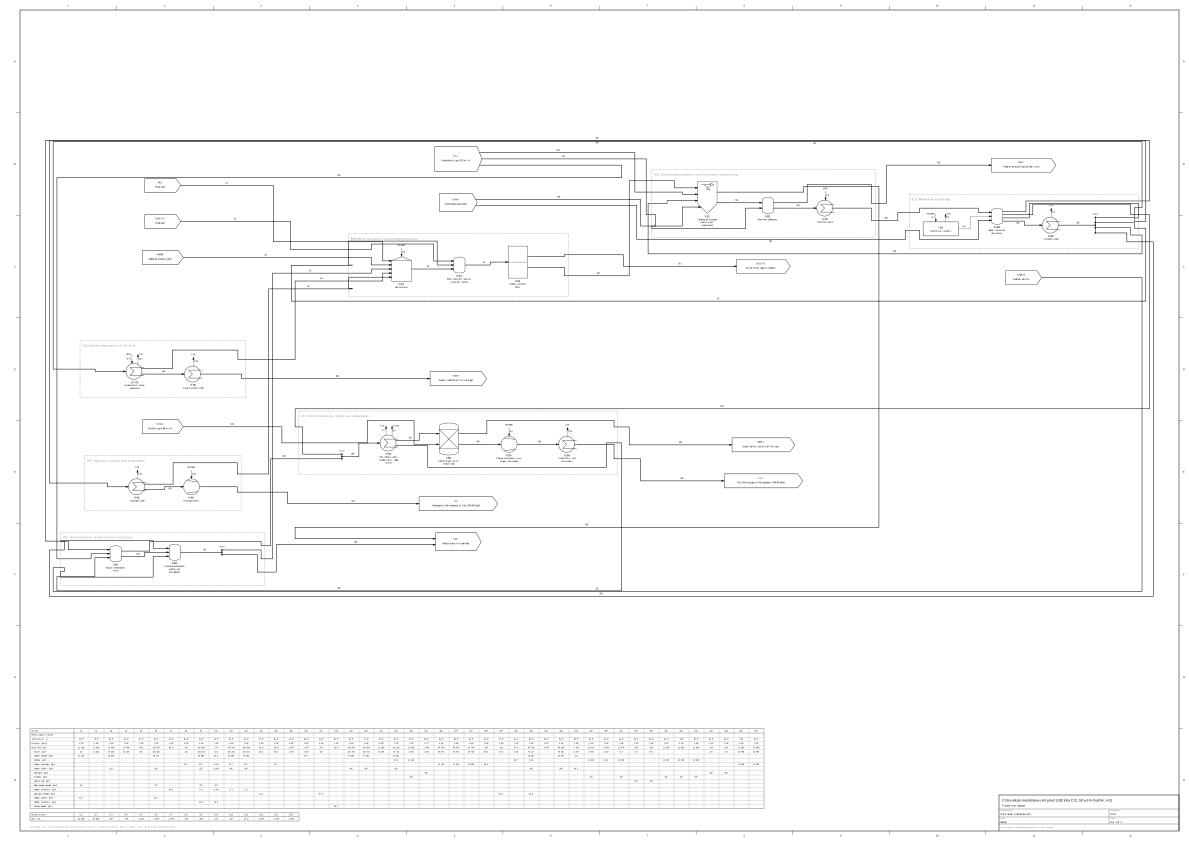
Bipolar membrane-cell electrolysis of recirculated rock-salt brine to dry chlorine gas, 50 wt-% caustic soda and hydrogen, with brine purification, dechlorination, chlorine drying and compression and double-effect caustic evaporation. Concept stage, balanced PFD and a preliminary unallocated gate-to-gate inventory.
Research outputNot engineering advice and not an approved design: do not use it for construction, operation or safety decisions. What this means
Overview
Rock salt is dissolved in return brine and purified (soda ash and caustic precipitation,
filtration, chelating ion exchange), acidified, heated and fed to bipolar membrane
electrolysers at 6.0 kA/m2 and 3.0 V (EU BREF 2014). The cells are balanced by cheme's
Faraday model with a specified voltage and current efficiency (0.965; the rest forms anodic
oxygen), never a predicted one. The depleted brine is dechlorinated under vacuum and with
sulfite, purged against sulfate and resaturated. Wet chlorine is cooled, dried with sulfuric
acid and compressed to 400 kPa(a); hydrogen is cooled and blown to 140 kPa(a); the 32 wt-%
catholyte is evaporated to 50 wt-%.
All values are concept estimates from an independent balance script whose inputs are
sourced (EU BREF 2014) or assumed; electrolyte enthalpies are not modelled, so the duties
outside the cells are first estimates. See DESIGN.md for every decision and gated step.
Capacity
100 kt/a dry chlorine gas (12.5 t/h contained Cl2), ASSUMED
Operation
8,000 h/a
Location
generic (not chosen)
Engineering gates
Concept and feasibility (no results yet)
Maintainers
Artur Schweidtmann
Design basis and assumptions (3)
D-001 boundary: salt to dry compressed Cl2, 50 wt-% NaOH and wet low-pressure H2; no liquefaction, no HCl or hypochlorite production, no H2 drying
D-006 the balance is a specified-split model (scripts/balance.py); electrolyte enthalpies are not modelled
Construction, transport and end of life are outside the preliminary LCI (D-013)
Each reaction's page has the conversion, heat of reaction, catalyst and sources this process states, next to those of other processes with the same reaction. All reactions
Life cycle assessment
Footprint not publishedThe process changed since the LCA was last run; its values return once it is run again. Method, functional unit and inventory are below.
Method and data
Goal
Preliminary gate-to-gate life cycle inventory of membrane-cell chlor-alkali electrolysis for the concept stage: the foreground exchanges of the balanced flowsheet (D-006) per kg of dry chlorine gas, with caustic soda and hydrogen as co-products (mass of the contained products, D-013), ready to be linked to background datasets later. No impact assessment is claimed.
Functional unit
1 kg Dry chlorine gas (1 kg chlorine)
Boundary
gate-to-gate
Allocation
shares
Characterisation
Factors kept with the process · GWP100
Data quality
Published factors
Result
partial screening carbon footprint · 12 data gaps
Inventory per 1 kg Dry chlorine gas (34 flows)
Flow
Phase
Direction
Quantity
Unit
Provenance
Rock salt
operation
input
0.7962
kg
assumed
Make-up process water
operation
input
0.4327
kg
assumed
Demineralised water
operation
input
0.5232
kg
assumed
Soda ash
operation
input
0.003581
kg
assumed
Hydrochloric acid 32 wt-%
operation
input
0.01578
kg
assumed
Sodium sulfite
operation
input
0.0001281
kg
assumed
Sulfuric acid 98 wt-%
operation
input
0.008884
kg
assumed
Electric power (AC, grid)
operation
input
1.21
kWh
assumed
MP steam 1000 kPa(a)
operation
input
0.2553
kWh
assumed
Dry chlorine gas to the consumer (400 kPa(a))
operation
output
1.008
kg
assumed
Caustic soda 50 wt-% to storage
operation
output
2.24
kg
assumed
Hydrogen to the consumer or fuel (140 kPa(a))
operation
output
0.0434
kg
assumed
Spent sulfuric acid to off-site use
operation
output
0.01155
kg
assumed
Waste water to treatment
operation
output
0.2261
kg
assumed
Brine filter cake to landfill
operation
output
0.01021
kg
assumed
Feed brine acidification vent to air
operation
output
0.0011
kg
assumed
Cooling water return
operation
output
0.4026
kWh
assumed
Chilled water return
operation
output
0.005409
kWh
assumed
CO2 to the environment
operation
output
0.0011
kg
assumed
CaCO3 to the environment
operation
output
0
kg
assumed
CaSO4 to the environment
operation
output
0
kg
assumed
Cl2 to the environment
operation
output
0
kg
assumed
H2 to the environment
operation
output
0
kg
assumed
H2O to the environment
operation
output
0.1979
kg
assumed
HCl to the environment
operation
output
0
kg
assumed
MgCl2 to the environment
operation
output
0
kg
assumed
MgOH2 to the environment
operation
output
0
kg
assumed
Na2CO3 to the environment
operation
output
0
kg
assumed
Na2SO3 to the environment
operation
output
0
kg
assumed
Na2SO4 to the environment
operation
output
0.00136
kg
assumed
NaCl to the environment
operation
output
0.02691
kg
assumed
NaOH to the environment
operation
output
0
kg
assumed
O2 to the environment
operation
output
0
kg
assumed
SiO2 to the environment
operation
output
0
kg
assumed
Computed by ChemE-as-Code from lca/README.md, lca/dataset.yaml, lca/factors.yaml, lca/gaps.csv, lca/inventory.csv, lca/lca.yaml, lca/mappings.yaml, lca/results.csv, lca/results.md.
KPI benchmark positions: not available (no benchmarked KPI for this process's datasets).
Maturity and review
Design maturity Concept (claimed): An idea or first flowsheet; numbers are rough. Concept PFD with closed mass, component and element balances in every block and step (cheme validate, cheme process streams; reactive extents agree with the elements). The electrolysers are checked by cheme process cell (specified 3.0 V, CE 0.965, side reaction O2): DC 2 351 kWh/t Cl2, AC 2 423 kWh/t with rectifier losses, inside the EU BREF 2014 Table 3.10 bipolar range 2 279-2 865. The other units are specified values of scripts/balance.py; energy balances outside the cell are not evaluable in core (no property package for NaCl/NaOH electrolytes). Consumptions per t Cl2 (salt 1.71 t, steam 0.98 t, HCl 10.9 kg, Na2CO3 7.7 kg, H2SO4 18.7 kg, purge 0.33 m3) fall inside the BREF 2014 Chapter 3 ranges, which is a plausibility check, not a validation. Main products and feeds are listed under chemistry with their chemicals registry entries (issue #251). cheme maturity reaches no level yet: the feed flows are design choices (ASSUMED, not sourced or owner-given) and the treatment steps are specified values. Not reviewed.
Calculation maturity, from the checked evidenceNot assessed
The process has no maturity report (cheme maturity, checks/maturity.json), so no calculation maturity is established.
No level shownThe design maturity (Concept) is the manifest's claim, not evidence. A level appears here once the process's repository holds a current report from cheme maturity --write.
Artifact completeness
Which deliverables exist. They never raise a calculation maturity level: a drawing from unchecked numbers is still unchecked.
Not reported without a maturity report.
Independent review
Not independently reviewed
No independent engineering review yet. Automated checks passing is not a review.
Set by people only. Reaching a calculation maturity level or passing automated checks is not an independent review or an approval.
Where the evidence comes from
Report
processes/chlor-alkali-1/checks/maturity.json(not in the library)
European Commission JRC (2014) Best Available Techniques (BAT) Reference Document for the Production of Chlor-alkali (Brinkmann, Giner Santonja, Schorcht, Roudier, Delgado Sancho) · doi:10.2791/13138
Cox, J.D., Wagman, D.D., Medvedev, V.A. (1989) CODATA Key Values for Thermodynamics. Hemisphere, New York
How to cite
For the data, cite the Process Atlas paper; for the platform that builds and checks it, the ChemE-as-Code paper.
Schweidtmann, A. M. & Weber, J. M. (2026, in preparation). Process Atlas: an open, git-native, reproducible library and life cycle inventory of chemical processes (working title).
For this process: "Chlor-alkali by membrane-cell electrolysis (100 kt/a Cl2, 50 wt-% caustic soda, hydrogen)", ChemE-as-Code process library, version c3ab348.
BibTeX
@unpublished{schweidtmann_process_atlas,
  author = {Schweidtmann, Artur M. and Weber, Jana M.},
  title = {{Process Atlas: an open, git-native, reproducible library and life cycle inventory of chemical processes (working title)}},
  year = {2026},
  url = {https://atlas.cheme-as-code.org},
  note = {in preparation}
}
Schweidtmann, A. M. (2026, in preparation). ChemE-as-Code: An Open-Source Platform for AI-Accelerated Chemical Process Engineering (working title).
BibTeX
@unpublished{schweidtmann_cheme_as_code,
  author = {Schweidtmann, Artur M.},
  title = {{ChemE-as-Code: An Open-Source Platform for AI-Accelerated Chemical Process Engineering (working title)}},
  year = {2026},
  url = {https://cheme-as-code.org},
  note = {in preparation}
}