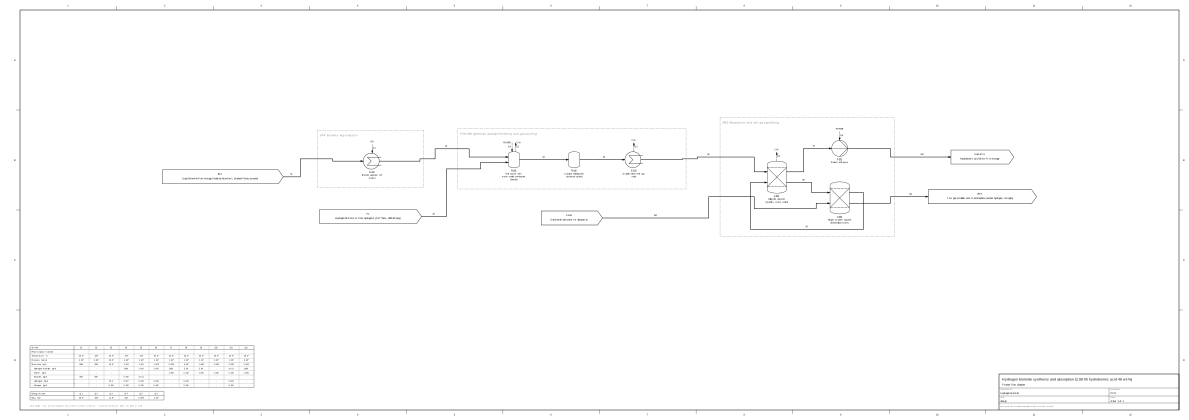
Hydrogen bromide synthesis burner with catalytic finishing and absorption (48 wt-% hydrobromic acid)
Bromine vapour burnt in a 5 % excess of hydrogen in a water-cooled burner, the residual bromine converted on an activated-carbon bed, the HBr gas absorbed in a graphite falling-film absorber to 48 wt-% hydrobromic acid and the tail gas scrubbed with the absorption water; bromine (bromine-1, planned) and hydrogen (hydrogen-1) as boundary feeds. Concept stage, 8 kt/a HBr, assumed basis.
Research outputNot engineering advice and not an approved design: do not use it for construction, operation or safety decisions. What this means
Overview
Liquid bromine is vaporised with LP steam at 300 kPa(a) and burnt with hydrogen from
hydrogen-1 in a burner whose chamber is cooled by water; 99.97 % of the bromine reacts in
the flame (a sourced flame-reactor result), the rest on an adiabatic activated-carbon
finishing bed at about 175 degC. A graphite block cooler takes the gas to 60 degC and an
isothermal falling-film absorber dissolves it in weak acid from the tail gas scrubber to
48 wt-% acid, just above the 47.6 wt-% azeotrope. All absorption water passes the scrubber
first; the excess hydrogen and the nitrogen of the hydrogen feed leave through the vent.
All values are concept estimates. The reactor outlets and the burner duty are calculated by
cheme (a sourced conversion for the burner, ideal-gas equilibrium for the finishing bed); the absorber and scrubber are specified values from an
independent balance script, and the acid's enthalpy rests on an assumed heat of solution
because no ChemE-as-Code property method covers HBr-water yet. See DESIGN.md of
the engineering files for every assumption and gated step.
D-001 boundary: liquid bromine and hydrogen gas at the fence to 48 wt-% acid in storage and the vent; no anhydrous HBr product, no acid storage or loading, no utility generation
D-005 R101 converts 99.97 % of the Br2 (sourced flame-reactor result), R102 the rest (equilibrium limit); no kinetics
D-006 the balance is a specified-split model (scripts/balance.py); the acid enthalpy rests on an ASSUMED heat of solution
Construction, transport and end of life are outside the preliminary LCI (D-012)
The interactive model (drawings, streams, 3D) is made for larger screens.
Snapshot of c3ab348, cheme-as-code 1.6.0.
What goes in and out
In
BromineFeedstockfeed:BR2, liquid bromine (e.g. bromine-1), 0.988 kg per kg HBr
HydrogenFeedstockHydrogen 99.9 mol-% from hydrogen-1 (feed:H2: 0.0133 kg per kg HBr), 5 mol-% excess
WaterFeedstockDemineralised water for the absorption (feed:DMW), 1.08 kg per kg HBr
Out
Hydrogen bromideMain productHydrobromic acid 48 wt-% to storage, counted by mass of the acid (2.083 kg per kg HBr)
HydrogenEmissionExcess hydrogen vented after the tail gas scrubber, 0.62 g per kg HBr
Utilities:Steam (LP steam 450 kPa(a) for the bromine vaporiser, 0.058 kWh (0.098 kg) per kg HBr), Electricity (Pump, burner management, instruments and analysers (ASSUMED)), Cooling water (25/35 C (ASSUMED), burner, gas cooler and absorber, 0.41 kWh per kg HBr)
Each reaction's page has the conversion, heat of reaction, catalyst and sources this process states, next to those of other processes with the same reaction. All reactions
Life cycle assessment
–kg CO2-eqPreliminarypartial, 6 data gaps
Climate change per 1 kg Hydrobromic acid 48 wt-%, gate-to-gate
No factors. No contribution is characterised, so no factor stands behind any number.
Main contributors
Method and data
Goal
Preliminary gate-to-gate life cycle inventory of hydrobromic acid (48 wt-%) by burning bromine vapour in hydrogen with catalytic finishing and absorption in water, for the concept stage: the foreground exchanges of the balanced flowsheet (D-006) per kg of contained HBr, ready to be linked to background datasets (bromine-1's bromine and hydrogen-1's hydrogen first). No impact assessment is claimed.
Functional unit
1 kg Hydrobromic acid 48 wt-% (1 kg hydrogen bromide)
Boundary
gate-to-gate
Characterisation
Factors kept with the process · GWP100
Data quality
No factors
Result
partial screening carbon footprint · 6 data gaps
Scenario
Climate change (kg CO2-eq)
baseline
no total (data gaps)
Inventory per 1 kg Hydrobromic acid 48 wt-% (13 flows)
Flow
Phase
Direction
Quantity
Unit
Provenance
Liquid bromine from storage (made by bromine-1, planned library process)
operation
input
0.9875
kg
assumed
Hydrogen 99.9 mol-% from hydrogen-1 (S17 there, 2850 kPa(a))
operation
input
0.01326
kg
assumed
Demineralised water for absorption
operation
input
1.083
kg
assumed
LP steam 450 kPa(a) (condensate returned)
operation
input
0.058
kWh
assumed
Electric power (AC, grid)
operation
input
0.00308
kWh
assumed
Hydrobromic acid 48 wt-% to storage
operation
output
2.083
kg
assumed
Tail gas scrubber vent to atmosphere (excess hydrogen, nitrogen)
operation
output
0.000935
kg
assumed
Cooling water return
operation
output
0.4106
kWh
assumed
Br2 to the environment
operation
output
0
kg
assumed
H2 to the environment
operation
output
0.000623
kg
assumed
H2O to the environment
operation
output
0.00013
kg
assumed
HBr to the environment
operation
output
0.00000003618
kg
assumed
N2 to the environment
operation
output
0.000182
kg
assumed
Computed by ChemE-as-Code from lca/README.md, lca/dataset.yaml, lca/factors.yaml, lca/gaps.csv, lca/inventory.csv, lca/lca.yaml, lca/mappings.yaml, lca/results.csv, lca/results.md.
Download it for Brightway, openLCA and other tools.
In the LCI database: system model, datasets and KPIs against the benchmarks
In the LCI database
Status
Preliminary 1 unmapped exchange. Some exchanges have no background mapping yet: they are exported unlinked and count no burden, so the inventory is incomplete.
System model
attributional, cut-off (methodology 1.1.0)
Allocation
mass (single-output, from default) · product:HBRACID 100 %
Allocation findings
none
Change report
Not available: this build has no change report against an earlier release.
KPI benchmark positions: not available (no benchmarked KPI for this process's datasets).
Maturity and review
Design maturity Concept (claimed): An idea or first flowsheet; numbers are rough. Concept PFD with closed mass, component and element balances (cheme validate, cheme process streams). The burner and finishing-bed outlets are calculated by cheme (99.97 % Br2 conversion in the flame from US 3 988 427 A; the carbon bed as an ideal-gas equilibrium reactor, K = 1.1e13 at 448 K, leaving a Br2 mole fraction of 4e-12); cheme maturity reaches no level (assumed feed flows, specified absorber and scrubber splits); cheme's burner duty (166.4 kW) equals the independent script's. The absorber, the scrubber and the acid's heat of solution are specified or ASSUMED values: no property package covers Br2/HBr gas or HBr-water, so energy closure is not evaluable in core. The preliminary gate-to-gate LCI closes in mass and in Br and H; every background is a gap. Not reviewed. Main products and feeds are listed under chemistry with their chemicals registry entries (issue #251).
Calculation maturity, from the checked evidenceNot assessed
The process has no maturity report (cheme maturity, checks/maturity.json), so no calculation maturity is established.
No level shownThe design maturity (Concept) is the manifest's claim, not evidence. A level appears here once the process's repository holds a current report from cheme maturity --write.
Artifact completeness
Which deliverables exist. They never raise a calculation maturity level: a drawing from unchecked numbers is still unchecked.
Not reported without a maturity report.
Independent review
Not independently reviewed
No independent engineering review yet. Automated checks passing is not a review.
Set by people only. Reaching a calculation maturity level or passing automated checks is not an independent review or an approval.
Where the evidence comes from
Report
processes/hydrogen-bromide-1/checks/maturity.json(not in the library)
Bromine Compounds. Ullmann's Encyclopedia of Industrial Chemistry, Wiley-VCH (route identity from issue #130; full text not read) · doi:10.1002/14356007.a04_405
For the data, cite the Process Atlas paper; for the platform that builds and checks it, the ChemE-as-Code paper.
Schweidtmann, A. M. & Weber, J. M. (2026, in preparation). Process Atlas: an open, git-native, reproducible library and life cycle inventory of chemical processes (working title).
For this process: "Hydrogen bromide synthesis burner with catalytic finishing and absorption (48 wt-% hydrobromic acid)", ChemE-as-Code process library, version c3ab348.
BibTeX
@unpublished{schweidtmann_process_atlas,
  author = {Schweidtmann, Artur M. and Weber, Jana M.},
  title = {{Process Atlas: an open, git-native, reproducible library and life cycle inventory of chemical processes (working title)}},
  year = {2026},
  url = {https://atlas.cheme-as-code.org},
  note = {in preparation}
}
Schweidtmann, A. M. (2026, in preparation). ChemE-as-Code: An Open-Source Platform for AI-Accelerated Chemical Process Engineering (working title).
BibTeX
@unpublished{schweidtmann_cheme_as_code,
  author = {Schweidtmann, Artur M.},
  title = {{ChemE-as-Code: An Open-Source Platform for AI-Accelerated Chemical Process Engineering (working title)}},
  year = {2026},
  url = {https://cheme-as-code.org},
  note = {in preparation}
}