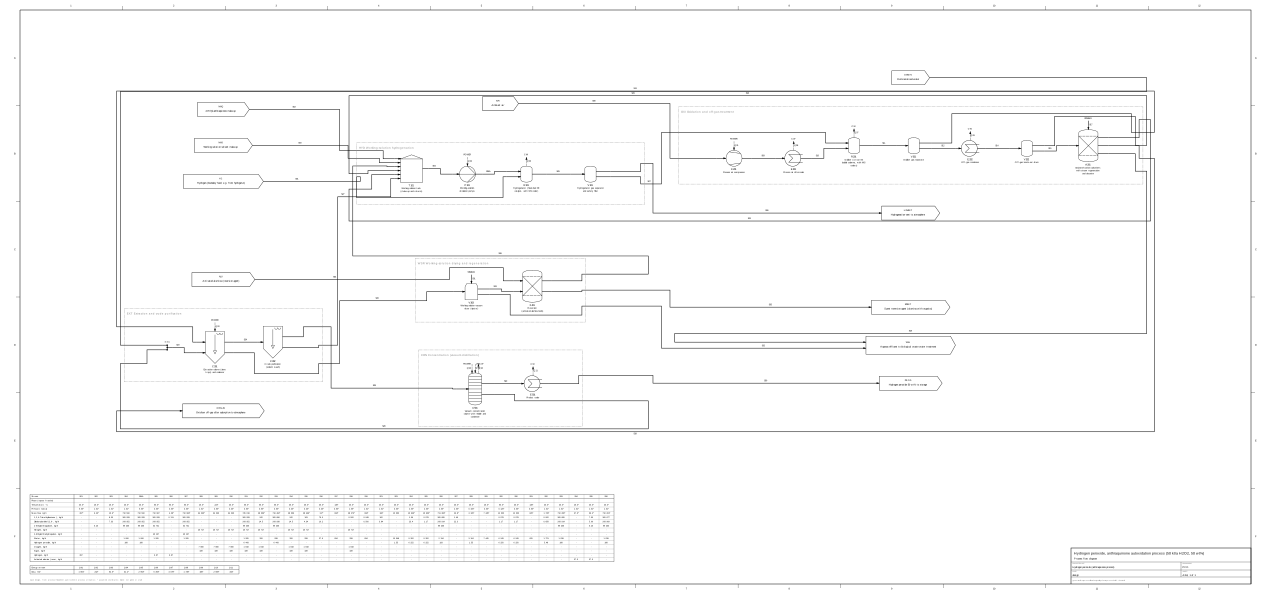
Hydrogen peroxide by the anthraquinone autoxidation process (50 kt/a H2O2, 50 wt%)
Cyclic hydrogenation of a 2-ethylanthraquinone working solution on palladium, autoxidation with air, water extraction, crude purification and vacuum concentration to 50 wt% H2O2, with working-solution drying and alumina regeneration; hydrogen is a boundary feed. Concept stage, assumed basis set inside the EU LVOC BREF ranges.
Research outputNot engineering advice and not an approved design: do not use it for construction, operation or safety decisions. What this means
Overview
A working solution of 2-ethylanthraquinone in a C9 aromatic / diisobutylcarbinol mixture is
hydrogenated over a fixed-bed Pd catalyst (45 % of the quinone per pass), separated from the
vent gas, filtered and oxidised with compressed air in bubble columns, which forms H2O2 and
regenerates the quinone. The H2O2 is extracted with water to a 40 wt% crude, washed with
solvent and concentrated to 50 wt% in a vacuum column whose distillate returns as extraction
water. The raffinate working solution is dried, part-regenerated on activated alumina and
returned. The oxidiser off-gas passes a condenser and steam-regenerated activated carbon.
All values are concept estimates (scripts/hp_balance.py of the engineering files): the
conversions, splits and duties are design choices set inside the ranges the EU LVOC BREF
2017 (chapter 12) reports, not plant or licensor data; see DESIGN.md for every assumption
and gated step.
Capacity
50 kt/a H2O2 (100 %) as 50 wt% solution (ASSUMED)
Operation
8,000 h/a
Location
generic (not chosen)
Engineering gates
Concept and feasibility (no results yet)
Maintainers
Artur Schweidtmann
Design basis and assumptions (9)
ASSUMED working solution: 2-ethylanthraquinone 14 wt% in 60:40 (mass) 1,2,4-trimethylbenzene : diisobutylcarbinol, 0.15 wt% water, 930 kg/m3; 'anthra' system, no tetrahydro derivatives modelled (D-004).
ASSUMED hydrogenation: fixed-bed Pd, 333 K, 400 kPa(a), 45 % of the quinone hydrogenated per pass (BREF: < 60 %), residual H2O2 in the recycled WS destroyed on the catalyst, 1 % of the H2 feed vented (D-003, D-005).
ASSUMED oxidation: air, 328 K, 350 kPa(a) (BREF 40-70 C, atmospheric-10 bar), complete oxidation of the hydroquinone (D-005, D-007).
ASSUMED extraction: 97 % of the H2O2 to a 40 wt% crude (BREF 20-50 wt%), raffinate 0.30 wt% water; a specified split, not an equilibrium-stage calculation (D-008).
ASSUMED concentration: vacuum column 10-12 kPa(a), reflux ratio 0.3, distillate 0.05 wt% H2O2 recycled to the extraction, no vapour recompression (D-010).
ASSUMED off-gas treatment: condenser at 308 K, activated carbon to 20 mg C/Nm3 (inside the BREF Table 12.8 plant values), regeneration steam 5 kg/kg (BREF 4-6) (D-009).
ASSUMED no H2O2 decomposition other than the hydrogenation of the residual H2O2 (D-005); stabilisers, nitric acid, caustic, Pd catalyst, activated carbon and ion-exchange resin are consumables outside the flowsheet (lca/lca.yaml, D-011).
Heats of reaction: oxidation 77.5 kJ/mol (BREF 12.3.4 d); hydrogenation -110.3 kJ/mol derived by Hess's law (D-005).
All flows and duties are concept estimates from scripts/hp_balance.py (D-006); accuracy not stated, roughly +/-30 %.
HydrogenFeedstockPure H2 at 500 kPa(a), 63.5 kg/t H2O2 (ASSUMED boundary feed; e.g. from processes/hydrogen-1)
AirFeedstockDry air for the oxidation, 30 % O2 excess (ASSUMED)
WaterFeedstockDemineralised water to the extraction, 1.19 t/t H2O2. The working-solution solvent make-up (feed:MKS, C9 aromatic and diisobutylcarbinol) has no registry entry yet
Out
Hydrogen peroxideMain productHydrogen peroxide 50 wt% to storage, counted by mass of the solution
WastewaterWasteDryer water, ejector and adsorber condensate with dissolved organics and H2O2, to biological treatment
NitrogenEmissionOxidiser off-gas after activated carbon: N2, O2, Ar, water and residual VOC to atmosphere
Utilities:Electricity (Air compressor, working-solution and auxiliary pumps, vacuum pump (ASSUMED electric drives)), Steam (LP steam 350 kPa(a) to the concentrator reboiler), Steam (LP steam used directly: adsorber regeneration and the WS dryer ejector), Cooling water (25/35 C (ASSUMED))
Each reaction's page has the conversion, heat of reaction, catalyst and sources this process states, next to those of other processes with the same reaction. All reactions
Life cycle assessment
Footprint not publishedThe process changed since the LCA was last run; its values return once it is run again. Method, functional unit and inventory are below.
Method and data
Goal
Preliminary gate-to-gate life cycle inventory of 50 wt% hydrogen peroxide by the anthraquinone process at the concept stage, for the process library: the foreground exchanges per kg of product with their provenance, and the list of backgrounds still to link. Not an impact result: every background is a gap.
Functional unit
1 kg Hydrogen peroxide 50 wt% (1 kg hydrogen peroxide)
Boundary
gate-to-gate
Characterisation
Factors kept with the process · GWP100
Data quality
No factors
Result
partial screening carbon footprint · 20 data gaps
Inventory per 1 kg Hydrogen peroxide 50 wt% (31 flows)
Flow
Phase
Direction
Quantity
Unit
Provenance
Hydrogen (boundary feed; e.g. from hydrogen-1)
operation
input
0.03176
kg
assumed
2-Ethylanthraquinone make-up
operation
input
0.0005
kg
assumed
Working-solution solvent make-up
operation
input
0.00125
kg
assumed
Ambient air
operation
input
2.723
kg
assumed
Demineralised water
operation
input
0.5956
kg
assumed
Activated alumina (reversion agent)
operation
input
0.003
kg
assumed
LP steam, direct use (adsorber regeneration, ejector)
operation
input
0.1167
kg
assumed
Electric power
operation
input
0.1773
kWh
assumed
LP steam 350 kPa(a), indirect
operation
input
0.2371
kWh
assumed
Hydrogen peroxide 50 wt% to storage
operation
output
1
kg
calculated
Hydrogenation vent to atmosphere
operation
output
0.0003264
kg
assumed
Oxidiser off-gas after adsorption to atmosphere
operation
output
2.262
kg
assumed
Aqueous effluent to biological waste water treatment
operation
output
0.2049
kg
assumed
Spent reversion agent (alumina with organics)
operation
output
0.0045
kg
assumed
Cooling water return
operation
output
1.233
kWh
assumed
AR to the environment
operation
output
0.03509
kg
assumed
DIBC to the environment
operation
output
0
kg
assumed
H2 to the environment
operation
output
0.0003175
kg
assumed
H2O to the environment
operation
output
0.02387
kg
assumed
N2 to the environment
operation
output
2.057
kg
assumed
O2 to the environment
operation
output
0.1455
kg
assumed
TMB to the environment
operation
output
0.00004893
kg
assumed
Nitric acid (100 % basis; pH adjustment and passivation)
operation
input
0.002
kg
assumed
Disposal: Nitric acid (100 % basis; pH adjustment and passivation) (neutralised nitrate to biological waste water treatment)
operation
output
0.002
kg
assumed
Sodium hydroxide (100 % basis)
operation
input
0.001
kg
assumed
Disposal: Sodium hydroxide (100 % basis) (neutralised sodium salts to biological waste water treatment)
operation
output
0.001
kg
assumed
Activated carbon (off-gas adsorbers A-201)
operation
input
0.00005
kg
assumed
Disposal: Activated carbon (off-gas adsorbers A-201) (incineration or reactivation of spent activated carbon)
operation
output
0.00005
kg
assumed
Ion-exchange resin (crude purification)
operation
input
0.0000075
kg
assumed
Disposal: Ion-exchange resin (crude purification) (incineration of spent ion-exchange resin)
operation
output
0.0000075
kg
assumed
Palladium lost from the hydrogenation catalyst (as Pd)
operation
input
0.0000001
kg
assumed
Computed by ChemE-as-Code from lca/README.md, lca/dataset.yaml, lca/factors.yaml, lca/gaps.csv, lca/inventory.csv, lca/lca.yaml, lca/mappings.yaml, lca/results.csv, lca/results.md.
Download it for Brightway, openLCA and other tools.
In the LCI database: system model, datasets and KPIs against the benchmarks
In the LCI database
Status
Preliminary 15 unmapped exchanges. Some exchanges have no background mapping yet: they are exported unlinked and count no burden, so the inventory is incomplete.
System model
attributional, cut-off (methodology 1.1.0)
Allocation
mass (single-output, from default) · product:PROD 100 %
Allocation findings
none
Change report
Not available: this build has no change report against an earlier release.
KPI benchmark positions: not available (no benchmarked KPI for this process's datasets).
Maturity and review
Design maturity Concept (claimed): An idea or first flowsheet; numbers are rough. Concept PFD with closed mass, component and element (reaction extent) balances in every block and step (cheme validate, cheme process streams). The reactors are conversion models calculated by cheme; the separator outlets and all duties are specified values from an independent script (scripts/hp_balance.py) whose specifications sit inside the EU LVOC BREF 2017 ranges (H2 63.5 kg/t, air 4215 Nm3/t, demineralised water 1.19 t/t, total energy about 3.6 GJ/t). Energy closure is not evaluable in core, the extraction is a specified split. cheme maturity: calculation maturity none (feed flows and separator specifications assumed, not sourced). The preliminary gate-to-gate LCI in lca/ leaves every background unmapped (gaps); its mass and element balances close. Not reviewed. Main products and feeds are listed under chemistry with their chemicals registry entries (issue #251).
Calculation maturity, from the checked evidenceNot assessed
The process has no maturity report (cheme maturity, checks/maturity.json), so no calculation maturity is established.
No level shownThe design maturity (Concept) is the manifest's claim, not evidence. A level appears here once the process's repository holds a current report from cheme maturity --write.
Artifact completeness
Which deliverables exist. They never raise a calculation maturity level: a drawing from unchecked numbers is still unchecked.
Not reported without a maturity report.
Independent review
Not independently reviewed
No independent engineering review yet. Automated checks passing is not a review.
Set by people only. Reaching a calculation maturity level or passing automated checks is not an independent review or an approval.
Where the evidence comes from
Report
processes/hydrogen-peroxide-1/checks/maturity.json(not in the library)
Falcke, H. et al. (2017) Best Available Techniques (BAT) Reference Document for the Production of Large Volume Organic Chemicals, EUR 28882 EN, JRC, chapter 12 Hydrogen peroxide · doi:10.2760/77304
Goor, G., Glenneberg, J., Jacobi, S. (2007) Hydrogen Peroxide. Ullmann's Encyclopedia of Industrial Chemistry (lead only; not read for this design) · doi:10.1002/14356007.a13_443.pub3
Campos-Martin, J. M., Blanco-Brieva, G., Fierro, J. L. G. (2006) Hydrogen peroxide synthesis: an outlook beyond the anthraquinone process. Angew. Chem. Int. Ed. 45, 6962 (lead only; not read for this design) · doi:10.1002/anie.200503779
For the data, cite the Process Atlas paper; for the platform that builds and checks it, the ChemE-as-Code paper.
Schweidtmann, A. M. & Weber, J. M. (2026, in preparation). Process Atlas: an open, git-native, reproducible library and life cycle inventory of chemical processes (working title).
For this process: "Hydrogen peroxide by the anthraquinone autoxidation process (50 kt/a H2O2, 50 wt%)", ChemE-as-Code process library, version c3ab348.
BibTeX
@unpublished{schweidtmann_process_atlas,
  author = {Schweidtmann, Artur M. and Weber, Jana M.},
  title = {{Process Atlas: an open, git-native, reproducible library and life cycle inventory of chemical processes (working title)}},
  year = {2026},
  url = {https://atlas.cheme-as-code.org},
  note = {in preparation}
}
Schweidtmann, A. M. (2026, in preparation). ChemE-as-Code: An Open-Source Platform for AI-Accelerated Chemical Process Engineering (working title).
BibTeX
@unpublished{schweidtmann_cheme_as_code,
  author = {Schweidtmann, Artur M.},
  title = {{ChemE-as-Code: An Open-Source Platform for AI-Accelerated Chemical Process Engineering (working title)}},
  year = {2026},
  url = {https://cheme-as-code.org},
  note = {in preparation}
}