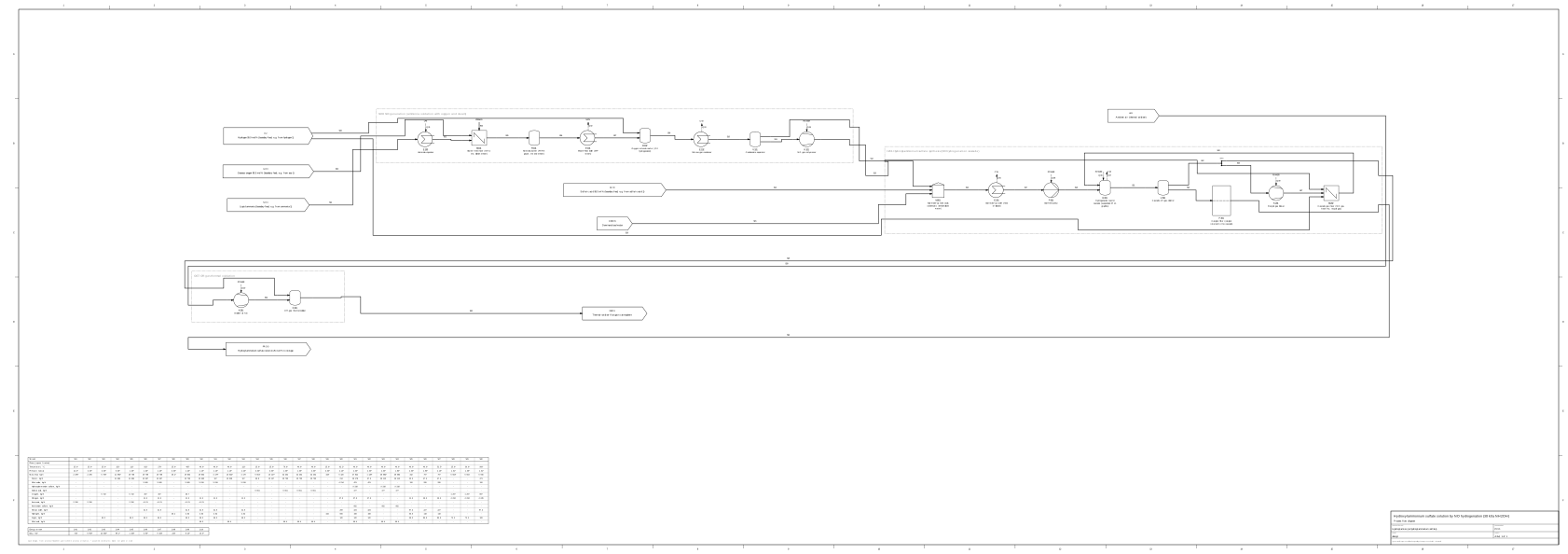
Liquid ammonia is vaporised, mixed with gaseous oxygen and LP steam (14 : 18.6 : 67.4 by volume) and burnt on a Pt/Rh gauze; a waste-heat boiler raises MP steam. The small oxygen excess is hydrogenated on a silver-manganese catalyst, the steam is condensed (the condensate, with a little nitric acid, becomes the acid dilution water) and the NO gas is compressed to a stirred-tank cascade. There NO and hydrogen (H2:NO 2:1) react at 313 K and 200 kPa(a) on a suspended, sulfur-modified Pt/graphite catalyst in about 20 wt% sulfuric acid to hydroxylammonium sulfate, with ammonium sulfate and N2O as by-products. The off-gas is recycled; 30 % is purged to a thermal oxidiser. The product carries 25.4 wt% hydroxylammonium sulfate (10.2 wt% NH2OH), 1.9 wt% ammonium sulfate and 1.3 wt% free acid.
All values are concept estimates (scripts/has_balance.py of the engineering files): burner ratios and yields, O2 removal, product analysis, cascade conditions and selectivities are taken from open patents (US 3,110,563; EP 0 945 401; US 4,895,711; EP 1 343 719; US 4,997,635), the burner N2O from the IPCC 2006 default; the per-pass conversion, purge, pressures and all duties are design choices. See DESIGN.md for every assumption and gated step.