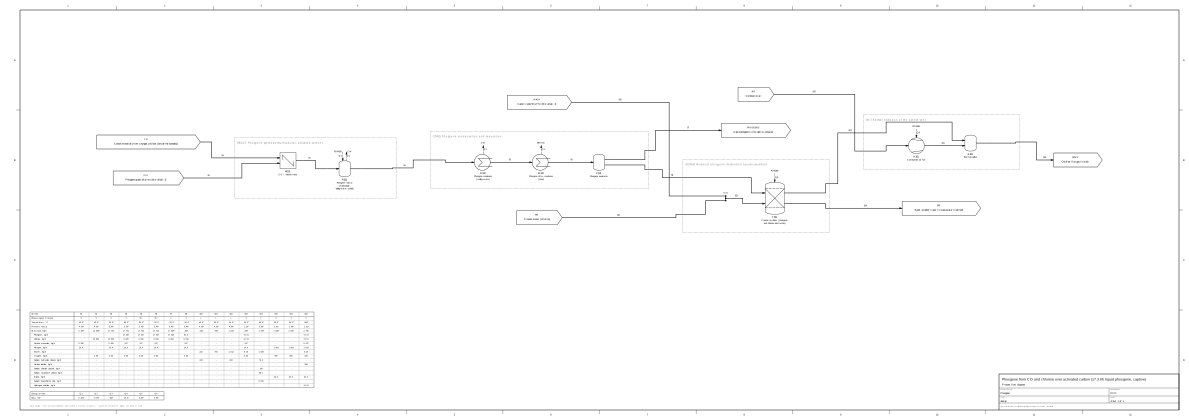
Phosgene-grade chlorine (the 12.5 t/h Cl2 of chlor-alkali-1, after liquefaction and re-evaporation) is mixed with 5 % molar excess carbon monoxide and converted over activated carbon in a multitubular reactor whose shell holds water boiling below atmospheric pressure (the arrangement of EP1640341A2). The outlet is condensed in two stages (cooling water, then brine to 253 K) and the liquid phosgene goes to the captive consumer without storage. The vent (mostly CO, with 9 mol% phosgene) passes a caustic scrubber that destroys the phosgene and chlorine, and a thermal oxidiser that burns the CO to CO2; every emission is explicit in the flue-gas stream and the inventory.
The reactor is a conversion model (99.995 % of the chlorine) checked against the ideal-gas equilibrium by cheme; the condenser and scrubber values come from an independent script (Raoult's law, scripts/balance.py) because no property package of core covers phosgene or the caustic liquor. See DESIGN.md for every assumption and gated step.