
Silicon carbide by the Acheson process (5000 kg/h crude SiC, concept)

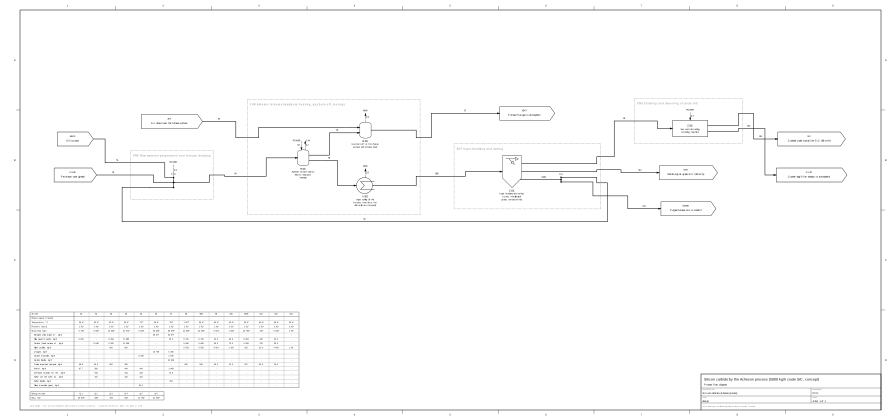
Crude crystalline silicon carbide from silica sand and petroleum coke in batch Acheson resistance furnaces: gas burn-off over the charge, ingot cooling, breaking and sorting with recycle of the unreacted mix, crushing. Electricity per kg, CO and SO2 explicit. Concept stage, assumed basis.

Calculation maturity: not assessedDesign maturity: Concept (research)Not independently reviewedInorganic chemicalsReport a problem with this process
Research outputNot engineering advice and not an approved design: do not use it for construction, operation or safety decisions. What this means

Overview

Silica sand and green petroleum coke are mixed with the unreacted mix of earlier runs and piled around a graphite core in batch Acheson furnaces. Electric resistance heating drives SiO2 + 3 C -> SiC + 2 CO; the CO, the coke volatiles, the sulfur and escaping SiO burn partly with air over the charge and leave through the hood stack. After cooling, the ingot is broken and sorted into crude crystalline SiC, a metallurgical-grade fraction and unreacted mix, which is recycled with a small purge; the crude SiC is crushed and screened.

All values are concept estimates from an independent sequential balance with assumed yields, grades and splits, cross-checked against the IPCC/EPA emission factors for silicon carbide. The furnace electricity is a labelled specific-energy basis (7.5 kWh/kg crude SiC, inside the published range for European plants), because cheme process furnace does not cover carbothermal SiC. See DESIGN.md for every assumption and gated step.
Capacity
5000 kg/h crushed crude crystalline SiC, 40 kt/a (ASSUMED normalisation basis)
Operation
8,000 h/a
Location
generic (not chosen)
Engineering gates
Concept and feasibility (no results yet)
Maintainers
Artur Schweidtmann
Design basis and assumptions (5)
  • ASSUMED furnace electricity 7.5 kWh per kg crude SiC (crystalline + metallurgical), inside the 6.3-9.02 kWh/kg reported for European plants (Mehrwald 1992, cited by Lima and Tenorio 2011) and near 7.15 kWh/kg (Fraunhofer IKTS 2023): a labelled specific-energy basis, since cheme process furnace refuses carbothermal SiC (D-004).
  • ASSUMED product slate: 0.25 kg metallurgical-grade SiC per kg crude crystalline SiC; recycled unreacted mix 3.0 kg/kg; 5 % of the sorted mix purged (D-006).
  • ASSUMED SiO loss 0.005 kmol per kmol SiC formed; CO burnt at the surface 70 %; CH4 slip at the IPCC Tier 1 default 11.6 kg/t SiC; all coke sulfur to SO2 (D-006).
  • ASSUMED auxiliary power 0.15 kWh/kg and crushing 0.10 kWh/kg; transformer and bus-bar losses 2 % of the furnace power to cooling water (D-008).
  • No furnace heat transfer or kinetics model: yields are imposed (D-007). No property package covers the solids or the hot furnace gas (D-007).

From process/design-basis.yaml.

Engineering model

Loading the drawing…
Drawing of the process (preview)Open the engineering model

The interactive model (drawings, streams, 3D) is made for larger screens.

Snapshot of c3ab348, cheme-as-code 1.6.0.

What goes in and out

In

  • Silicon dioxideFeedstockfeed:SAND: silica sand, 1.95 kg/kg crude SiC (unallocated)
  • Petroleum cokeFeedstockfeed:COKE: green petroleum coke, 1.36 kg/kg crude SiC (unallocated)
  • AirFeedstockAir drawn over the furnace for the gas burn-off

Out

  • Silicon carbideMain productCrushed crude crystalline SiC, 98 wt%
  • Silicon carbideCo-productMetallurgical-grade SiC, 88 wt%
  • Carbon dioxideEmissionBurnt furnace gas (fossil carbon of the coke), about 2.1 kg/kg crude SiC unallocated; with CO, CH4, SO2 and silica fume

Utilities: Electricity (Furnace transformers 7.5 kWh/kg crude SiC plus auxiliaries and crushing), Cooling water (Transformer and bus-bar cooling, 25/35 C (ASSUMED))

Show in the process graph

Reactions

IdAs writtenReactionOther processes
CH4XCH4 + 2 O2 → CO2 + 2 H2O · Combustion of the coke volatiles (as CH4)CH4+2O2givesCO2+2H2O9 other processes
COXCO + 0.5 O2 → CO2 · CO burn-off at the charge surface and in the hood2CO+O2gives2CO27 other processes
RX1SiO2(s) + 3 C(s) → SiC(s) + 2 CO(g) · Carbothermal reduction of silica to silicon carbide (Acheson furnace)SiO2+3CgivesSiC+2CO
RX2SiO2(s) + C(s) → SiO(g) + CO(g) · Silicon monoxide formation (SiO escaping the charge)SiO2+CgivesSiO+CO
SIOXSiO + 0.5 O2 → SiO2 · Oxidation of SiO to silica fume2SiO+O2gives2SiO2
SOXS + O2 → SO2 · Oxidation of the coke sulfur to SO2S+O2givesSO21 other process

Each reaction's page has the conversion, heat of reaction, catalyst and sources this process states, next to those of other processes with the same reaction. All reactions

Life cycle assessment

2.03kg CO2-eqPreliminarypartial, 5 data gaps

Climate change per 1 kg Crushed crude crystalline SiC (98 wt%), cradle-to-gate

Main contributors
  • CO2 to the environment83.6 %
  • CH4 to the environment16.4 %
Contributions, baseline
1.695 kg CO2-eq0.3336 kg CO2-eq2.029 kg CO2-eqCO2 to the environment1.695 kg CO2-eqCO2 to the environment: 1.695 kg CO2-eqCH4 to the environment0.3336 kg CO2-eqCH4 to the environment: 0.3336 kg CO2-eqOperation2.029 kg CO2-eqOperation: 2.029 kg CO2-eq1 kg Crushed crude …2.029 kg CO2-eq1 kg Crushed crude crystalline SiC (98 wt%): 2.029 kg CO2-eq

Each flow of the inventory into its phase, the phases into the functional unit; band widths are impacts. Hatched: a credit.

Method and data
Goal
Preliminary foreground (gate-to-gate) life cycle inventory of crude crystalline silicon carbide by the Acheson process at the concept stage: which raw materials, electricity, emissions and wastes the balanced flowsheet implies per kg of product, ready to be linked to background datasets later. Flows are concept estimates on assumed yields and a specific-energy furnace basis (DESIGN.md D-004, D-006). The climate value this study reports is the DIRECT (scope 1) furnace CO2 and CH4 only, NOT a carbon footprint: electricity (about 7.7 kWh per kg after allocation, the largest exchange), coke, sand, cooling water and landfill are gaps, and the uncertainty interval covers only the direct amounts. Fossil CO is not characterised by the method; counted by its atmospheric oxidation to CO2 (44/28 kg CO2 per kg CO) it would add about 0.64 kg CO2-eq per kg (D-010).
Functional unit
1 kg Crushed crude crystalline SiC (98 wt%) (1 kg silicon carbide)
Boundary
cradle-to-gate
Allocation
shares
Characterisation
Factors kept with the process · GWP100
Data quality
Published factors
Result
partial screening carbon footprint · 5 data gaps
ScenarioClimate change (kg CO2-eq)
baseline2.029

Inventory per 1 kg Crushed crude crystalline SiC (98 wt%) (20 flows)

FlowPhaseDirectionQuantityUnitProvenance
Silica sandoperationinput1.563kgassumed
Petroleum coke (green)operationinput1.089kgassumed
Air drawn over the furnace surfaceoperationinput7.415kgassumed
Electric poweroperationinput7.7kWhassumed
Crushed crude crystalline SiC (98 wt%)operationoutput1kgassumed
Metallurgical-grade SiC (88 wt%)operationoutput0.25kgassumed
Purged furnace mix to landfilloperationoutput0.1263kgassumed
Furnace flue gas to atmosphereoperationoutput8.941kgassumed
Crusher bag-filter exhaust to atmosphereoperationoutput0.00016kgassumed
Cooling water returnoperationoutput0.15kWhassumed
Heat to ambient air (natural cooling of the ingot, burn-off heat; no fans)operationoutput5.245kWhassumed
CH4 to the environmentoperationoutput0.01119kgassumed
CO to the environmentoperationoutput0.4056kgassumed
CO2 to the environmentoperationoutput1.695kgassumed
H2O to the environmentoperationoutput0.2351kgassumed
N2 to the environmentoperationoutput5.692kgassumed
O2 to the environmentoperationoutput0.8616kgassumed
SO2 to the environmentoperationoutput0.03263kgassumed
SiC to the environmentoperationoutput0.00016kgassumed
SiO2 to the environmentoperationoutput0.007233kgassumed

Computed by ChemE-as-Code from lca/README.md, lca/dataset.yaml, lca/factors.yaml, lca/gaps.csv, lca/inventory.csv, lca/lca.yaml, lca/mappings.yaml, lca/results.csv, lca/results.md, lca/uncertainty.csv.

In the open LCI database (cheme-as-code-atlas-preview-c3ab348) as Silicon carbide, Crushed crude crystalline SiC (98 wt%) Preliminary; Silicon carbide, Metallurgical-grade SiC (88 wt%) Preliminary.

Download it for Brightway, openLCA and other tools.

In the LCI database: system model, datasets and KPIs against the benchmarks

In the LCI database

Status
Preliminary 4 unmapped exchanges. Some exchanges have no background mapping yet: they are exported unlinked and count no burden, so the inventory is incomplete.
System model
attributional, cut-off (methodology 1.1.0)
Allocation
shares (deviation, from study) · product:MET 20 %, product:SIC 80 %
Allocation findings
none
Change report
Not available: this build has no change report against an earlier release.
Dataset pages
Silicon carbide, Metallurgical-grade SiC (88 wt%) Preliminary · Silicon carbide, Crushed crude crystalline SiC (98 wt%) Preliminary

KPI benchmark positions: not available (no benchmarked KPI for this process's datasets).

Maturity and review

Design maturity Concept (claimed): An idea or first flowsheet; numbers are rough. Concept BFD/PFD with closed mass, component and element balances (cheme validate, cheme process streams: 4 blocks, 7 steps, reactive balances by extents). All flows and compositions are specified values of an independent balance (scripts/sic_balance.py) on assumed yields, grades and splits; no furnace heat transfer, kinetics or SiO/CO gas-solid model is calculated. cheme process furnace supports limestone calcination only and refuses carbothermal SiC, so the furnace electricity is a labelled specific-energy basis; no property package covers the solids or the hot furnace gas, so energy closure is a lumped script estimate. cheme maturity supports no calculation maturity level until the feeds, conversions and sorting split are given with sources; concept is the lowest level the manifest allows. The gate-to-gate LCI is preliminary, with every background unmapped: its climate value (about 2.0 kg CO2-eq per kg, with its interval) is the DIRECT furnace CO2 and CH4 only, NOT a carbon footprint; electricity (about 7.7 kWh/kg, the largest exchange), coke, sand and landfill are gaps, and fossil CO (0.41 kg/kg) is not characterised (about 0.64 kg CO2-eq/kg more if counted as oxidised to CO2). Not reviewed.

Calculation maturity, from the checked evidenceNot assessed

The process has no maturity report (cheme maturity, checks/maturity.json), so no calculation maturity is established.

No level shownThe design maturity (Concept) is the manifest's claim, not evidence. A level appears here once the process's repository holds a current report from cheme maturity --write.

Artifact completeness

Which deliverables exist. They never raise a calculation maturity level: a drawing from unchecked numbers is still unchecked.

Not reported without a maturity report.

Independent review

Not independently reviewed

No independent engineering review yet. Automated checks passing is not a review.

Set by people only. Reaching a calculation maturity level or passing automated checks is not an independent review or an approval.

Where the evidence comes from
Report
processes/silicon-carbide-1/checks/maturity.json (not in the library)
Design basis
process/design-basis.yaml
Method
How ChemE-as-Code checks the levels (requirement by requirement)

Open items

Sources

Engineering project
Silicon carbide (Acheson process) · cheme-as-code>=0.8
Library version
c3ab348 (process last changed in c3ab348)
Drawings rendered by
cheme 1.6.0 (pyDEXPI 2.1.0)
Data
Catalog record (JSON) · CC-BY-4.0
Files
View the files on GitHub · change history and authors

References

How to cite

For the data, cite the Process Atlas paper; for the platform that builds and checks it, the ChemE-as-Code paper.

Schweidtmann, A. M. & Weber, J. M. (2026, in preparation). Process Atlas: an open, git-native, reproducible library and life cycle inventory of chemical processes (working title).

For this process: "Silicon carbide by the Acheson process (5000 kg/h crude SiC, concept)", ChemE-as-Code process library, version c3ab348.

BibTeX
@unpublished{schweidtmann_process_atlas,
  author = {Schweidtmann, Artur M. and Weber, Jana M.},
  title = {{Process Atlas: an open, git-native, reproducible library and life cycle inventory of chemical processes (working title)}},
  year = {2026},
  url = {https://atlas.cheme-as-code.org},
  note = {in preparation}
}

Schweidtmann, A. M. (2026, in preparation). ChemE-as-Code: An Open-Source Platform for AI-Accelerated Chemical Process Engineering (working title).

BibTeX
@unpublished{schweidtmann_cheme_as_code,
  author = {Schweidtmann, Artur M.},
  title = {{ChemE-as-Code: An Open-Source Platform for AI-Accelerated Chemical Process Engineering (working title)}},
  year = {2026},
  url = {https://cheme-as-code.org},
  note = {in preparation}
}