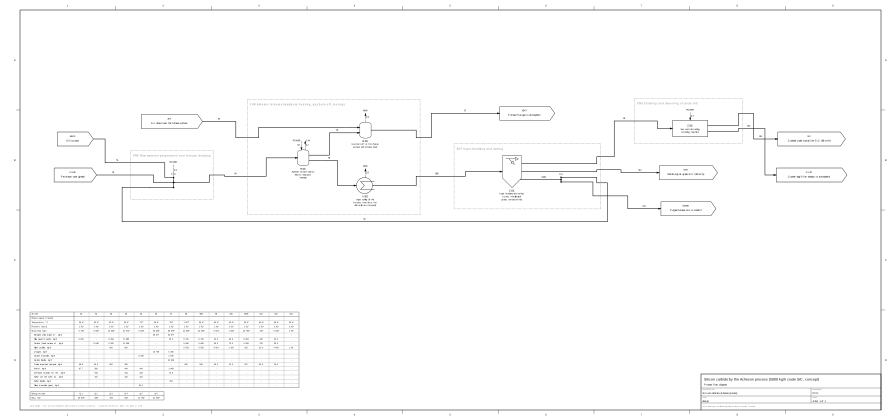
Silica sand and green petroleum coke are mixed with the unreacted mix of earlier runs and piled around a graphite core in batch Acheson furnaces. Electric resistance heating drives SiO2 + 3 C -> SiC + 2 CO; the CO, the coke volatiles, the sulfur and escaping SiO burn partly with air over the charge and leave through the hood stack. After cooling, the ingot is broken and sorted into crude crystalline SiC, a metallurgical-grade fraction and unreacted mix, which is recycled with a small purge; the crude SiC is crushed and screened.
All values are concept estimates from an independent sequential balance with assumed yields, grades and splits, cross-checked against the IPCC/EPA emission factors for silicon carbide. The furnace electricity is a labelled specific-energy basis (7.5 kWh/kg crude SiC, inside the published range for European plants), because cheme process furnace does not cover carbothermal SiC. See DESIGN.md for every assumption and gated step.