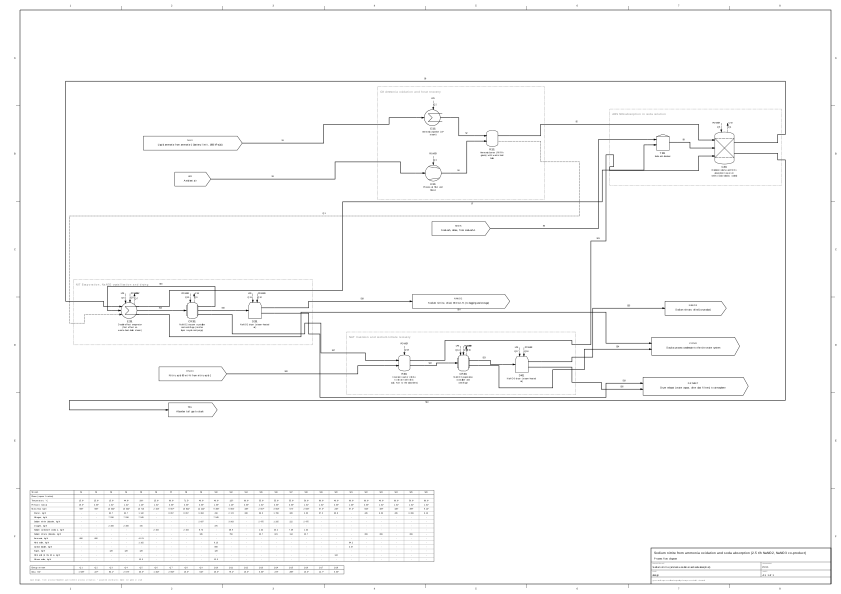
Liquid ammonia is vaporised, mixed with air to 10.3 mol-% and burnt over Pt/Rh gauzes; a waste heat boiler cools the nitrous gas to 200 degC and its steam drives the first effect of the liquor evaporator. In an oxidation volume and absorption towers in series the gas meets a 20 wt-% soda solution; the oxidation degree of the nitric oxide is held near one half (NO : NO2 about 1 : 1, the N2O3 ratio) so that nitrite forms and nitrate stays at about one twentieth of it. The liquor is concentrated, sodium nitrite crystallised by vacuum cooling, centrifuged and dried; most of the mother liquor returns to the evaporator, and a purge that removes the nitrate is converted with nitric acid to sodium nitrate, whose nitric oxide goes back to the absorbers.
All values are concept estimates. The burner outlet and duty are calculated by cheme (conversion reactor, specified selectivities); absorption, crystallisation and inversion are specified values from an independent balance script; the liquors are aqueous electrolytes that no ChemE-as-Code property method covers yet. See DESIGN.md of the engineering files for every assumption and gated step.