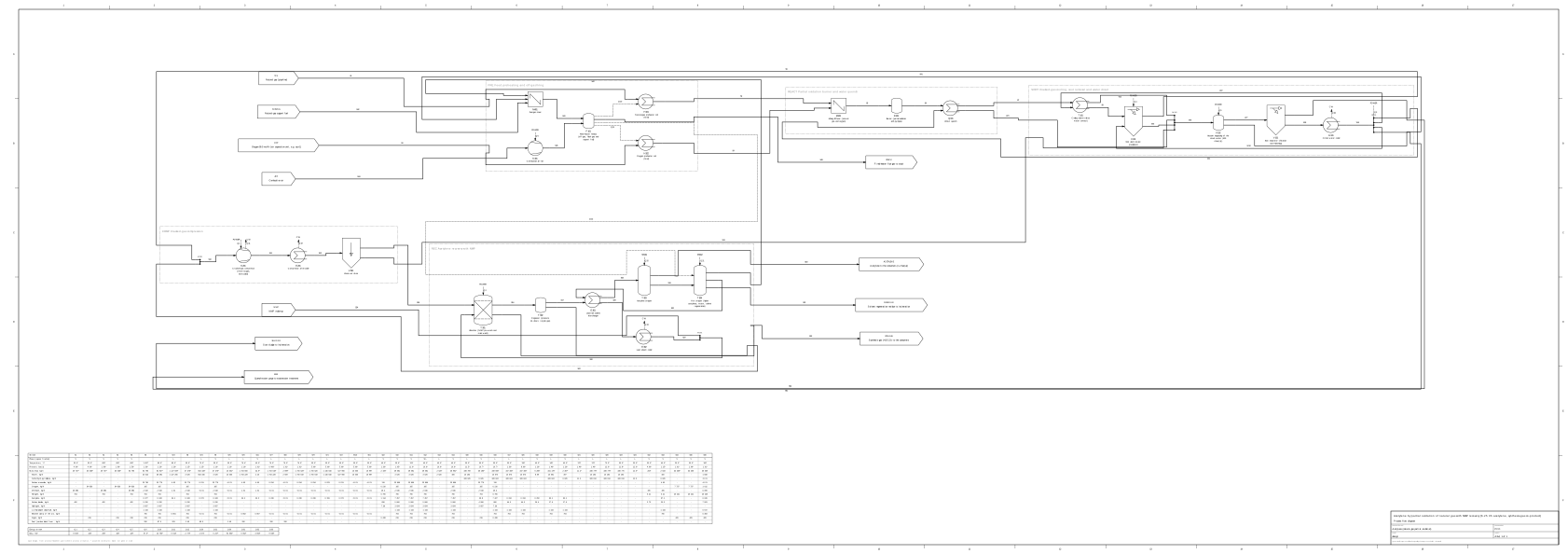
Acetylene by partial oxidation of natural gas with NMP recovery (6.25 t/h, synthesis-gas co-product)
Natural gas and oxygen, preheated to 600 C, react in a BASF-type burner; the cracked gas is water-quenched, freed of soot, compressed and washed with N-methylpyrrolidone, which yields 99.5 % acetylene and leaves a hydrogen-rich synthesis gas as co-product. Concept stage, assumed basis, preliminary gate-to-gate LCI.
Research outputNot engineering advice and not an approved design: do not use it for construction, operation or safety decisions. What this means
Overview
Natural gas (98 % methane) and 99.5 % oxygen are preheated separately to 873 K in a fired
heater, premixed and burnt in a BASF (Sachsse-Bartholome) burner at an O2/natural-gas ratio
of 0.60 (vol); the flame reaches about 1970 K and is quenched with water to 353 K. A cooling
column and a wet electrostatic precipitator remove the soot; the quench water runs in a closed
circuit with vacuum degassing (the dissolved hydrocarbons go to the fired heater), soot
separation and a purge. The cracked gas (7.5 % acetylene) is compressed to 11 bar(a) and
washed with NMP; a degasser recycles the co-absorbed gases to the compressor, the acetylene
stripper delivers the product and a hot stripper removes the higher acetylenes and water,
which are burnt in the fired heater. The unabsorbed gas is synthesis gas (H2/CO 2.15).
The burner is a sourced outlet-composition model (the typical cracked gas of US8975460B2 and
the soot ratio of US5824834A), not kinetics; the O2/natural-gas ratio and the 1970 K flame
follow from the element and energy balances and agree with the patents. Separators, the
NMP section and the duties come from an independent script (scripts/balance.py) because no
property package of core covers soot, the quench water or NMP. See DESIGN.md for every
assumption and gated step.
Capacity
6250 kg/h acetylene (50 kt/a at 8000 h), ASSUMED; 36.2 t/h synthesis gas co-product
Operation
8,000 h/a
Location
generic (not chosen)
Engineering gates
Concept and feasibility (no results yet)
Maintainers
Artur Schweidtmann
Design basis and assumptions (6)
ASSUMED natural gas and oxygen preheated separately to 873 K (600 C), the value of the examples of US5824834A and of US8975460B2 and US11459281B2 (D-004).
Burner as a sourced outlet-composition model (D-005): dry cracked gas of US8975460B2 (H2 56, CH4 5, C2H2 7.5, CO 26, CO2 3.5, higher hydrocarbons 1 vol%), acetylene/soot 22 kg/kg (US5824834A comparative example 2), residual O2 0.1 vol% ASSUMED; O2/NG 0.602 and the adiabatic 1970 K follow.
ASSUMED water quench to 353 K (80-90 C per US11459281B2 claim 1), cooling column to 308 K, ESP; closed water circuit degassed at 400 mbar(a) (99.31 % of the dissolved hydrocarbons, US11459281B2) and cooled to 303 K with cooling water (D-006).
ASSUMED three-stage compression to 11 bar(a), isentropic efficiency 0.78 (D-007).
ASSUMED NMP recovery splits and solvent loading 20 Nm3 C2H2/m3 (inside the 15-35 cited in US10059640B2); 98.0 % of the acetylene formed reaches the product to product (D-009).
All flows, temperatures and duties are concept estimates (scripts/balance.py); accuracy +/-30 % not demonstrated.
OxygenFeedstock99.5 mol% O2 by pipeline from an air separation unit (e.g. asu-1), 5.58 kg/kg acetylene (unallocated)
AirFeedstockCombustion air of the fired preheater, 5.32 kg/kg acetylene
Out
AcetyleneMain productAcetylene gas (99.55 mol%, 1.2 bar(a)) to the consumers
Synthesis gasCo-productSynthesis gas (H2/CO) to the consumers, 5.76 kg/kg acetylene
Carbon dioxideEmission1.19 kg/kg acetylene (unallocated), fossil, from burning the plant's off-gas and support fuel in the fired preheater
WastewaterWasteQuench-water purge, 2.70 kg/kg acetylene, after vacuum degassing; the soot sludge (product:SLUDGE, 0.46 kg/kg, 10 wt% carbon) and the NMP residue (product:RESIDUE) go to incineration
Utilities:Electricity (1.52 kWh/kg acetylene (unallocated): cracked-gas compressor 8.8 MW, pumps, ESP, vacuum pump, air fan), Steam (MP steam 12 bar(a), 1.10 kWh/kg acetylene: acetylene stripper and hot-stripper reboiler), Cooling water (17.7 kWh/kg acetylene, 82 % of it the quench heat removed from the circulating water (25/35 C, ASSUMED))
Each reaction's page has the conversion, heat of reaction, catalyst and sources this process states, next to those of other processes with the same reaction. All reactions
Life cycle assessment
Footprint not publishedThe process changed since the LCA was last run; its values return once it is run again. Method, functional unit and inventory are below.
Method and data
Goal
Preliminary gate-to-gate life cycle inventory of acetylene made by partial oxidation of natural gas with oxygen (BASF type) with NMP recovery and a synthesis-gas co-product, at the concept stage: which raw materials, utilities, wastes and emissions the plant exchanges per kg of acetylene, as the foreground for a later cradle-to-gate study. No impact results: the backgrounds are not mapped yet (D-013).
Functional unit
1 kg Acetylene (1 kg acetylene)
Boundary
cradle-to-gate
Allocation
energy
Characterisation
Factors kept with the process · GWP100
Data quality
Published factors
Result
partial screening carbon footprint · 10 data gaps
Inventory per 1 kg Acetylene (25 flows)
Flow
Phase
Direction
Quantity
Unit
Provenance
Natural gas (pipeline)
operation
input
1.278
kg
assumed
Oxygen 99.5 mol% (air separation unit, e.g. asu-1)
operation
input
1.506
kg
assumed
Natural-gas support fuel
operation
input
0.008726
kg
assumed
Combustion air
operation
input
1.435
kg
assumed
NMP make-up
operation
input
0.0005371
kg
assumed
Electric power
operation
input
0.4104
kWh
assumed
MP steam 1200 kPa(a)
operation
input
0.2973
kWh
assumed
Acetylene to the consumers (1.2 bar(a))
operation
output
1
kg
assumed
Synthesis gas (H2/CO) to the consumers
operation
output
5.757
kg
assumed
Quench-water purge to wastewater treatment
operation
output
0.7303
kg
calculated
Soot sludge to incineration
operation
output
0.1246
kg
assumed
Solvent regeneration residue to incineration
operation
output
0.0004834
kg
assumed
Fired-heater flue gas to stack
operation
output
1.549
kg
calculated
Cooling water return
operation
output
4.788
kWh
assumed
AR to the environment
operation
output
0.01841
kg
calculated
C2H2 to the environment
operation
output
0.000002086
kg
calculated
C4H2 to the environment
operation
output
0.00002458
kg
calculated
C6H6 to the environment
operation
output
0.00001644
kg
calculated
CH4 to the environment
operation
output
0.000004214
kg
calculated
CO to the environment
operation
output
0.0000001052
kg
calculated
CO2 to the environment
operation
output
0.3224
kg
calculated
H2O to the environment
operation
output
0.07942
kg
calculated
N2 to the environment
operation
output
1.085
kg
calculated
NMP to the environment
operation
output
0.00000001343
kg
calculated
O2 to the environment
operation
output
0.04351
kg
calculated
Computed by ChemE-as-Code from lca/README.md, lca/dataset.yaml, lca/factors.yaml, lca/gaps.csv, lca/inventory.csv, lca/lca.yaml, lca/mappings.yaml, lca/results.csv, lca/results.md.
Download it for Brightway, openLCA and other tools.
In the LCI database: system model, datasets and KPIs against the benchmarks
In the LCI database
Status
Preliminary 4 unmapped exchanges. Some exchanges have no background mapping yet: they are exported unlinked and count no burden, so the inventory is incomplete.
System model
attributional, cut-off (methodology 1.1.0)
Allocation
energy (deviation, from study) · product:ACETYLENE 27 %, product:SYNGAS 73 %
Allocation findings
none
Change report
Not available: this build has no change report against an earlier release.
KPI benchmark positions: not available (no benchmarked KPI for this process's datasets).
Maturity and review
Design maturity Concept (claimed): An idea or first flowsheet; numbers are rough. Concept PFD with closed mass, component and element balances (cheme validate, cheme process streams: every block and step ok). The burner R101 and the fired heater F101 are calculated by cheme (conversion model); the burner's conversions are fixed by a published cracked-gas composition and soot ratio, and the resulting O2/natural-gas ratio (0.602) and adiabatic flame temperature (1970 K, from scripts/balance.py) agree with US5824834A (0.58-0.75) and US8975460B2 (about 1700 C). The quench-water purge (2.72 kg/kg acetylene) matches the process water of US5824834A comparative example 2 (2.67 m3/t). Core cannot evaluate the burner energy balance (no data for soot; C4H2/C6H6 fitted to 1000 K only) nor the quench, the circuit water or the NMP section; their values are specified from scripts/balance.py. Core's fired-heater duty (25.8 MW to a 433 K stack) is consistent with the 23.0 MW used plus 10 % casing loss. Capacity, natural-gas and oxygen purity, NMP splits and loss, compression pressure and utility allowances are assumed. Preliminary gate-to-gate LCI with every background unmapped (gaps). Not reviewed. Main products and feeds are listed under chemistry with their chemicals registry entries (issue #251).
Calculation maturity, from the checked evidenceNot assessed
The process has no maturity report (cheme maturity, checks/maturity.json), so no calculation maturity is established.
No level shownThe design maturity (Concept) is the manifest's claim, not evidence. A level appears here once the process's repository holds a current report from cheme maturity --write.
Artifact completeness
Which deliverables exist. They never raise a calculation maturity level: a drawing from unchecked numbers is still unchecked.
Not reported without a maturity report.
Independent review
Not independently reviewed
No independent engineering review yet. Automated checks passing is not a review.
Set by people only. Reaching a calculation maturity level or passing automated checks is not an independent review or an approval.
Where the evidence comes from
Report
processes/acetylene-1/checks/maturity.json(not in the library)
Pässler, P. et al. Acetylene. Ullmann's Encyclopedia of Industrial Chemistry (route reference; not read in full) · doi:10.1002/14356007.a01_097.pub4
How to cite
For the data, cite the Process Atlas paper; for the platform that builds and checks it, the ChemE-as-Code paper.
Schweidtmann, A. M. & Weber, J. M. (2026, in preparation). Process Atlas: an open, git-native, reproducible library and life cycle inventory of chemical processes (working title).
For this process: "Acetylene by partial oxidation of natural gas with NMP recovery (6.25 t/h, synthesis-gas co-product)", ChemE-as-Code process library, version c3ab348.
BibTeX
@unpublished{schweidtmann_process_atlas,
  author = {Schweidtmann, Artur M. and Weber, Jana M.},
  title = {{Process Atlas: an open, git-native, reproducible library and life cycle inventory of chemical processes (working title)}},
  year = {2026},
  url = {https://atlas.cheme-as-code.org},
  note = {in preparation}
}
Schweidtmann, A. M. (2026, in preparation). ChemE-as-Code: An Open-Source Platform for AI-Accelerated Chemical Process Engineering (working title).
BibTeX
@unpublished{schweidtmann_cheme_as_code,
  author = {Schweidtmann, Artur M.},
  title = {{ChemE-as-Code: An Open-Source Platform for AI-Accelerated Chemical Process Engineering (working title)}},
  year = {2026},
  url = {https://cheme-as-code.org},
  note = {in preparation}
}