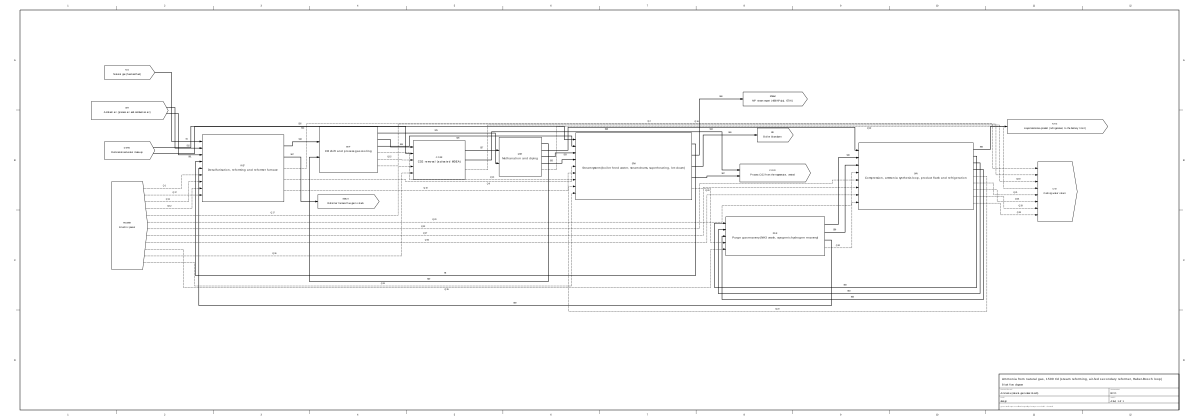
Natural gas (an assumed benchmark lean gas) is desulfurised, mixed with steam (steam to carbon 3.0) and reformed in a prereformer, a fired primary reformer and an air-blown secondary reformer whose process air brings the nitrogen for a 3:1 H2/N2 synthesis gas. High- and low-temperature shift convert the CO; the CO2 is absorbed in activated MDEA and vented; methanation removes the last carbon oxides and molecular sieves dry the gas. The synthesis gas is compressed to about 150 bar and converted on promoted iron in a three-bed converter; ammonia condenses against cooling water and refrigeration, the purge and flash gases pass an NH3 wash and cryogenic hydrogen recovery, and the tail gas fuels the reformer. Waste heat raises MP steam for the process and for export; all machines are electric.
The reactors are equilibrium (reformers, shifts, converter with Peng-Robinson fugacity) or complete-conversion models calculated by cheme; separators, CO2 removal, purge recovery, steam system and duties come from an independent balance script whose property methods are not qualified by ChemE-as-Code for these mixtures. All values are concept estimates; see DESIGN.md of the engineering files.