
Ammonia from natural gas (1500 t/d, steam reforming with air-fed secondary reformer, Haber-Bosch loop)

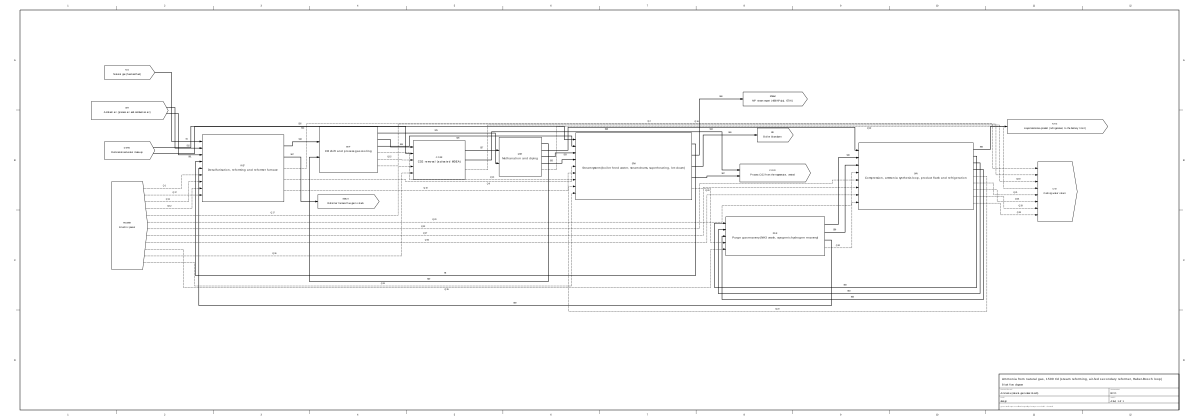
Conventional natural-gas ammonia plant: desulfurisation, prereforming, fired primary and air-blown secondary reforming, HT/LT shift, aMDEA CO2 removal (CO2 vented), methanation, drying, a 150 bar synthesis loop with refrigeration and purge recovery, to refrigerated liquid ammonia. Concept stage, assumed basis, preliminary gate-to-gate LCI.

Calculation maturity: not assessedDesign maturity: Concept (research)Not independently reviewedAmmoniaReport a problem with this process
Research outputNot engineering advice and not an approved design: do not use it for construction, operation or safety decisions. What this means

Overview

Natural gas (an assumed benchmark lean gas) is desulfurised, mixed with steam (steam to carbon 3.0) and reformed in a prereformer, a fired primary reformer and an air-blown secondary reformer whose process air brings the nitrogen for a 3:1 H2/N2 synthesis gas. High- and low-temperature shift convert the CO; the CO2 is absorbed in activated MDEA and vented; methanation removes the last carbon oxides and molecular sieves dry the gas. The synthesis gas is compressed to about 150 bar and converted on promoted iron in a three-bed converter; ammonia condenses against cooling water and refrigeration, the purge and flash gases pass an NH3 wash and cryogenic hydrogen recovery, and the tail gas fuels the reformer. Waste heat raises MP steam for the process and for export; all machines are electric.

The reactors are equilibrium (reformers, shifts, converter with Peng-Robinson fugacity) or complete-conversion models calculated by cheme; separators, CO2 removal, purge recovery, steam system and duties come from an independent balance script whose property methods are not qualified by ChemE-as-Code for these mixtures. All values are concept estimates; see DESIGN.md of the engineering files.
Capacity
1500 t/d contained NH3 as refrigerated liquid (issue #304 proposed brief)
Operation
8,000 h/a
Location
hypothetical Rotterdam-area site (no site data used)
Automated checks
20 of 22 pass (Concept and feasibility gates)
Maintainers
Artur Schweidtmann
Design basis and assumptions (8)
  • ASSUMED feed: benchmark lean natural gas (D-004), open input I-01.
  • ASSUMED reforming: steam to carbon 3.0, adiabatic prereformer at 773 K, primary reformer outlet 1083 K / 3500 kPa(a), secondary reformer adiabatic with process air at 773 K, equilibrium approach 10 K (D-005, D-007).
  • ASSUMED shift: HTS inlet 643 K, LTS inlet 478 K, equilibrium approach 10 K (D-008).
  • ASSUMED CO2 removal: activated MDEA, 500 ppmv CO2 slip, regeneration 1.0 MJ/kg CO2, solvent pumping 21 kWh/t CO2 (D-009).
  • ASSUMED synthesis loop: 14,600-15,500 kPa(a), converter outlet 703 K at equilibrium approach 15 K (Peng-Robinson fugacity), 12 mol% inerts at the converter inlet, separator 263 K (D-011).
  • ASSUMED purge recovery: NH3 99 %, H2 90 % recovered (D-013); furnace 10 % excess O2, bridgewall 1323 K, stack 423 K, 1.5 % casing loss (D-014).
  • ASSUMED compressor isentropic efficiency 0.78 per stage, refrigeration at 0.55 of Carnot (D-016, D-017).
  • All flows, temperatures and duties are concept estimates on ideal-gas enthalpies and an unqualified Peng-Robinson flash (D-006); accuracy not stated.

From process/design-basis.yaml.

Engineering model

Loading the drawing…
Drawing of the process (preview)Open the engineering model

The interactive model (drawings, streams, 3D) is made for larger screens.

Snapshot of c3ab348, cheme-as-code 1.6.0.

What goes in and out

In

  • MethaneFeedstockNatural gas (94.7 mol% CH4, plus ethane, propane, CO2, N2; representative pipeline gas, D-040), feed and furnace fuel. The registry has no natural-gas entry yet
  • AirFeedstockProcess air (nitrogen source, secondary reformer) and combustion air
  • WaterFeedstockDemineralised water make-up to the steam system and the CO2 removal

Out

  • AmmoniaMain productLiquid ammonia, refrigerated, to the battery limit
  • SteamCo-productMP steam export 4600 kPa(a), 673 K
  • Carbon dioxideEmissionProcess CO2 from the aMDEA regenerator, vented (no CCS, no urea)
  • Carbon dioxideEmissionCombustion CO2 in the reformer furnace flue gas
  • WastewaterWasteBoiler blowdown

Utilities: Electricity (All compressors, fans and pumps (ASSUMED electric drives)), Cooling water (25/35 C (ASSUMED))

Show in the process graph

Reactions

IdAs writtenReactionOther processes
C2H6_COMB2 C2H6 + 7 O2 → 4 CO2 + 6 H2O2C2H6+7O2gives4CO2+6H2O3 other processes
C2H6_REFC2H6 + 2 H2O → 2 CO + 5 H2C2H6+2H2Ogives2CO+5H2
C3H8_COMBC3H8 + 5 O2 → 3 CO2 + 4 H2OC3H8+5O2gives3CO2+4H2O2 other processes
C3H8_REFC3H8 + 3 H2O → 3 CO + 7 H2C3H8+3H2Ogives3CO+7H2
CH4_COMBCH4 + 2 O2 → CO2 + 2 H2OCH4+2O2givesCO2+2H2O9 other processes
H2_COMB2 H2 + O2 → 2 H2O2H2+O2gives2H2O5 other processes
H2_OX2 H2 + O2 → 2 H2O2H2+O2gives2H2O5 other processes
METH_COCO + 3 H2 → CH4 + H2OCO+3H2givesCH4+H2O
METH_CO2CO2 + 4 H2 → CH4 + 2 H2OCO2+4H2givesCH4+2H2O
NH3_COMB4 NH3 + 3 O2 → 2 N2 + 6 H2O4NH3+3O2gives2N2+6H2O3 other processes
NH3_SYNN2 + 3 H2 ⇌ 2 NH3N2+3H2in equilibrium with2NH3
SMRCH4 + H2O ⇌ CO + 3 H2CH4+H2Oin equilibrium withCO+3H21 other process
WGSCO + H2O ⇌ CO2 + H2CO+H2Oin equilibrium withCO2+H22 other processes

Each reaction's page has the conversion, heat of reaction, catalyst and sources this process states, next to those of other processes with the same reaction. All reactions

Life cycle assessment

1.46kg CO2-eqpartial, 5 data gaps

Climate change per 1 kg Liquid ammonia product (refrigerated), gate-to-gate

Main contributors
  • CO2 to the environment100 %
  • CH4 to the environment0 %
Contributions, baseline
1.465 kg CO2-eq1.931e-8 kg CO2-eq1.465 kg CO2-eqCO2 to the environment1.465 kg CO2-eqCO2 to the environment: 1.465 kg CO2-eqCH4 to the environment1.931e-8 kg CO2-eqCH4 to the environment: 1.931e-8 kg CO2-eqOperation1.465 kg CO2-eqOperation: 1.465 kg CO2-eq1 kg Liquid ammonia…1.465 kg CO2-eq1 kg Liquid ammonia product (refrigerated): 1.465 kg CO2-eq

Each flow of the inventory into its phase, the phases into the functional unit; band widths are impacts. Hatched: a credit.

Method and data
Goal
Preliminary gate-to-gate life cycle inventory of refrigerated liquid ammonia from a conventional natural-gas plant (1500 t/d, concept stage): the foreground exchanges per kg NH3 from the balanced flowsheet, ready to be linked to background datasets later. No impact result is claimed: every background exchange is an open gap (D-020).
Functional unit
1 kg Liquid ammonia product (refrigerated) (1 kg ammonia)
Boundary
gate-to-gate
Allocation
exergy
Characterisation
Factors kept with the process · GWP100
Data quality
Published factors
Result
partial screening carbon footprint · 5 data gaps
ScenarioClimate change (kg CO2-eq)
baseline1.465

Inventory per 1 kg Liquid ammonia product (refrigerated) (21 flows)

FlowPhaseDirectionQuantityUnitProvenance
Natural gas (feed and fuel)operationinput0.5364kggiven
Ambient air (process air and combustion air)operationinput3.561kggiven
Demineralised water make-upoperationinput1.653kggiven
Electric poweroperationinput0.5533kWhassumed
Liquid ammonia product (refrigerated, to the battery limit)operationoutput1kgcalculated
Process CO2 from the regenerator, ventedoperationoutput1.118kgassumed
Reformer furnace flue gas to stackoperationoutput2.687kgcalculated
MP steam export (4600 kPa(a), 673 K)operationoutput1.02kgassumed
Boiler blowdownoperationoutput0.04717kgassumed
Cooling water returnoperationoutput2.055kWhassumed
AR to the environmentoperationoutput0.04567kgassumed
C2H6 to the environmentoperationoutput0kgassumed
C3H8 to the environmentoperationoutput0kgassumed
CH4 to the environmentoperationoutput0.0000000006481kgassumed
CO to the environmentoperationoutput0.00000002772kgassumed
CO2 to the environmentoperationoutput1.465kgassumed
H2 to the environmentoperationoutput0.0000008776kgassumed
H2O to the environmentoperationoutput0.3218kgassumed
N2 to the environmentoperationoutput1.92kgassumed
NH3 to the environmentoperationoutput0kgassumed
O2 to the environmentoperationoutput0.05257kgassumed

Computed by ChemE-as-Code from lca/README.md, lca/dataset.yaml, lca/factors.yaml, lca/gaps.csv, lca/inventory.csv, lca/lca.yaml, lca/mappings.yaml, lca/results.csv, lca/results.md, lca/uncertainty.csv.

In the open LCI database (cheme-as-code-atlas-preview-c3ab348) as Liquid ammonia product (refrigerated, to the battery limit); MP steam export (4600 kPa(a), 673 K).

Download it for Brightway, openLCA and other tools.

In the LCI database: system model, datasets and KPIs against the benchmarks

In the LCI database

System model
attributional, cut-off (methodology 1.1.0)
Allocation
exergy (deviation, from study) · product:NH3 94 %, product:STEAM 6 %
Allocation findings
none
Change report
Not available: this build has no change report against an earlier release.
Dataset pages
Liquid ammonia product (refrigerated, to the battery limit) · MP steam export (4600 kPa(a), 673 K)

KPI benchmark positions

Maturity and review

Design maturity Concept (claimed): An idea or first flowsheet; numbers are rough. Concept PFD with closed mass, component and element balances on every block and step (cheme validate, cheme process streams). Reactor outlets are calculated by cheme (equilibrium and conversion models from its reaction library); the separators, CO2 removal, purge recovery, steam system and all duties are specified values from scripts/plant_balance.py (ideal-gas enthalpies, thermo Peng-Robinson flash with ChemSep kij, IAPWS-IF97 steam) that core cannot qualify for syngas/ammonia/water mixtures. Energy closure is not evaluable in core. The feeds are a representative specification approved by the owner for this paper case study (S5c, I-006, D-040): a published typical pipeline gas (Enbridge), NASA dry air, IAPWS make-up water. Not reviewed. Main products and feeds are listed under chemistry with their chemicals registry entries (issue #251). `cheme maturity` reaches calculation maturity balanced (S5c, D-040; predictive fails on the excluded steps, specified splits and the property claim); concept is the lowest manifest value (DESIGN.md D-019). The LCA result is gate-to-gate direct fossil CO2 only, not a carbon footprint: every background is still a gap (D-020).

Calculation maturity, from the checked evidenceNot assessed

The process has no maturity report (cheme maturity, checks/maturity.json), so no calculation maturity is established.

No level shownThe design maturity (Concept) is the manifest's claim, not evidence. A level appears here once the process's repository holds a current report from cheme maturity --write.

Artifact completeness

Which deliverables exist. They never raise a calculation maturity level: a drawing from unchecked numbers is still unchecked.

Not reported without a maturity report.

Independent review

Not independently reviewed

No independent engineering review yet. Automated checks passing is not a review.

Set by people only. Reaching a calculation maturity level or passing automated checks is not an independent review or an approval.

Where the evidence comes from
Report
processes/ammonia-1/checks/maturity.json (not in the library)
Design basis
process/design-basis.yaml
Method
How ChemE-as-Code checks the levels (requirement by requirement)

Open items

Sources

Engineering project
Ammonia (natural-gas Haber-Bosch) · cheme-as-code>=0.8
Library version
c3ab348 (process last changed in c3ab348)
Drawings rendered by
cheme 1.6.0 (pyDEXPI 2.1.0)
Data
Catalog record (JSON) · CC-BY-4.0
Files
View the files on GitHub · change history and authors

References

How to cite

For the data, cite the Process Atlas paper; for the platform that builds and checks it, the ChemE-as-Code paper.

Schweidtmann, A. M. & Weber, J. M. (2026, in preparation). Process Atlas: an open, git-native, reproducible library and life cycle inventory of chemical processes (working title).

For this process: "Ammonia from natural gas (1500 t/d, steam reforming with air-fed secondary reformer, Haber-Bosch loop)", ChemE-as-Code process library, version c3ab348.

BibTeX
@unpublished{schweidtmann_process_atlas,
  author = {Schweidtmann, Artur M. and Weber, Jana M.},
  title = {{Process Atlas: an open, git-native, reproducible library and life cycle inventory of chemical processes (working title)}},
  year = {2026},
  url = {https://atlas.cheme-as-code.org},
  note = {in preparation}
}

Schweidtmann, A. M. (2026, in preparation). ChemE-as-Code: An Open-Source Platform for AI-Accelerated Chemical Process Engineering (working title).

BibTeX
@unpublished{schweidtmann_cheme_as_code,
  author = {Schweidtmann, Artur M.},
  title = {{ChemE-as-Code: An Open-Source Platform for AI-Accelerated Chemical Process Engineering (working title)}},
  year = {2026},
  url = {https://cheme-as-code.org},
  note = {in preparation}
}