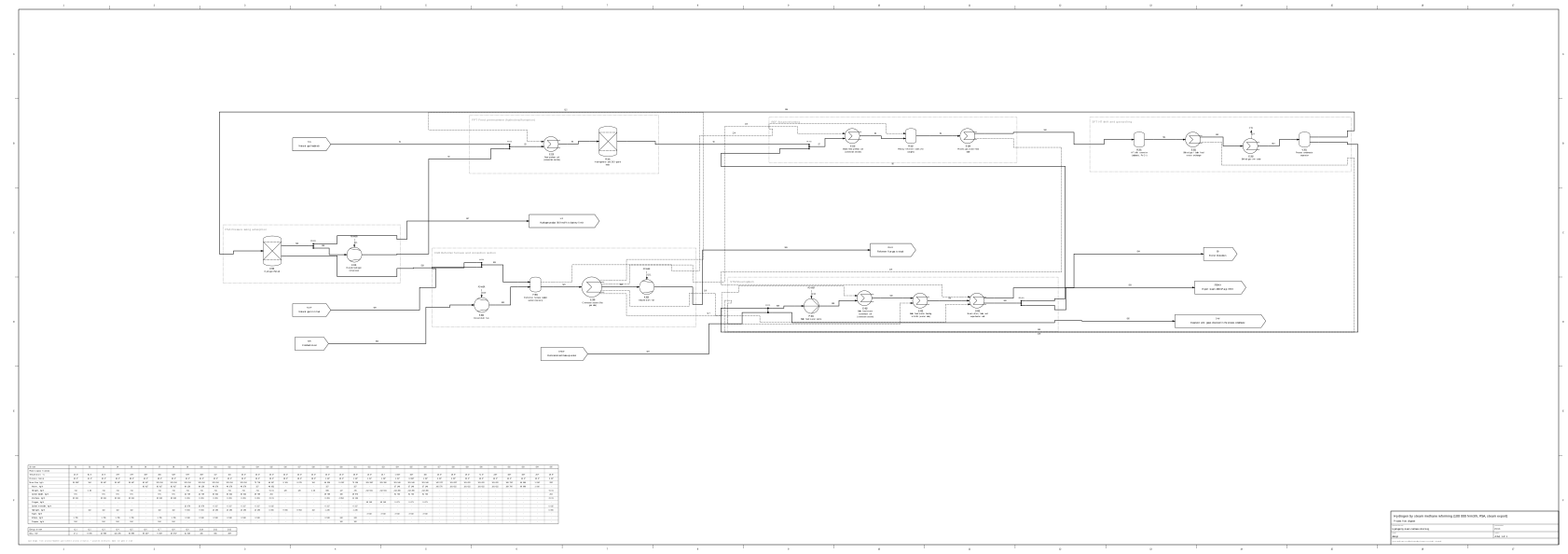
Hydrogen by natural-gas steam methane reforming with PSA (100 000 Nm3/h, steam export)
Natural gas is desulfurised, reformed with steam over nickel in a fired tubular reformer, shifted at high temperature and purified by pressure swing adsorption to 99.9 mol% hydrogen; the PSA tail gas fires the reformer with trim natural gas and surplus steam is exported. Concept stage, assumed basis.
Research outputNot engineering advice and not an approved design: do not use it for construction, operation or safety decisions. What this means
Overview
An independent concept design (issue ChemE-as-Code/process-library#117). The reformer outlet
and the high-temperature shift outlet are modelled as ideal-gas chemical equilibrium
(steam methane reforming and water-gas shift; ethane and propane reformed completely) at
assumed temperatures and approaches: a model basis, not kinetics. The PSA is a specified
split (hydrogen recovery 0.88). The furnace burns the PSA tail gas and the trim natural gas
completely; the trim fuel closes the radiant section's energy balance, and the convection
section and the process gas waste heat boiler raise 4.3 MPa steam for the process and for
export. All CO2 leaves through the stack; the inventory keeps the feedstock carbon and the
trim-fuel carbon apart.
All values are concept estimates. Flashes, enthalpies and duties come from an independent
balance script (ideal-gas enthalpies plus IAPWS-IF97 water and steam) that core cannot yet
qualify for these mixtures; the reactor outlets and the reactor and furnace
duties are recalculated by cheme and agree. See DESIGN.md of the engineering files.
Capacity
100 000 Nm3/h hydrogen 99.9 mol% (ASSUMED)
Operation
8,400 h/a
Location
generic (not chosen)
Engineering gates
Concept and feasibility (no results yet)
Maintainers
Artur Schweidtmann
Design basis and assumptions (9)
ASSUMED steam-to-carbon ratio 3.0 (kmol H2O per kmol hydrocarbon carbon) (D-007).
ASSUMED reformer: inlet 893 K / 3500 kPa(a), outlet 1143 K / 3200 kPa(a), ideal-gas equilibrium of SMR and WGS with K 10 K colder than the outlet; ethane and propane reformed to equilibrium (complete) (D-003, D-007).
ASSUMED no pre-reformer (lean gas, D-007) and no low-temperature shift (PSA purification, D-001).
ASSUMED adiabatic HT shift, inlet 623 K, ideal-gas WGS equilibrium with K 10 K hotter than the outlet (D-007).
ASSUMED PSA: H2 recovery 0.88, product 99.9 mol% H2 (remainder N2), tail gas 130 kPa(a); a specified split, not a cycle model (D-008).
ASSUMED furnace: PSA tail gas plus trim natural gas, 10 % excess air, no air preheat, bridgewall 1273 K, stack 423 K, casing losses not counted (D-009).
ASSUMED recycle of 0.03 kmol product hydrogen per kmol natural gas feedstock to the hydrogenator (D-005).
ASSUMED machine efficiencies: compressor 0.75, fans and pump 0.70 (D-012).
All flows, temperatures and duties are concept estimates from an ideal-gas enthalpy model plus IAPWS water/steam (D-006); accuracy not stated.
Each reaction's page has the conversion, heat of reaction, catalyst and sources this process states, next to those of other processes with the same reaction. All reactions
Life cycle assessment
9.14kg CO2-eqpartial, 6 data gaps
Climate change per 1 kg Hydrogen product 99.9 mol%, gate-to-gate
Main contributors
CO2 to the environment100 %
CH4 to the environment0.03 %
N2O to the environment (estimated)0.02 %
Contributions, baseline
Each flow of the inventory into its phase, the phases into the functional unit; band widths are impacts. Hatched: a credit.
Method and data
Goal
Preliminary gate-to-gate life cycle inventory of hydrogen (99.9 mol%, 2.85 MPa) from natural-gas steam methane reforming with PSA and steam export, at concept stage: the foreground exchanges per kg of hydrogen, with the feedstock and fuel carbon kept apart, ready to be linked to background datasets in the next stage (DESIGN.md D-013). Flows are concept estimates; backgrounds are unmapped gaps.
Functional unit
1 kg Hydrogen product 99.9 mol% (1 kg hydrogen)
Boundary
gate-to-gate
Allocation
exergy
Characterisation
Factors kept with the process · GWP100
Data quality
Published factors
Result
partial screening carbon footprint · 6 data gaps
Scenario
Climate change (kg CO2-eq)
baseline
9.138
Inventory per 1 kg Hydrogen product 99.9 mol% (23 flows)
Flow
Phase
Direction
Quantity
Unit
Provenance
Natural gas feedstock
operation
input
2.909
kg
assumed
Natural gas trim fuel
operation
input
0.5578
kg
assumed
Combustion air
operation
input
27.93
kg
assumed
Demineralised make-up water
operation
input
14.15
kg
assumed
Electric power
operation
input
0.1475
kWh
assumed
Hydrogen product 99.9 mol% to battery limit
operation
output
1
kg
calculated
Export steam 4300 kPa(a) 673 K
operation
output
10.59
kg
calculated
Reformer flue gas to stack
operation
output
34.9
kg
calculated
Boiler blowdown
operation
output
0.1902
kg
assumed
Deaerator vent: gases dissolved in the process condensate
operation
output
0.02527
kg
assumed
Cooling water return
operation
output
3.082
kWh
calculated
AR to the environment
operation
output
0.3584
kg
calculated
C2H6 to the environment
operation
output
0
kg
assumed
C3H8 to the environment
operation
output
0
kg
assumed
CH4 to the environment
operation
output
0.00007834
kg
assumed
CO to the environment
operation
output
0.002271
kg
assumed
CO2 to the environment
operation
output
9.133
kg
assumed
H2 to the environment
operation
output
0.000006437
kg
assumed
H2O to the environment
operation
output
3.688
kg
assumed
N2 to the environment
operation
output
21.18
kg
assumed
O2 to the environment
operation
output
0.563
kg
calculated
N2O to the environment (estimated)
operation
output
0.000007826
kg
estimated
NOx to the environment (estimated)
operation
output
0.005792
kg
estimated
Computed by ChemE-as-Code from lca/README.md, lca/dataset.yaml, lca/factors.yaml, lca/gaps.csv, lca/inventory.csv, lca/lca.yaml, lca/mappings.yaml, lca/results.csv, lca/results.md.
KPI benchmark positions: not available (no benchmarked KPI for this process's datasets).
Maturity and review
Design maturity Concept (claimed): An idea or first flowsheet; numbers are rough. Concept PFD with closed mass, component and element balances (cheme validate, cheme process streams; every block and step ok). The reformer and shift outlets are calculated by cheme (equilibrium reactors) and reproduce the independent balance script (scripts/h2_balance.py); cheme process reactors gives a reformer duty of 102.0 MW and a furnace radiant duty of -102.0 MW on the same ideal-gas basis, and an adiabatic shift (0.03 kW). Since 2026-11-01 (DESIGN.md D-016) the process side is simulated in DWSIM (cheme process simulate, Peng-Robinson, converged; process/simulation-run.json) and its stream values and duties are the simulated ones; Peng-Robinson is not qualified for this water-bearing mixture and its use is a substitution not yet accepted. The furnace and steam system are excluded from the simulation and keep the concept balance's values. The natural gas composition, capacity, PSA recovery and all conditions are ASSUMED, not sourced, so cheme maturity reaches no level yet (sourced boundary and sourced model basis fail; the concept claim is the manifest's lowest level). Not reviewed. A preliminary gate-to-gate LCI (lca/) is written with its backgrounds unmapped (gaps). The chemicals registry entries used here are listed in DESIGN.md D-014 where they are missing.
Calculation maturity, from the checked evidenceNot assessed
The process has no maturity report (cheme maturity, checks/maturity.json), so no calculation maturity is established.
No level shownThe design maturity (Concept) is the manifest's claim, not evidence. A level appears here once the process's repository holds a current report from cheme maturity --write.
Artifact completeness
Which deliverables exist. They never raise a calculation maturity level: a drawing from unchecked numbers is still unchecked.
Not reported without a maturity report.
Independent review
Not independently reviewed
No independent engineering review yet. Automated checks passing is not a review.
Set by people only. Reaching a calculation maturity level or passing automated checks is not an independent review or an approval.
Where the evidence comes from
Report
processes/hydrogen-1/checks/maturity.json(not in the library)
Ullmann's Encyclopedia of Industrial Chemistry: Hydrogen, 2. Production (route survey) · doi:10.1002/14356007.o13_o03
Twigg, M. V. (ed.) (1989) Catalyst Handbook, 2nd ed., Manson (reforming and shift catalyst windows, via the cheme reaction library)
How to cite
For the data, cite the Process Atlas paper; for the platform that builds and checks it, the ChemE-as-Code paper.
Schweidtmann, A. M. & Weber, J. M. (2026, in preparation). Process Atlas: an open, git-native, reproducible library and life cycle inventory of chemical processes (working title).
For this process: "Hydrogen by natural-gas steam methane reforming with PSA (100 000 Nm3/h, steam export)", ChemE-as-Code process library, version c3ab348.
BibTeX
@unpublished{schweidtmann_process_atlas,
  author = {Schweidtmann, Artur M. and Weber, Jana M.},
  title = {{Process Atlas: an open, git-native, reproducible library and life cycle inventory of chemical processes (working title)}},
  year = {2026},
  url = {https://atlas.cheme-as-code.org},
  note = {in preparation}
}
Schweidtmann, A. M. (2026, in preparation). ChemE-as-Code: An Open-Source Platform for AI-Accelerated Chemical Process Engineering (working title).
BibTeX
@unpublished{schweidtmann_cheme_as_code,
  author = {Schweidtmann, Artur M.},
  title = {{ChemE-as-Code: An Open-Source Platform for AI-Accelerated Chemical Process Engineering (working title)}},
  year = {2026},
  url = {https://cheme-as-code.org},
  note = {in preparation}
}